
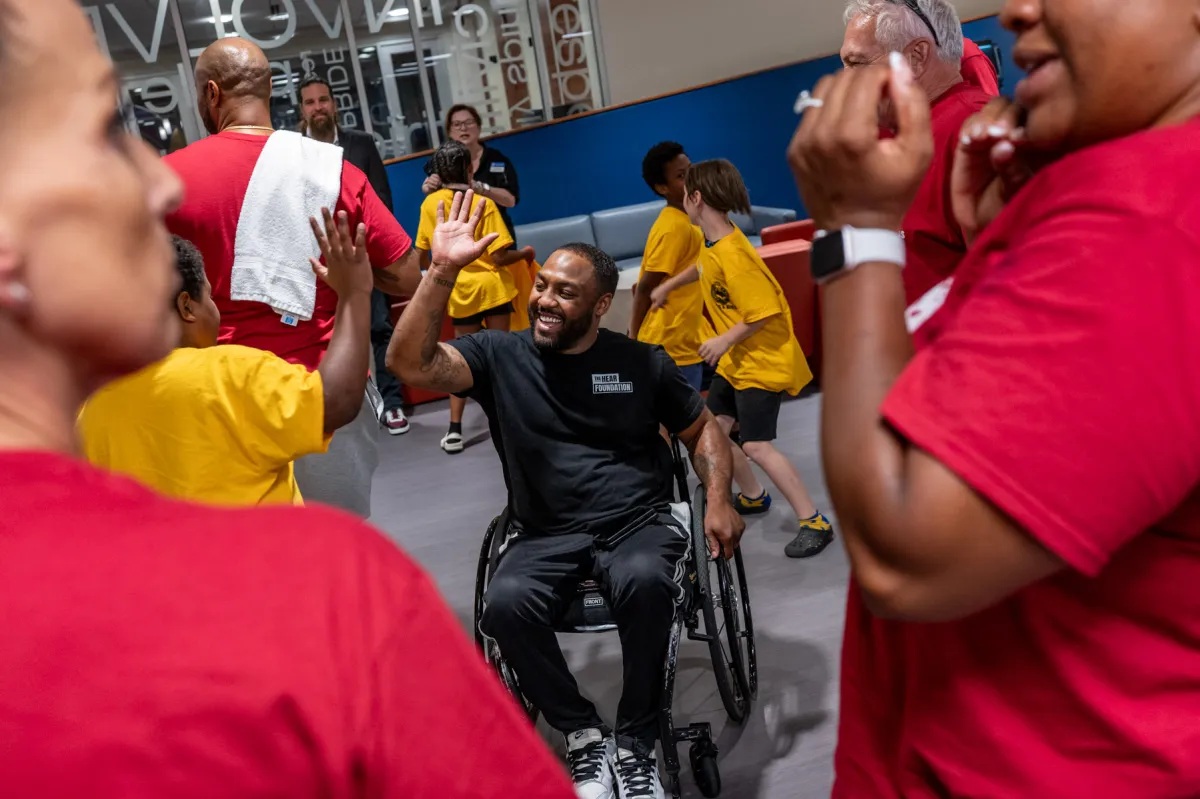
Leon Ford high fives youth at Cops and Kids Camp Thursday, July 31, 2025, at Duquesne University after talking to them about his relationship with the police years after being shot during a traffic stop. While the shooting left Ford paralyzed, he advocates for building trust and relationships between communities and police. (Photo by Stephanie Strasburg/Pittsburgh’s Public Source)
Leon Ford’s grandfather asked him: “Do you want to make a point or a difference?” That led to a mission that puts him in police stations and in front of students who he urges to consider law enforcement.
“Pittsburgh’s Public Source is an independent nonprofit newsroom serving the Pittsburgh region. Sign up for our free newsletters.”
Just last week, I spoke to about 40 kids at the city’s Cops and Kids Summer Camp — young, open-hearted kids. If you know my story, you know how unlikely that moment might seem.
I told them the truth, just like one of my mentors once told me to tell my son as he grew up: my truth, the officer’s mistakes, my own mistakes. One girl said she used to be afraid of police but now sees there are good ones. That stuck with me.

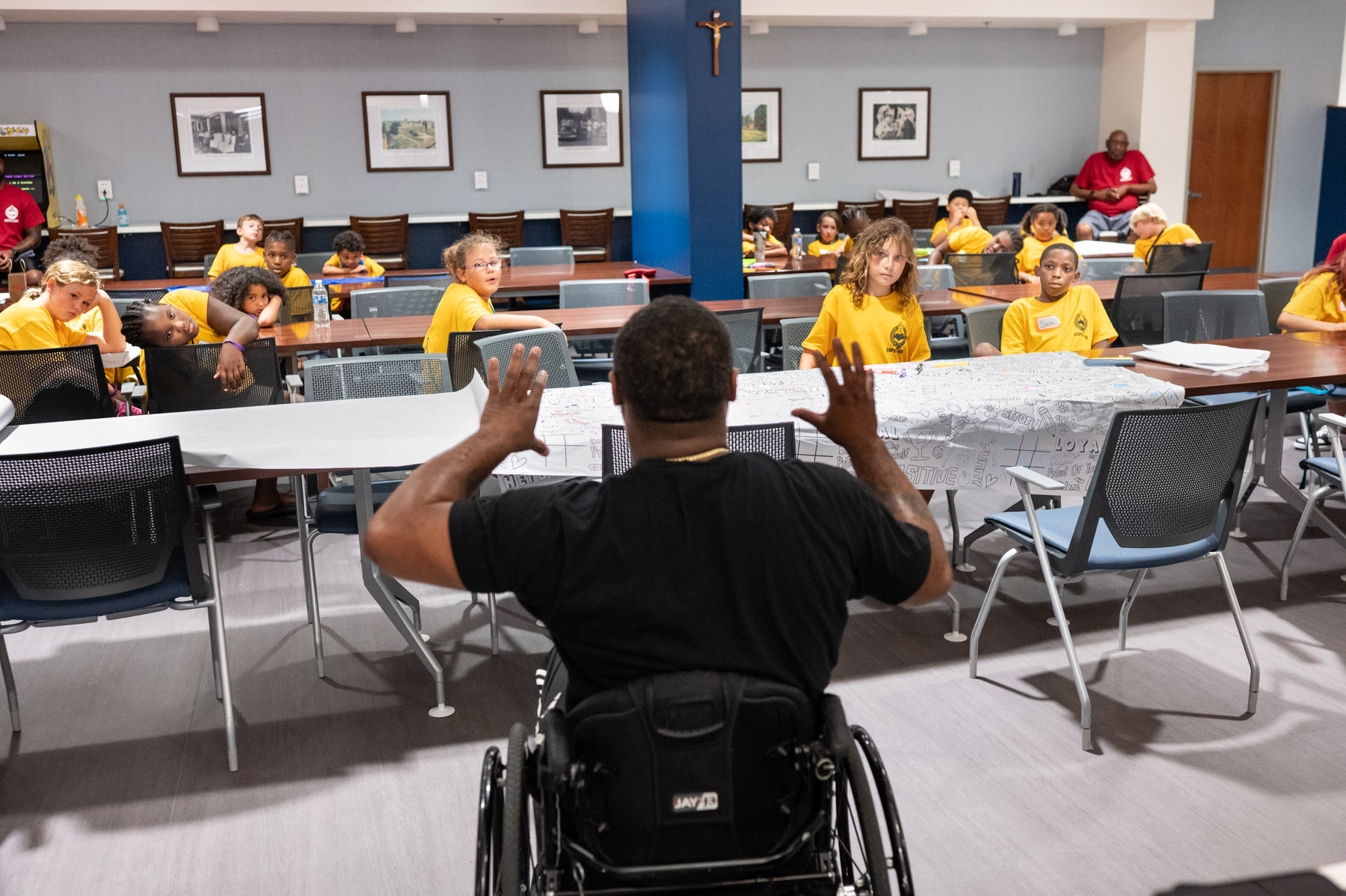
These kids weren’t just talking about swimming or seeing police cruisers at camp; they were talking about trust. About seeing people, not just uniforms. Being there felt full circle. It brought back memories. Because before I became someone invited to speak at events like this, before I had a son of my own, I was someone else entirely.
In 2012, my life was irrevocably altered when I was shot five times by a Pittsburgh police officer during a traffic stop in which I was mistaken for another man. I was left paralyzed.
The trauma and injustice I experienced ignited a profound anger within me — and caused a further divide between police and community. I channeled this fury into activism — organizing protests, selling shirts emblazoned with “Criminals on Patrol” to critique law enforcement, and vocally condemning police and political figures. My activism was a manifestation of my pain, a cry against a system that had failed me.
However, a pivotal conversation with my grandfather and encouragement from a few mentors challenged my approach. My grandfather asked, “Do you want to make a point, or a difference?”

His words compelled me to reflect deeply on the impact of my actions and the future I envisioned for my son. I talked with mentors like Laura Ellsworth of Jones Day, John Henne of Henne Jewelers, Norman Conti of Duquesne University and Diana Bucco of The Buhl Foundation, who helped me understand how to leverage my experiences and transform my pain into purposeful leadership.
One of those mentors, Laura, set up my first face-to-face meeting with then-police Chief Scott Schubert. I didn’t trust the chief and wasn’t inclined to like him. Though he wasn’t the chief when I was shot, for me, he symbolized the institution that shattered my life. I had even called him racist on social media.
Meeting with him felt like sitting across from a sworn enemy. The air in the room was thick with tension. Laura, smiling with quiet confidence, believed something magical would happen. As the conversation unfolded, Scott shared how his father had been a police officer and how he had always envisioned a more compassionate and community-oriented public safety model. I shared stories from my own childhood, how police barged into my home, cut open couches, and tore through walls when my father was indicted. The trauma and distrust from seeing law enforcement destroy my home and take my father had stayed with me.
Despite coming from two completely different worlds, we discovered one shared goal: to make Pittsburgh safer for everyone. I spoke about my mental health journey and the pain of losing loved ones to gun violence. He shared the trauma officers experience from violent crime scenes — something I had never considered. That conversation was the beginning of building a bridge neither of us ever imagined could exist.
We eventually co-founded The Hear Foundation.

Since then, I’ve had the opportunity to meet police officers whose goals are genuinely to protect and serve. Many of them enter the profession with a deep commitment to public safety and a desire to make a positive difference. These relationships offered a narrative that I didn’t believe after being shot: that good cops existed.
Through open dialogue and community collaboration, we at The Hear Foundation have witnessed that it’s possible to foster a culture where both officers and community members are valued — not just for their roles, but for the impact they make in creating thriving neighborhoods. Yes, we acknowledge the flaws and historic traumas embedded in the system, but we also recognize our shared responsibility to one another and to the cities we love. We must embrace each other and work toward bridging the gap between police and community — collectively striving to create safer, more connected environments where every resident can thrive.
‘If you were the officer who pulled me over …’
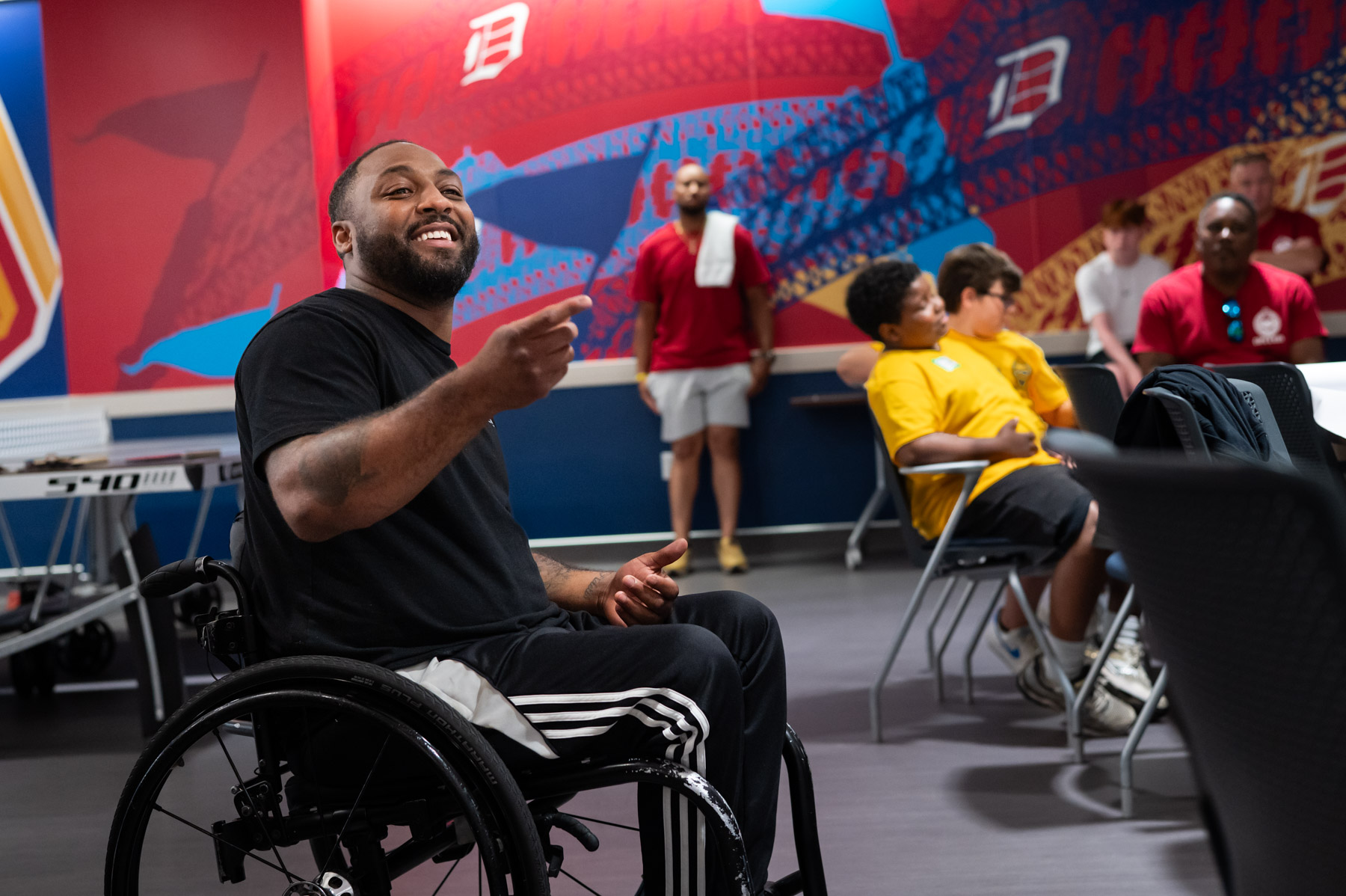
I find myself in front of hundreds of youth per month, mostly from Pittsburgh Public Schools as they added my memoir “An Unspeakable Hope” to their curriculum for 11th and 12th graders. I also spend time at Woodland Hills as The Hear Foundation is a sponsor for their multidistrict school summit.
Whenever I’m in front of students, I’m always asking them if they like or trust police officers. I am met with a strong “NO.” Afterward, I ask them if their parents and/or grandparents like or trust police officers: again a strong “NO.” Then I follow up by asking simply, what have they done about it? I see faces of confusion, but they immediately understand what I am saying.

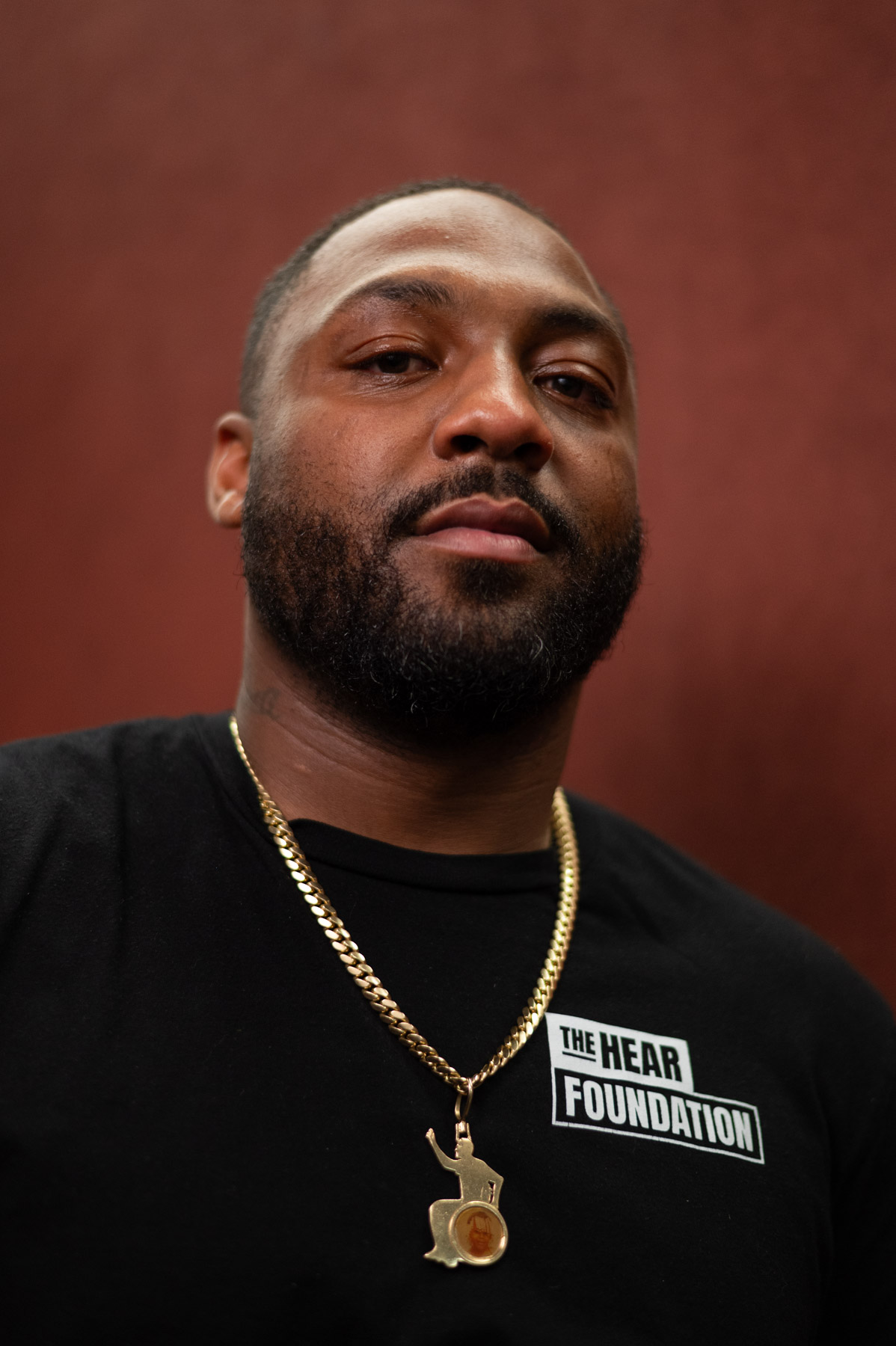
We’ve been complaining for a long time, we’ve protested for generations and this is why I decided to listen to my grandfather and make a difference versus making a point. I am not saying that protesting isn’t effective, and I’ve done my share, but I decided to try another approach. I believe in collaboration so that our communities are safe — and we need both police and community involvement to make that happen.
Sometimes I am met with resistance, whether its law enforcement-averse students, activists or community leaders questioning my why. I understand their hesitance, and I am not asking them to love the police. I am asking them to lean in and become contributors to public safety.
One of my favorite questions to ask our youth is: “If you were the officer who pulled me over the night I was shot, do you think I would be in this wheelchair?” The response is overwhelmingly, “No.” Whenever I am questioned about my forgiveness, I ask activist and community leaders to reflect on this subtle truth.
Imagine the quality of my life if every time I thought about the officer who shot me or even saw a police cruiser, I became triggered — robbed of my peace, my joy, my happiness. For me, forgiveness is more than an act of righteousness, it is directly connected to my healing, and a path to unify my community.

Bridging the crisis in policing
Today, police departments nationwide grapple with significant recruitment and retention challenges. A 2024 survey by the International Association of Chiefs of Police revealed that over 70% of agencies find recruitment more difficult than five years ago, with the Midwest and Northeast experiencing the most severe shortages. Pittsburgh is no exception; from norms of 900, the uniformed force recently dropped to around 750.
Compounding this issue is the lack of diversity within the force. In a city where 23% of residents are Black, only around 12% of the police force reflects this demographic. Recent academy classes have seen minimal representation from Black recruits, raising concerns about the department’s ability to effectively serve and connect with all communities.
In response to these challenges, the Hear Foundation initiated the Bridging the Badge program, designed to foster understanding and collaboration between youth and law enforcement. In partnership with the National Organization of Black Law Enforcement Executives, we took five students to the NOBLE conference in New Orleans last year, providing them with exposure to positive role models in policing. Of the five, one will be applying to Allegheny County’s police academy this summer and the other will be attending Community College of Allegheny County to study criminal justice. This year, we plan to expand this initiative by taking 10 youths to the conference in Hollywood, Florida.

Our mission transcends merely increasing the number of Black officers; it’s about cultivating a police force that embodies empathy, accountability and community engagement. By integrating lived experiences with collaborative strategies, we aim to reform policing practices, ensuring they uphold public safety while respecting the dignity of individuals on both sides of the badge, regardless of race, gender or background. We also aim to help the community heal from the deep-rooted trauma and longstanding distrust caused by both negative experiences and the damaging effects of viral videos of misconduct. The moral of the story is both sides need to heal, and we must work together to make Pittsburgh safer for everyone.
Encouraging young people to consider careers in law enforcement helps ensure future generations are represented in positions of authority and influence. This fosters trust and mutual respect between the police and communities. Furthermore, it cultivates an environment where both law enforcement and the public can overcome preconceived notions, enabling them to work together more effectively.
Leon Ford is the co-founder and director of external affairs for The Hear Foundation and can be reached at leon@hearfoundation.com.
This article first appeared on Pittsburgh’s Public Source and is republished here under a Creative Commons Attribution-NoDerivatives 4.0 International License.

