

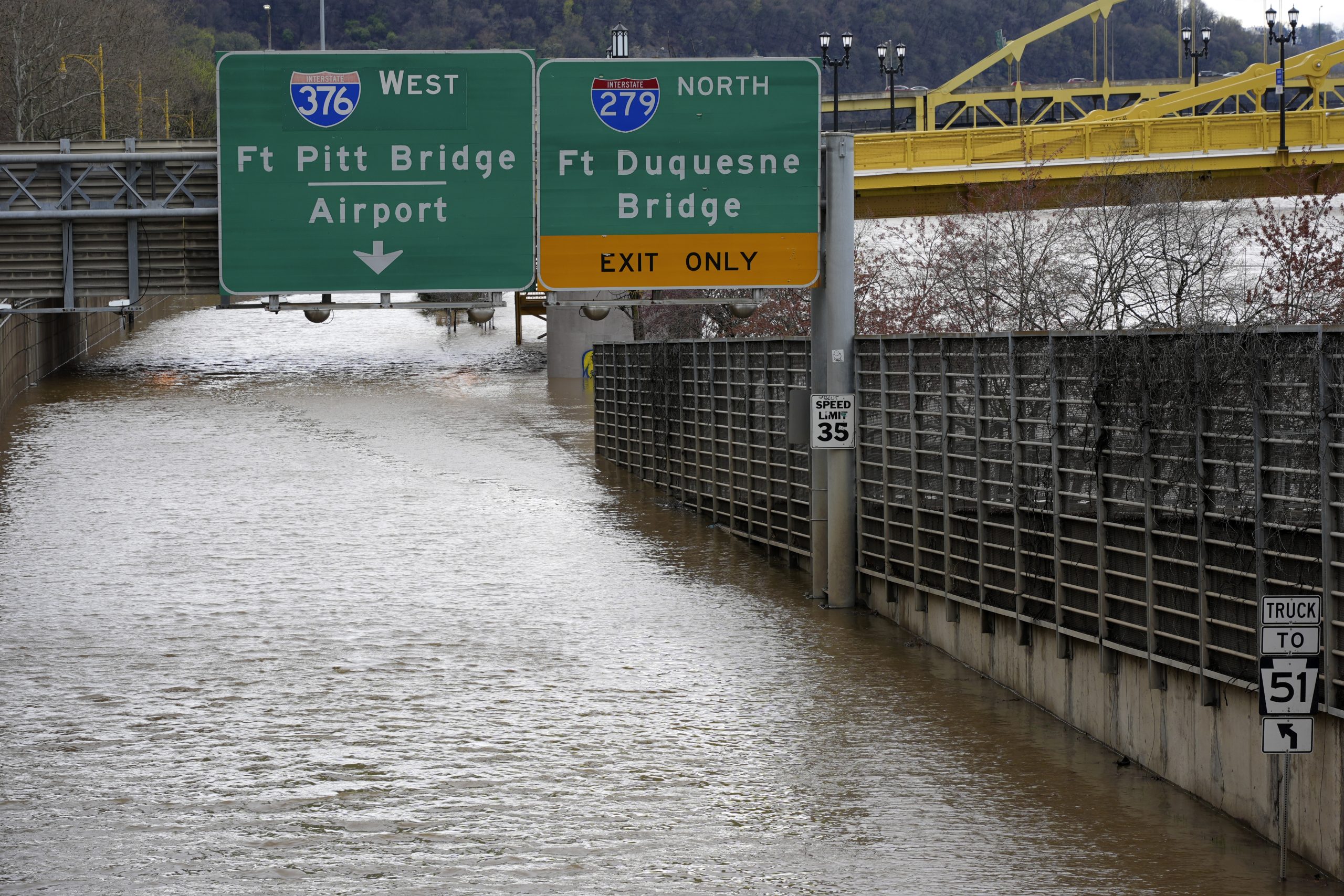
In this image provided by Pittsburgh Public Safety, a Pittsburgh-area water rescue team rescued a woman trapped in a car sinking in rising waters along a section of Route 51 east of the city on Thursday night, April 11, 2024, in Pittsburgh. Flash flooding caused by relentless heavy rains that soaked Western Pennsylvania spurred numerous rescues and evacuations in the region, but no injuries were reported. (Pittsburgh Public Safety via AP Photos)
The April 29 storm that knocked out power to much of Pittsburgh spurred a push for a more climate-resilient plan. Council asked the administration for an update
“Pittsburgh’s Public Source is an independent nonprofit newsroom serving the Pittsburgh region.
Pittsburgh Bureau Fire Chief Darryl Jones told City Council that the city completed an after-action review of the storm response. In addition to public communication, he identified adaptability as a strength. But outages at facilities, including sheltering centers, were concerning. Officials are now working to better deploy generators, and encouraging individual facilities to buy their own generators in preparation.
Jones’ comments came at council’s first special meeting to review its response to the April 29 storm. Following the storm, Mayor Ed Gainey issued an executive order for a climate-resilient “All-Hazard Mitigation Plan.” Officials said work on that plan is ongoing.

The storm lasted only about 10 minutes, but its 85-mile-per-hour winds:
- knocked out power for many of the region’s hospitals, which had to run on generators
- reduced cellular coverage in the area
- overwhelmed 911, which received 1,000 calls in one minute
- cut power to medical oxygen users, some whom did not have backup generators
The review also identified a need to provide more training for those who restore power lines, who must determine whether or not lines are live. Better identification skills could speed up power restoration. Currently, special coordination with Duquesne Light is required to confirm that a line is de-energized before work begins.
Councilors Theresa Kail-Smith and Bob Charland expressed concern that emergency services did not update council members adequately during the storm.
“I often struggle in knowing who my point of contact is in an emergency situation,” Charland said. “I just want to know so I know what I’m saying is correct.”
Jones identified a course for public and elected officials to understand the incident command system.
Allegheny County Hazard Mitigation Plans are updated every five years and signed off by local municipalities, including Pittsburgh. The county began updating the plan last year and it is due in March of 2026. It will be completed internally by the end of September before it is sent to PMA and FEMA for review.
Gainey’s May executive order calls for a more localized “All-Hazard” Mitigation plan, which will take a long-term approach to disaster management, including flood and landslide prevention.
The city held a Climate Resilience Forum on May 15 with several department leaders to discuss storm stress points, including the hundreds of fallen trees, which blocked road access and downed power lines.
Officials are beginning to consider how they will approach planning for high winds, but the city is unlikely to cut down healthy trees in preparation according to Flore Marion, the city’s assistant director of sustainability and resilience.
At the May resilience forum, it was clear that downed trees on power lines were the main culprit for power outages across the city. The All-Hazard Mitigation Plan will balance emergency resilience with year-round livability.
“Pittsburgh is an extremely green city,” said Michael Kelley, the city’s utility coordination arborist, at the May meeting. “We have over 3 million trees — and these trees, they serve as the lungs and kidneys of our city.”

“Every single one of these trees that we lose makes it harder in the future for us to live in our communities,” Kelley said, pointing to increased temperatures and decreased air quality. “We’re going to see increased localized flooding for every single tree that is lost.”
The plan also formalizes collaboration between EMS and the City Planning Department. Planning is attending EMS meetings and hiring a staff member to work with the medics.
Council will hold a separate meeting to review the Duquesne Light’s storm response on September 18.
Hannah Frances Johansson is an editorial intern at Pittsburgh’s Public Source and can be reached at hannah@publicsource.org.
This article first appeared on Pittsburgh’s Public Source and is republished here under a Creative Commons Attribution-NoDerivatives 4.0 International License.

