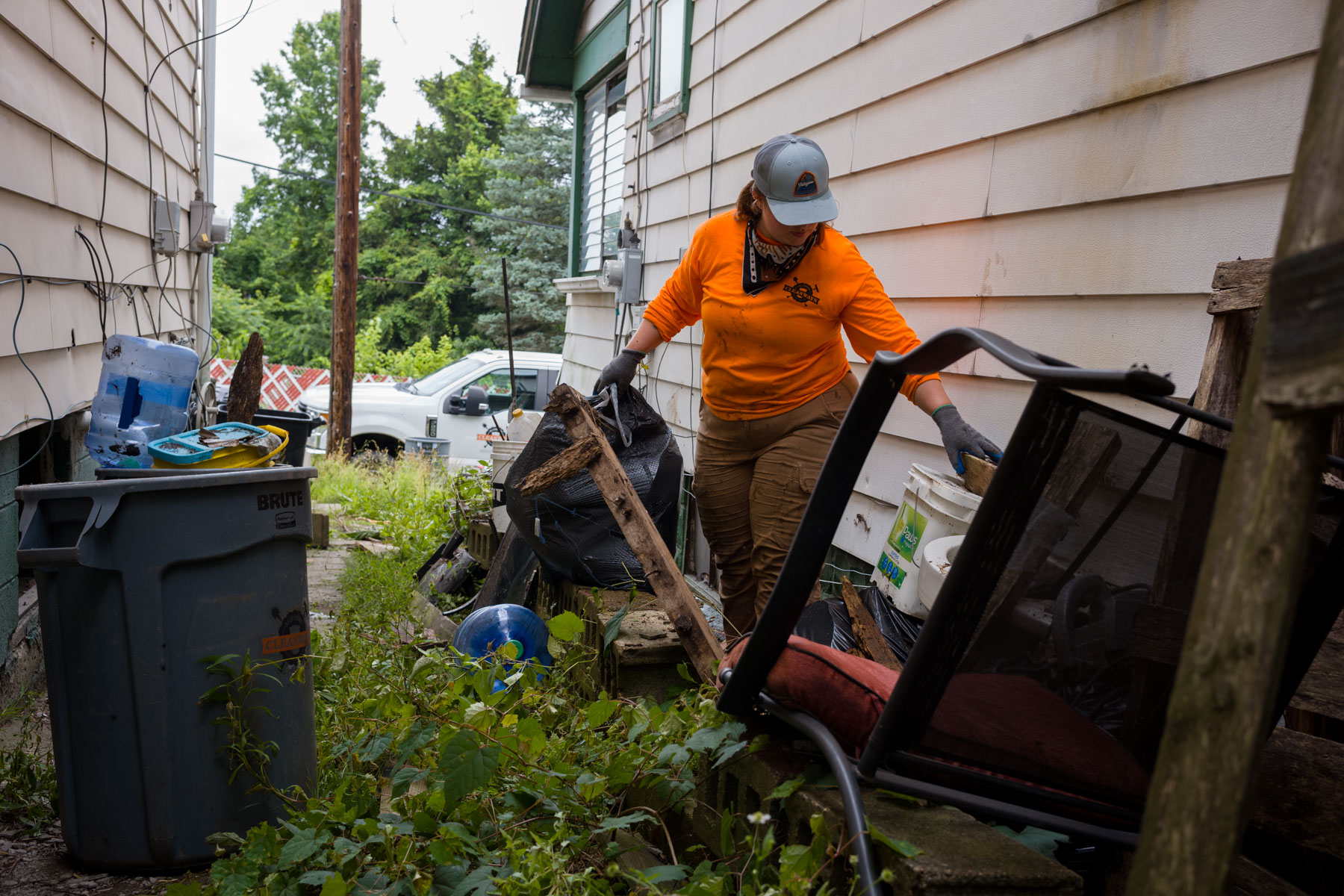
Lyssa Eberhardt and Asher Khersonsky, of Allegheny CleanWays, clear debris from condemned houses in McKeesport on June 27. The nonprofit organization, which cleans up illegal dumping across Allegheny County, recently lost funding as a result of cancelled federal grants. (Photo by Quinn Glabicki/PublicSource)
The county Board of Health voted in support of legislation that would allow county crews to remediate outdoor hazards, then lien the properties. The measure now goes to County Council for a vote.
“Pittsburgh’s Public Source is an independent nonprofit newsroom serving the Pittsburgh region. Sign up for our free newsletters.”
The Allegheny County Board of Health voted unanimously on Wednesday to approve what one advocate called “a clean and lien” approach to spur neglectful property owners to address outdoor health hazards on their properties.
The enforcement tool is an amendment to Article VI, the county’s housing code, which was updated last year for the first time in a quarter-century. It empowers the county Health Department to hire a contractor to clean up tire piles, unmaintained swimming pools, hoarding around the exterior of a home and other health hazards. Such a move would be an escalation if attempts by the county to order the property owner to address the hazard are ignored, and fines the county imposes go unpaid.
The county can put a lien on the property to ensure the cost of the clean-up can be covered via seizure and sale of the home, said County Councilor Michelle Naccarati-Chapkis, who chairs the county’s new Housing and Community Environment Advisory Committee. She’s also the executive director of Women for a Healthy Environment, a nonprofit working to promote healthy housing in the county.
A tenant advocate described the update as “a good start” toward a more proactive approach to enforcing the housing code. Advocates have long criticized the Health Department for relying on a complaint-driven system that pits vulnerable tenants against landlords.
“It’s a pretty effective remedy and it should certainly be in the toolbox,” said Kevin Quisenberry, the litigation director of Community Justice Project, which provides legal aid to tenants. The amendment gives the department “leverage” to “make sure the work gets done,” he added.
The advisory committee worked with department staffers to draft the amendment. The group is a mechanism for public oversight of housing policy that tenant advocates had pushed for since former County Executive Rich Fitzgerald was in office. The committee was created last year under new County Executive Sara Innamorato’s leadership. Its members include elected officials, housing advocates, a real estate agent, a public health professor, a legal aid lawyer who represents tenants and other experts.
“They’ve been really receptive to feedback,” said Naccarati-Chapkis, describing the collaborative process between the committee and the department. “We’re off to a great start and it’s working well.”
The committee voted unanimously on July 8 to send the amendment to the Board of Health for approval — their first major action since they began meeting in March. The amendment will be sent to County Council for final approval.
Another committee member said the update meets an urgent need to address the health hazards being created by climate change.
“It’s been getting wetter and wetter in Pittsburgh,” said Devon Goetze, a member who’s also the director of housing services at Auberle, a human services nonprofit. “We really don’t get a reprieve anymore” from the frequent rainfall this spring and summer.
Tire piles that collect rainwater create breeding grounds for mosquitoes and hoarding near homes attracts rats, among other disease vectors, she said. “We’re seeing more and more abandoned properties, more and more people who maybe can’t or aren’t taking care of their property and some confusion between who’s supposed to take care of the property — the landlord or the tenant,” she added.
Before she voted to approve the amendment, health board member Margaret Larkins-Pettigrew asked a department staffer if it could disproportionately affect financially struggling people in the county.
“Many of the people who have some of these violations are low-income,” said Larkins-Pettigrew, an OB-GYN who was the Allegheny Health Network’s senior vice president and chief clinical diversity, equity and inclusion officer. “They really can’t afford” to clean up the property or pay the fines levied by the department. “Where do you go from there?”
The protocol would only affect property owners, not tenants, said Otis Pitts, the department’s deputy director of food, housing and public policy. If action isn’t taken after months of legal notices, “we’re forced to step in for the greater good,” he told Larkins-Pettigrew.
A spokesperson for a group that represents the interests of landlords and property owners pointed out the county and its municipalities have “existing enforcement clean-up mechanisms in place.”
This new proposal adds “additional private contractors to provide these services,” wrote John Petrack, executive vice president of the Realtors Association of Metropolitan Pittsburgh. “As many of the properties in question are owned by modest consumers, we would like to see as many warnings and chances for remediation as possible before placing potentially higher costs upon the consumer,” he added, noting the group believes local government plays “a vital role in addressing major health and safety violations in our communities.”
Quisenberry urged the advisory committee to build on this “good enforcement tool” by steering the Health Department toward a more proactive rental inspection system. He suggested a rental licensing program that requires units to be inspected regularly.
“It would almost totally remove this whole paradigm of having to file a complaint and stick your neck out, make yourself the enemy of your landlord and risk retaliation or eviction because you’ve done it,” he said.
A 2021 investigation by Pittsburgh’s Public Source and WESA found that the Health Department received an average of 1,900 complaints of unhealthy housing annually and conducted 3,000 inspections, but levied just a few dozen fines per year and collected only a fraction of those.

Venuri Siriwardane is the health and mental health reporter at Pittsburgh’s Public Source. She can be reached at venuri@publicsource.org or on Bluesky @venuri.bsky.social.
The Jewish Healthcare Foundation has contributed funding to Public Source’s health care reporting.
This story was fact-checked by Rich Lord.
This article first appeared on Pittsburgh’s Public Source and is republished here under a Creative Commons Attribution-NoDerivatives 4.0 International License.
About Post Author
