President Donald Trump arrives to speak at the “Inaugural Pennsylvania Energy and Innovation Event” at Carnegie Mellon University, Tuesday, July 15, 2025, in Pittsburgh. Standing with the President are from left, Treasury Secretary Scott Bessent, Sen. Dave McCormick, R-Pa., Trump and Jon Gray, President and Chief Operating Officer, Blackstone. (Evan Vucci/AP Photo)
Trump’s boasts of surging development come after he has sparred with higher ed institutions over funding, diversity and international students. Some at Carnegie Mellon University saw the president’s visit as an honor, others as “insulting.”
“PublicSource is an independent nonprofit newsroom serving the Pittsburgh region. Sign up for our free newsletters.”
A Pennsylvania Energy and Innovation Summit at Carnegie Mellon University Tuesday, with headline billing from President Donald Trump, drew protests in Oakland even as it spotlighted the state’s economic opportunities.
U.S. Sen. Dave McCormick, a Republican from Pittsburgh, organized the summit, summoning a bipartisan speaker’s list including Democrat Gov. Josh Shapiro and numerous business and government leaders. Trump’s afternoon attendance elevated expectations and opposition.
Trump opened his comments at the summit declaring the United States “the hottest country in the world.”
Flanked by McCormick, Blackstone Group COO Jonathan Gray and others, Trump said that he was back in Pittsburgh “to announce the largest package of investments in the history of the commonwealth.”
Trump said that these investments would bring $92 billion in development to the state.
“We’re doing things nobody thought possible,” Trump said.
Trump said these investments would bring to the area AI data centers along with power plants of all kinds from nuclear to “clean, beautiful coal.”
“We believe that America’s destiny is to dominate every industry,” Trump said. “And that includes being the world’s superpower in AI tech. We’re way ahead in AI tech.”

Turning his attention to the global stage, Trump said, “We won’t let China catch up on AI. … We’re going to be fighting them in a friendly fashion.”
He claimed “a great relationship with President [Xi Jinping]” and noted that he shares smiles with the Chinese leader. But he said America is going to be the clear leader in AI. “I think China is going to be very far behind because we have a lot of places going up right now.”
Trump added that China is “opening up coal-fired plants all over the place and we’re entitled and allowed to do that too.”
Between calls to “drill, baby, drill,” Trump said that in Pennsylvania, “you have tremendous skill in this state.”
America “remaining the world’s leader in AI will require an increase of energy and you’re doing it with buildout of infrastructure.”
Noting plans for a data center in Homer City, Indiana County, Trump said there are “36 data center projects announced and more to come in the weeks ahead.”
Trump concluded his opening remarks, saying, “it’s going to truly be a golden age for this country. You’re going to see some real action here so get ready. It’s going to be beautiful to be whole.”

Post-summit clash near museum
After Trump’s remarks, many attendees, including CMU President Farnam Jahanian, left campus for a private, post-summit event at the Carnegie Museums. Upwards of 50 protesters got there first, leading to some of the most confrontational exchanges of the day.
Attendees had to walk through protesters to get to the museum, and members of the two camps exchanged harsh words and gestures.
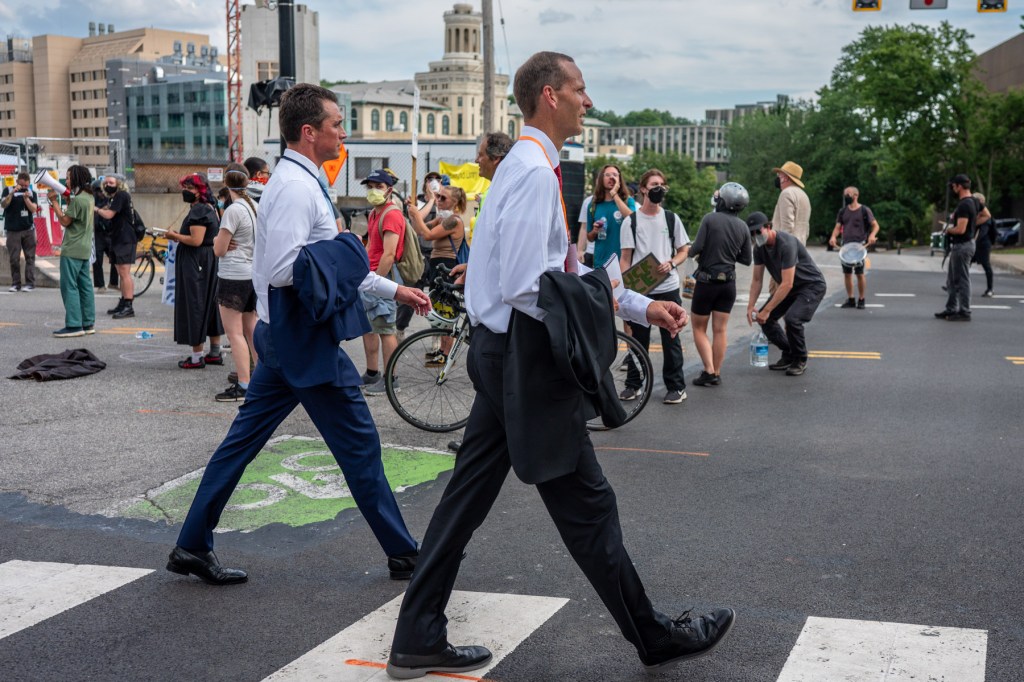
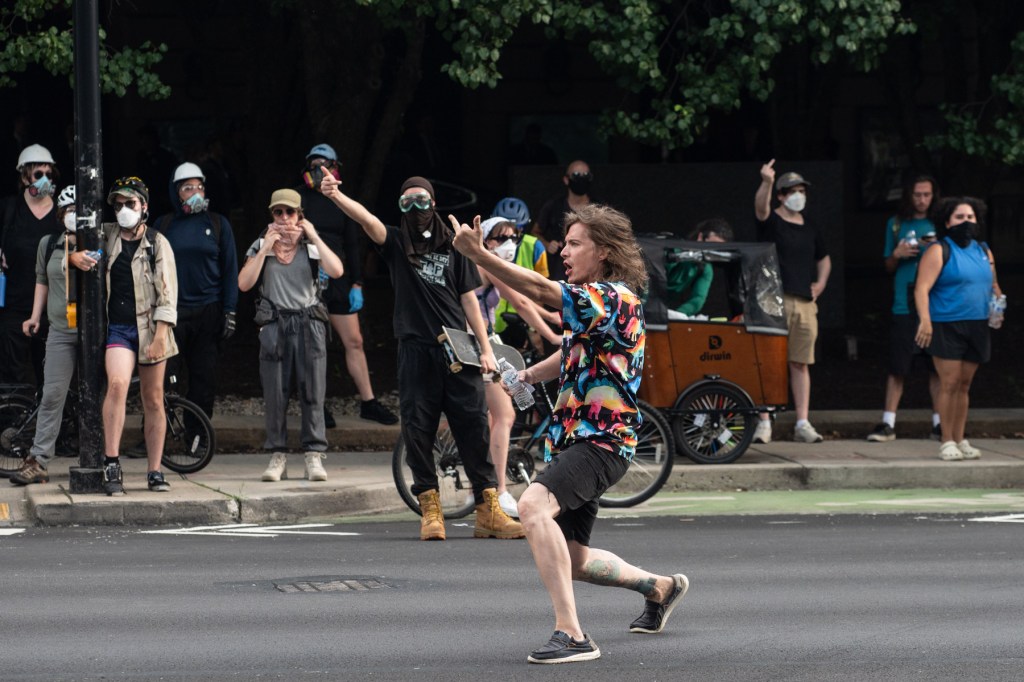
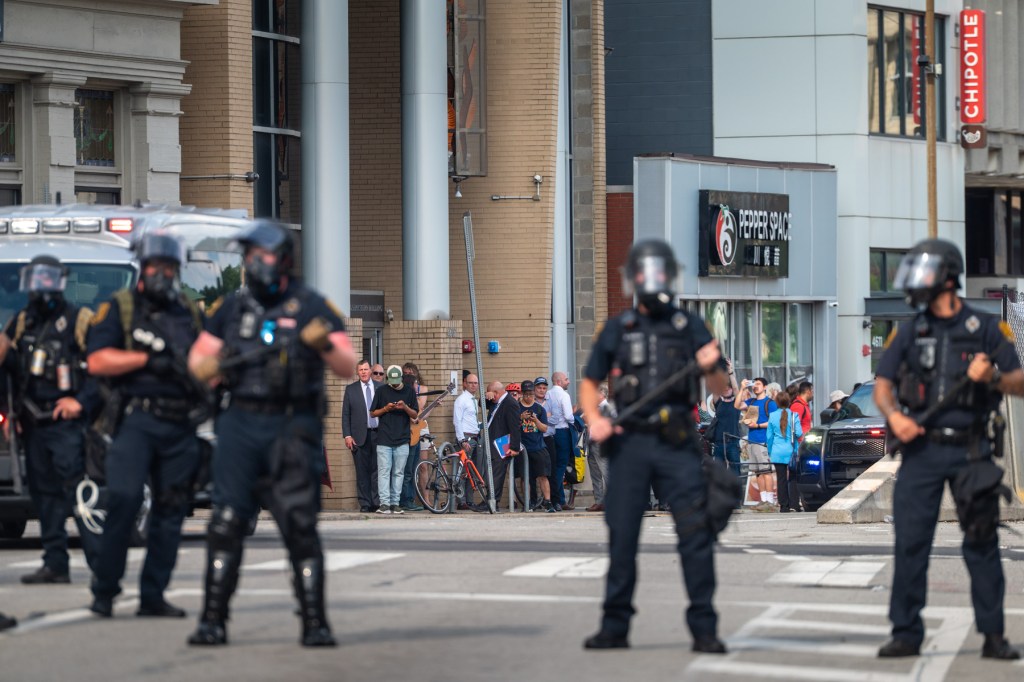
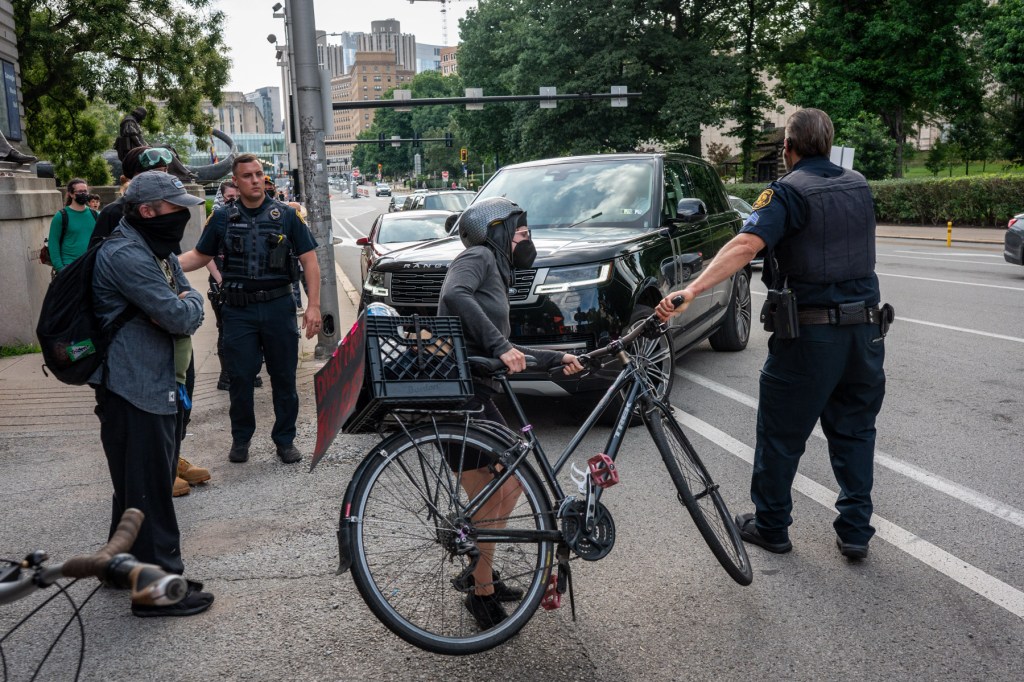
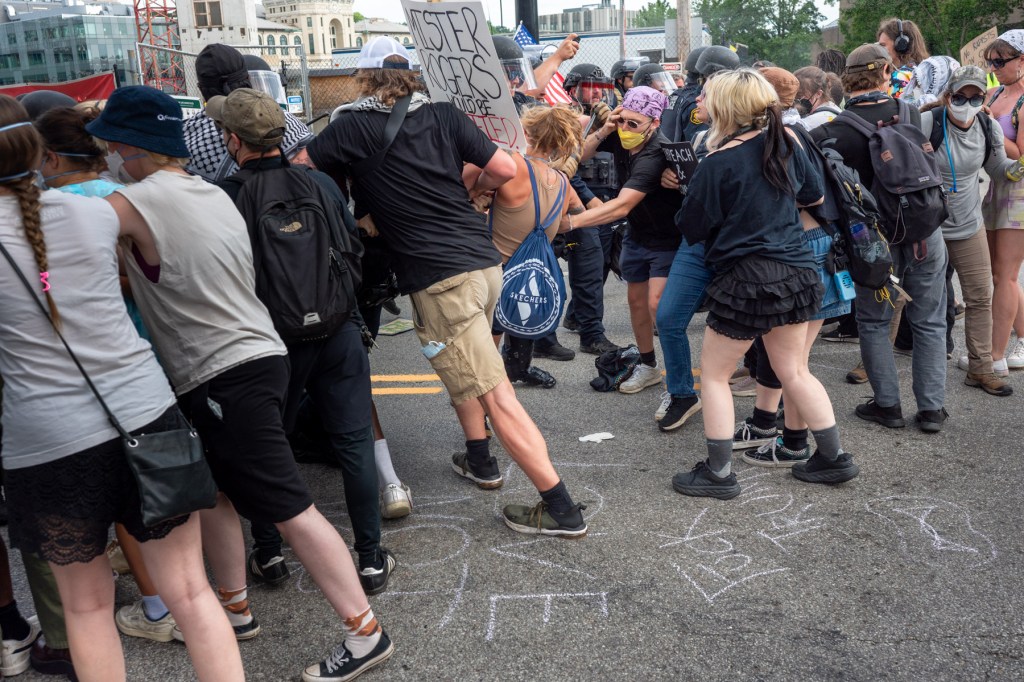
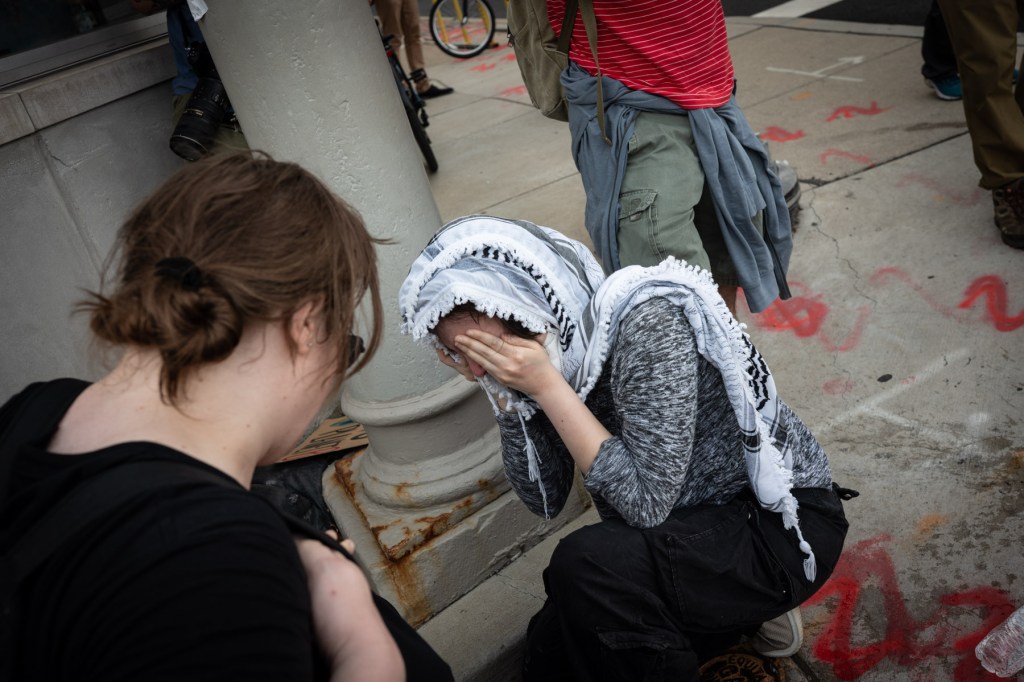
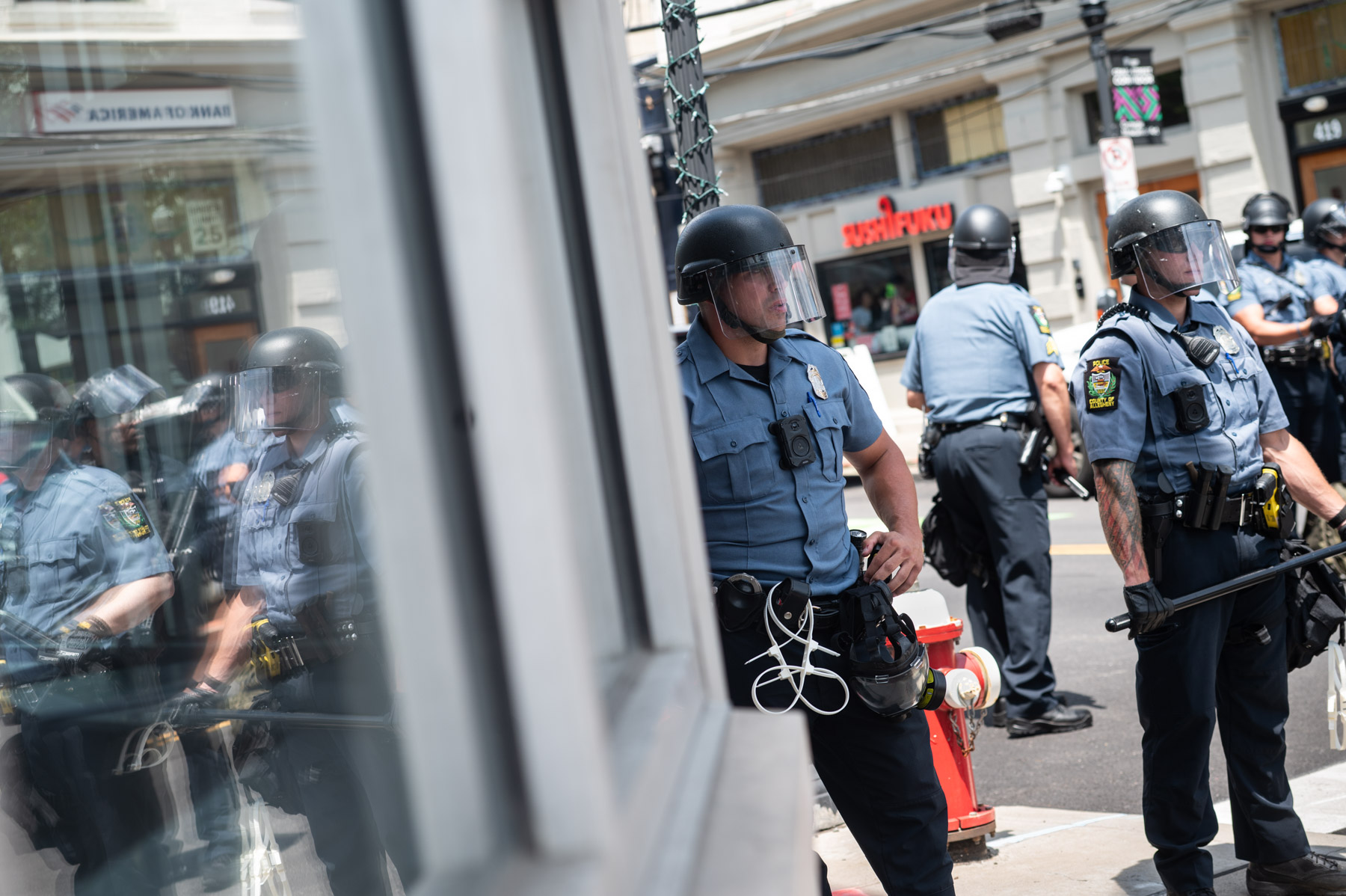
After summit attendees left Carnegie Mellon University for a private event at the Carnegie Museums, protesters sought to impede them. Pittsburgh police lined up, kept access open, pushed protesters back and eventually used an irritant spray. (Photos by Stephanie Strasburg/PublicSource)
Police threatened protesters with arrest and used an irritant spray around 5:30 p.m., prompting calls for help from street medics who responded with eye wash.
Police instructed protesters to retreat toward the Cathedral of Learning and steadily pushed them back from the intersection of Craig Street and Forbes Avenue to South Bellefield Avenue.
Riot-gear-clad police left the area around 6 p.m. A few dozen protesters remained near the museum by 6:30 p.m., sometimes trying to impede event attendees’ cars and interacting with police.
Pennsylvania a key in race with China
The summit aimed to highlight:
- The race to pioneer and utilize artificial intelligence
- The case for Pennsylvania as a national leader in AI
- Indications that the state is already demonstrating that leadership
- The energy needs created by AI, and where that investment is occurring.
Jahanian opened the summit, noting that Southwestern Pennsylvania has history suggesting it can be a pioneer. “Here in Pittsburgh, the legacy of discovery and reinvention runs deep, from steel to semiconductors to robotics to nuclear energy.”
“Pennsylvania is so well-positioned to spearhead the charge for American energy and AI dominance,” McCormick added.
The AI revolution is here and Pennsylvania is capitalizing on it, summit panelists said.
During a panel discussion, the senator and governor emphasized that Democratic and Republican state officials were united on advancing energy investments, such as the $20 billion Amazon plans to spend on data centers that will be built in Luzerne and Bucks counties.
Microsoft says it is spending $1.6 billion to reopen the lone functional nuclear reactor on Three Mile Island under a long-term power supply agreement for its data centers. AI cloud computing firm CoreWeave says it will spend more than $6 billion to equip a data center in southcentral Pennsylvania and Gradiant says it will begin commercial production of lithium in 2026 by extracting it from gas drilling wastewater in northeastern Pennsylvania.
Throughout the summit, industry CEOs boasted of ongoing seven- and eight-figure investments in the state.
“It’s critically important that we use Pennsylvania energy and the workers that create energy — just like the workers that forged the steel and went down in the coal mines — to be the ones powering the AI revolution,” Shapiro said.
The governor said the summit represented a pivotal moment in history for not only the state, but the U.S. He referenced the past, pointing to the industrial revolution, and Pennsylvania’s role in creating a middle class and modern-day labor movement, saying these “made us more free as a nation.”
He believes this will happen again, with deals to build more data centers and further advancements in AI helping to outpace that of China and protect national interests.
“This is a global race for both energy dominance and AI dominance and we need homegrown Pennsylvanians to be doing this work,” Shapiro said. “We do not want China to beat us in this AI race. This is one of the most important national security questions we have.”
Speaking to a room of media members along with tech and energy industry giants, Shapiro said the state’s workforce and top energy exporter status uniquely positioned it to lead this charge. He emphasized the role of higher education institutions in Pennsylvania as key collaborators in the push to bring companies to the state, specifically highlighting CMU, the University of Pittsburgh, Penn State University and community colleges.

Shapiro also noted the critical role of skilled labor in growing Pennsylvania, where, he said, 62% of adults don’t have a college degree. He said data center developments would strengthen the state’s economy by developing high-paying work opportunities, with McCormick adding that “hundreds of thousands of jobs” would be opened — ones that would allow people to stay on for decades.
“We create more jobs — more moms and dads get to go home and put food on the tables for their families,” Shapiro said. “More kids have opportunity. Our future is brighter. That’s what this is all about.”
Shapiro said wait times for state permits have steadily decreased. By allowing deals to take shape faster, he said they’ve “de-risked and incentivized” investments in the state, creating enough interest for a summit to take place.
“Pennsylvania is on the rise … the sky is the limit for us,” he said.
Activists raise concerns with AI, environment
Though the summit’s tone was relentlessly positive, the polarizing president’s appearance meant weeks of debate on campus, culminating in a multi-protest afternoon in Oakland.
The Fence at CMU, which is routinely repainted by students and previously read, “No rapists on our campus,” was decorated with anti-summit messaging days before the start of the summit. Around midday Tuesday, workers appeared to be covering that messaging with white paint.

On Flagstaff Hill next to campus, the first of several protests against the summit began around 10:15 a.m. on Tuesday.
“We need clean air, not another billionaire,” chanted attendees at the rally held by the advocacy group Sunrise Movement.
Speakers warned of the adverse environmental effects of large-scale data centers, which climate activists said add to air pollution and consume necessary water and electricity resources, particularly for rural communities.
“I don’t know about you, but I want water for Pennsylvania homes, families and businesses, not Google, AI or ChatGPT,” said speaker Lauren Posey, an environmental policy advocate with the nonprofit Protect PT.
The rally and following block party went into planning soon after the summit was announced, the group’s media liaison Max Blair said.


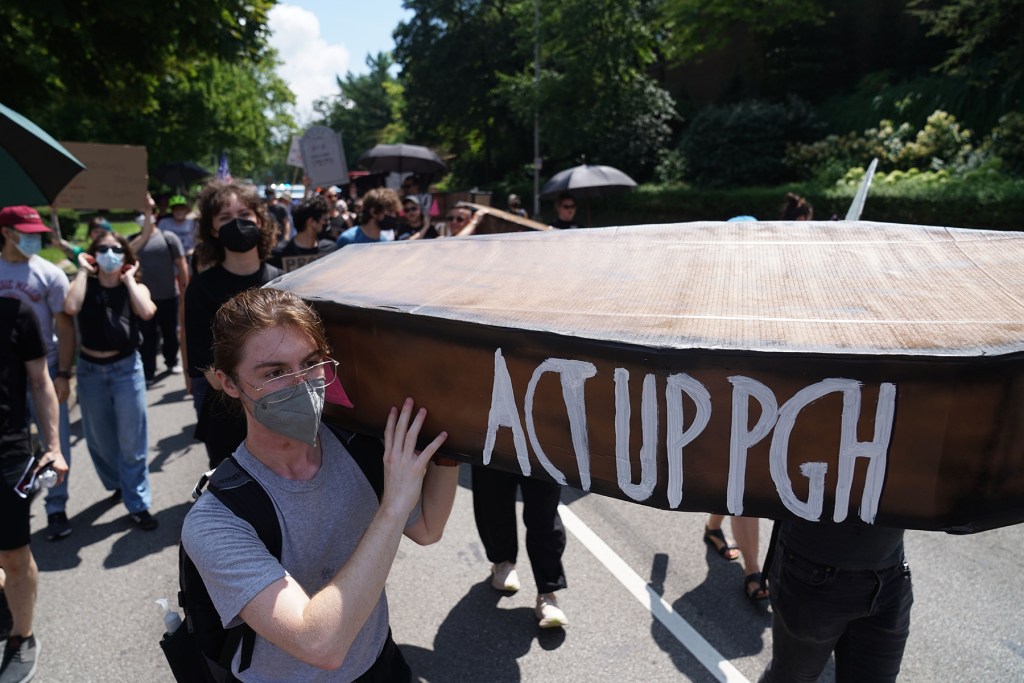
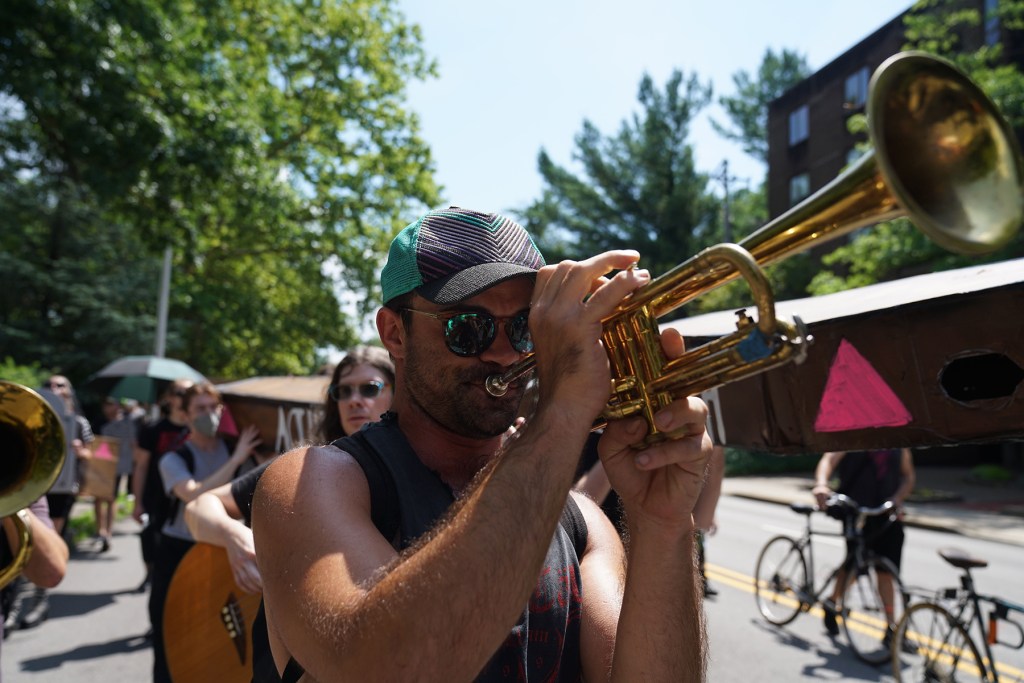
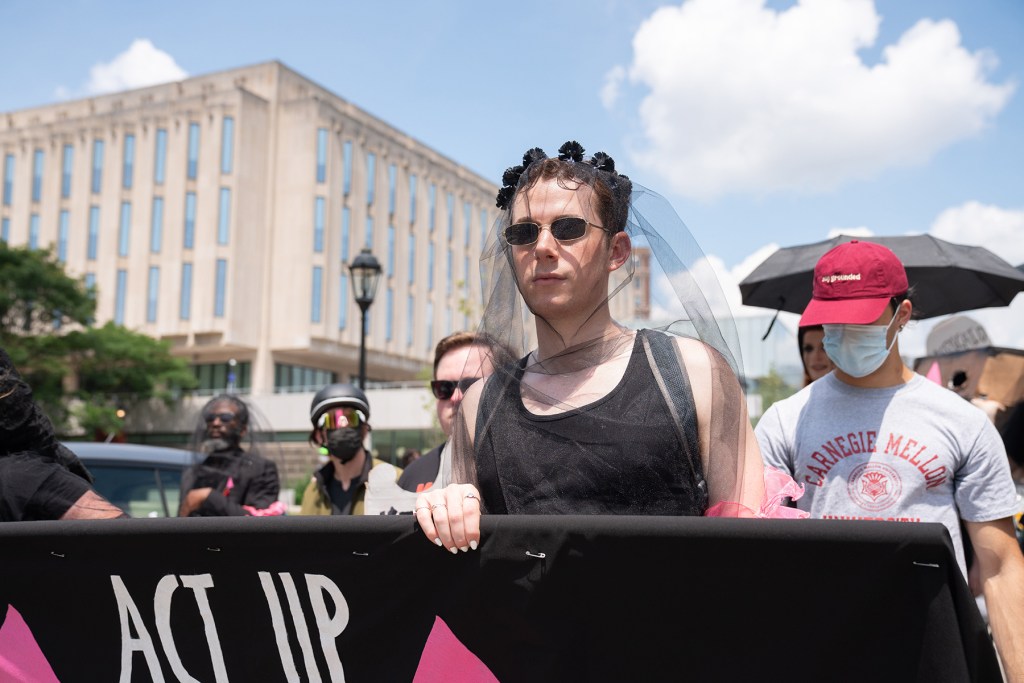


The Act Up Pittsburgh protest moved through Oakland on Tuesday, July 15, 2025, ahead of President Donald Trump’s arrival at the Pennsylvania Energy and Innovation Summit at Carnegie Mellon University. (Photos by Caleb Kaufman/PublicSource)
Sunrise Movement is a national youth-led organization focused on championing solutions to climate change. Blair said many of the Pittsburgh chapter’s members are CMU students or alumni who wanted to express their disapproval of the event.
“Climate is not just one issue among many issues, but it’s the base upon which everything rests,” Blair said. “If we don’t have a stable society, which relies on a stable environment, then we won’t be able to do anything else as a society.”
Not your typical CMU event
Prior to the summit, Jahanian emphasized CMU’s “history of constructively engaging with the federal government and administrations across the political spectrum.”
The summit, though, comes during unique times.
- CMU and other research institutions are suing the federal government over deep cuts to research funding.
- Trump’s executive orders and a letter from the federal Department of Education have sought to force a nationwide rollback in longstanding diversity initiatives.
- Marquee institutions, notably including Harvard, have faced escalating demands from Washington and litigated to counter punitive measures.
- The administration’s efforts to curb some forms of immigration and respond to what it views as anti-American speech have bled into measures targeting international students.
As a result, Trump’s visit drew critics and enthusiasts.
Prior to the summit, Anthony Cacciato, president of CMU’s College Republicans, said the event cements the university’s position as an AI pioneer.
“As a school and community, we should be proud that someone of that rigor is coming to our campus,” he said. “While some might be in opposition, most people can acknowledge the importance of the president coming to our campus.”
He said he’s observed that “people are excited,” while acknowledging that “those who are opposed have certainly made their voices heard.
“It’s their right to do so, it’s a beautiful facet of our democracy to protest,” he added.
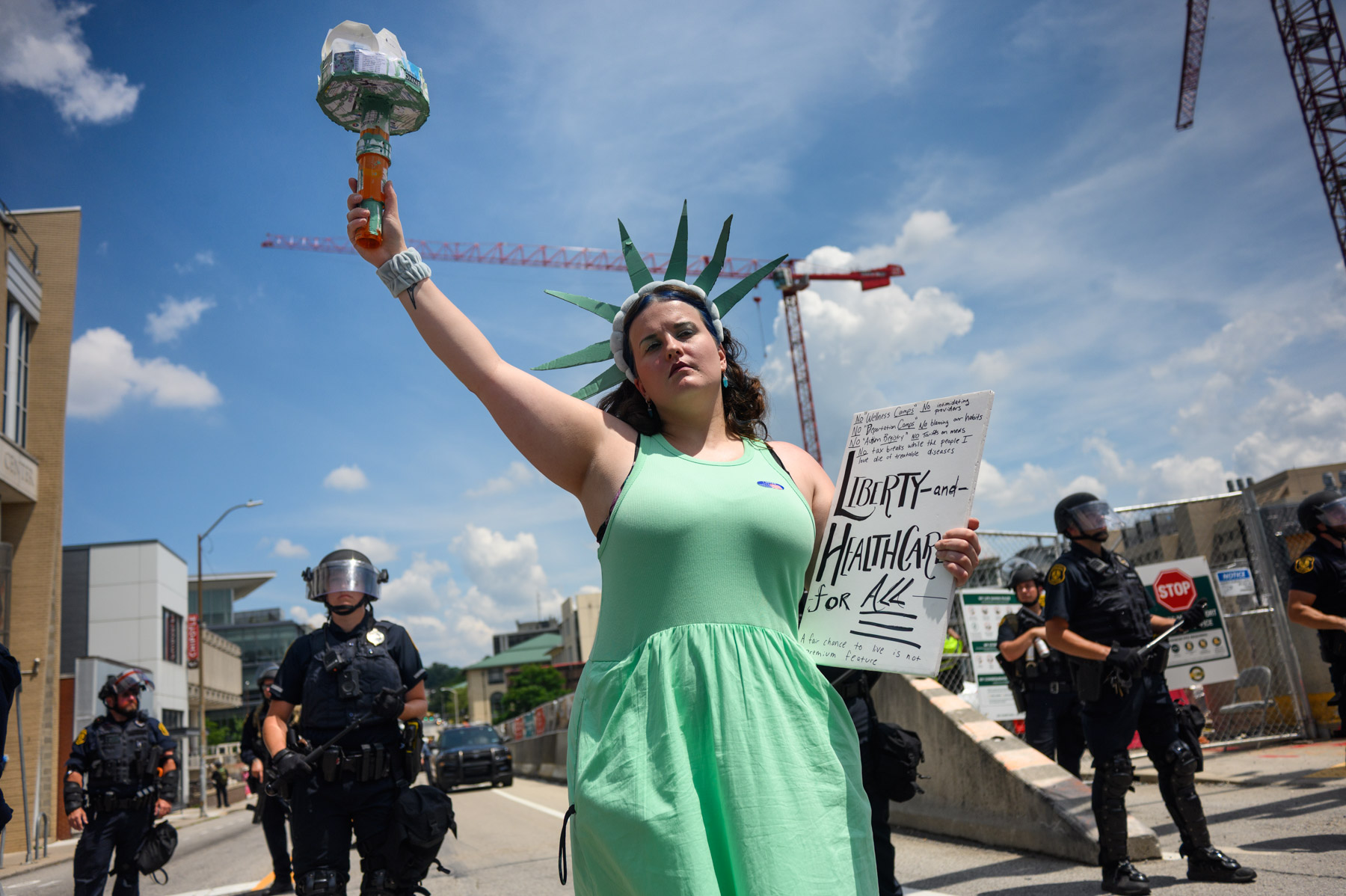
Avalon Sueiro, the president of CMU Democrats, believes that the university is going against its own beliefs by hosting Trump.
“It’s someone who is actively conducting the biggest attack on democracy in U.S. history,” Sueiro said. “This supersedes politics and whatever other excuses the university is making.”
Sueiro brought up the visit made by then-Vice President Kamala Harris, who was Trump’s general election foe, just last year.
“Many are pointing to Harris’ visit last year saying, ‘it’s only fair,’ but if Harris had recently passed a bill that would strip 10 million people of their health insurance, I’d be against her visit too.”
Student organization Sustainable Earth’s co-presidents Ella Vander Velde and Nathan Cottrell said in an email that they hope tech leaders will be mindful of local and global impacts of AI in the summit discussions, including water and air pollution, large scale waste and disproportionate land-use of low-income or marginalized communities.
“The incredible amount of energy needed to operate AI equipment offers an opportunity to invest in reliable, clean, and renewable energy sources,” the co-presidents said in an email. “In doing such, we can limit the harmful effects of fossil fuel extraction and reduce the industry’s contribution to climate change, pollution, and habitat destruction.”
Julia Elrod, studying toward a doctorate in statistical genomics at CMU, penned an open letter to Jahanian saying the school is putting itself “on the wrong side of history” by hosting a president who has threatened institutions of higher education and slashed research funding. She also noted McCormick’s views on climate change. He has said that climate change is something the country will need to adapt to, and has touted natural gas as a positive, aligning himself closely with fracking leaders but putting him at odds with scientists.
“I think it felt, to be frank, insulting to see the university president speaking to the community in this way that totally ignored the reality of who these people are,” she said.
Elrod added that some of her friends don’t feel safe speaking their minds publicly because they aren’t citizens. “I don’t have as much to lose as a lot of other CMU grad students,” said Elrod, adding that she is white and a citizen.
Robert Strauss, a professor of economics and public policy at CMU, said that he didn’t agree with the sentiment “Trump should not be allowed to speak” that he saw scribbled on a campus sidewalk.
“That strikes me as censorship,” Strauss said. “I don’t believe in preventing somebody from speaking, especially if they’re willing to answer questions. … That’s what free speech is about.”
He added, however, that university officials are often keen to keep things scripted and that CMU is image conscious “beyond comprehension and beyond the bounds of what universities used to be about, which was the interaction of civil discourse.”
“If it’s just a private sort of a corporate brain-think with no opportunity for question and answer … maybe a university campus isn’t the right place for it,” Strauss said.

Maddy Franklin reports on higher ed for PublicSource, in partnership with Open Campus, and can be reached at madison@publicsource.org.

Eric Jankiewicz is PublicSource’s economic development reporter, and can be reached at ericj@publicsource.org or on Twitter @ericjankiewicz.
Ayla Saeed, Ember Duke and Femi Horrall contributed.
The Associated Press contributed.
This article first appeared on Pittsburgh’s Public Source and is republished here under a Creative Commons Attribution-NoDerivatives 4.0 International License.
About Post Author
