Cleopatra before Caesar (1866), Jean-Léon Gérôme, oil on canvas. Private collection. CC BY-ND
Cleopatra will be the focus of one of the major exhibitions of 2025, ” The Mystery of Cleopatra ,” presented at the Arab World Institute starting June 11. This historical figure has fueled heated debates among historians, artists, feminists, Afro-descendant activists, and conservatives in the United States for nearly two centuries.
By the early 19th century, Cleopatra was already well known to American audiences thanks to ancient sources and Shakespeare’s play . But around 1850, her figure was reborn in a movement exploring sexuality and the nude. Numerous artistic works then shaped a new imaginary, like the poem Cleopatra (1864) by the artist William Wetmore Story, in which the queen is depicted in situations imbued with eroticism. These representations transformed Cleopatra into an ambivalent figure, both sexualized and idealized, reflecting societal tensions over race, gender, and sexuality. Since then, many have continued to reinterpret this queen to serve their own cultural and political agendas.
Also read: Was Cleopatra’s perfume really captivating?
The Queen’s Breasts
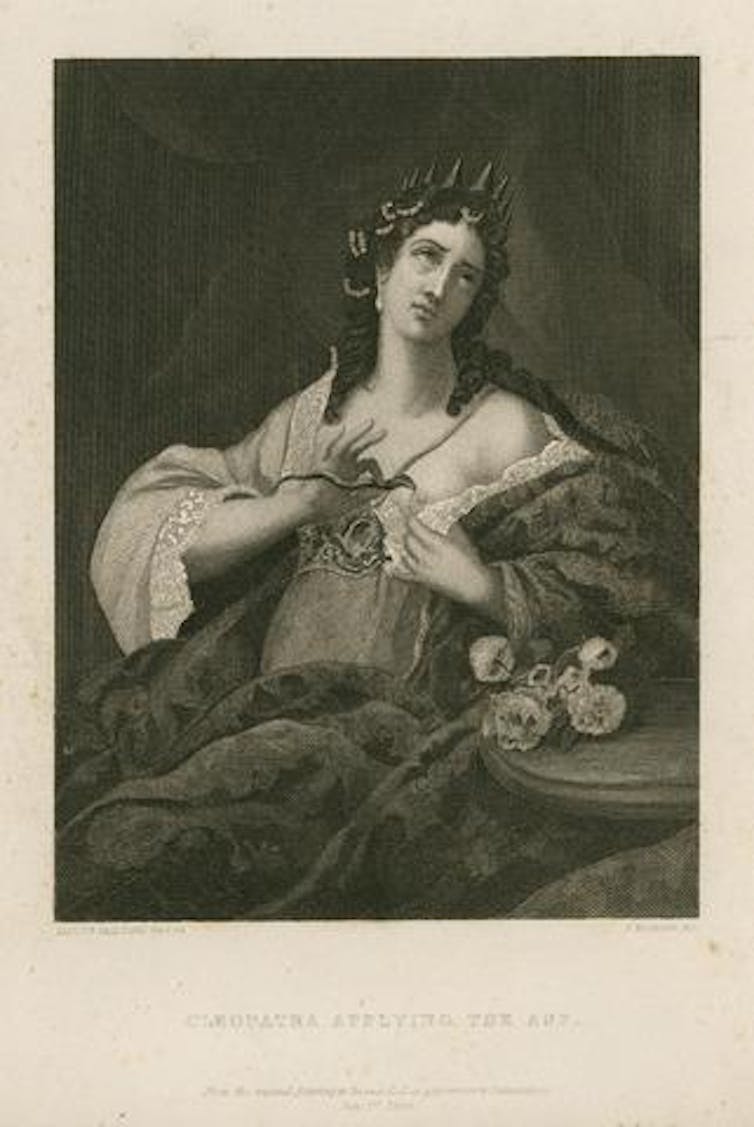
Cleopatra’s death, supposedly caused by the venom of an asp that she allowed to bite her breast, provided 19th-century American artists and writers with an ideal pretext for revealing a nude woman. The sexualization of the queen then focused on this area of the body, her breasts being erected as symbols of disturbing sensuality and magnified femininity, becoming the center of erotic and exotic fascination. Historian Mary Hamer points out that her death provided an “ideal opportunity to display a voluptuous young woman with bare breasts,” making Cleopatra a true visual attraction.
Inspired by a painting by Guido Reni , the American John Rogers created in 1858 Cleopatra applying the asp guiding the gaze towards the serpent on Cleopatra’s chest, combining chastity and temptation.

Poets also exploit this sensuality with a fantasy about breasts. In 1853, the poet William Gilmore Simms spoke of the queen’s breast as “the sweet recess where rises every gentle slope that seems to swell.” The poets John Banister Tabb and Algernoon Swinburne also exploited this sensuality in their works, portraying Cleopatra as an “intellectual mistress of pleasure” and the femme fatale who breaks men’s hearts.
Faced with this hypersexualized and naked vision of Cleopatra, some American writers engaged in a moral rehabilitation of the queen, seeking to counter these representations by placing her within the codes of Victorian dignity and purity.
Also read: Why does Antiquity fascinate young people today?
Dress the queen
From 1850 onwards, feminist biographers challenged this sexualised representation, such as the American writer Star King who quoted Plutarch to argue that the asp was not introduced under clothing.
Other writers emphasize a queen dressed for death, in a modest and elegant vision, symbolizing purity. Feminist biographer Lydia Hoyt Farmer describes a Cleopatra who, in her final act, remains dignified and modest. Cleopatra is redefined as a figure of purity and feminist resistance, far from the degrading representations of the time.
This desire for the moral rehabilitation of Cleopatra is part of a broader approach of feminist movements, which see in her not only a model of dignity, but also a figure of emancipation and of the fight against patriarchal and social norms.
Feminist Cleopatra?
In the 19th century, numerous social and moral debates in the United States placed Cleopatra at the heart of discussions about the role of women. A symbol of power and intelligence, she was adopted by feminist movements seeking freedom and resistance to patriarchy and the threat of sexual freedom.
For historian Mary Hamer, Cleopatra is not just a reference to the ancient queen; she also reflects society’s concerns about the place of women. She symbolizes the fear of a free, powerful, and seductive woman, which explains why Margaret E. Foley , a former Massachusetts mill worker turned sculptor, depicts her wearing a light gown, subtly defying convention. Cleopatra becomes a figure of emancipation.
The feminist journal The Lowell Offerings of 1842-1843 also praises the influence of the last of the Ptolemies:
“Cleopatra was one of the most fascinating women, and she exercised the power she had – which is what women always do.”
These tensions between feminist reappropriation and sexist gaze are also found in sculptural art, where Cleopatra becomes a field of expression both to celebrate her symbolic power and to exploit her sensual image, revealing the ambiguities of 19th-century American society .
Sculpting Cleopatra
Inspired by the scene from Shakespeare’s Antony and Cleopatra , African-American sculptor Edmonia Lewis created The Death of Cleopatra in 1876 for Philadelphia’s centennial, partially exposing her breasts. This feminist reappropriation of the queen’s nudity and sensual power transforms her into a figure of sensual power, no longer subject to the male gaze, but mobilized by women to assert their autonomy, their bodily freedom, and their right to an assumed sexuality.
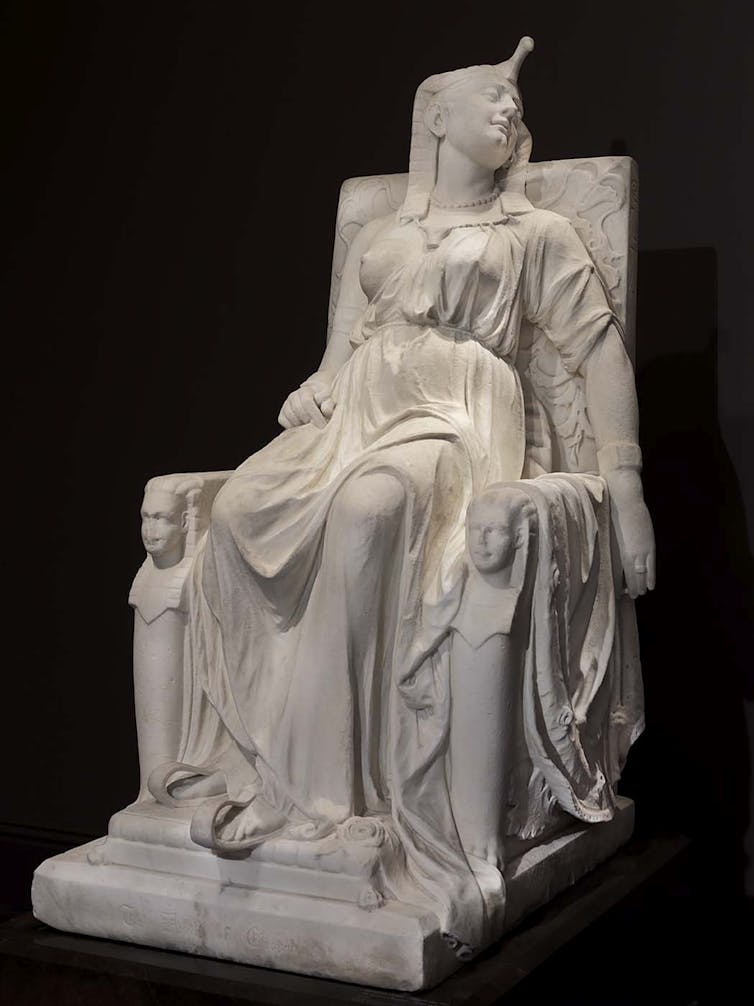
At this time, for artists in Western societies, the representation of partial nudity became acceptable within the symbolic framework of an authentic narrative of a beautiful and strong woman. Some American sculptors, such as Edmonia Lewis and Margaret Foley, were largely influenced by the Orientalist codes of the then-fashionable French studios , which offered freedoms of representation and allowed women artists to find their place in a male artistic world while exploring powerful subjects.
Conversely, among male artists such as the sculptor Thomas Ridgeway Gould , Cleopatra’s death is often associated with a macabre sensuality. For his part, the sculptor William Wetmore Story suggests an African origin for the queen he represents, in a context where debates on the abolition of slavery are gaining momentum. For the American anti-slavery and abolitionist Edward Everett Hale, Story created a queen “full of her burning blood” that many white pseudo-scientists will link to the myth of the hypersexuality of Black people.
These sculptural representations of Cleopatra, mixing sensuality and symbolism, are not limited to questions of gender, but are also part of the racial debates of the 19th century, where the figure of the queen becomes a battleground between orientalist myths and racial stereotypes.
Cleopatra and Racial Prejudice
The figure of the eroticized femme fatale, derived from Roman propaganda, fueled racial prejudices in the United States , where Black sexuality was perceived as deviant and uncontrollable in the face of White “purity.”
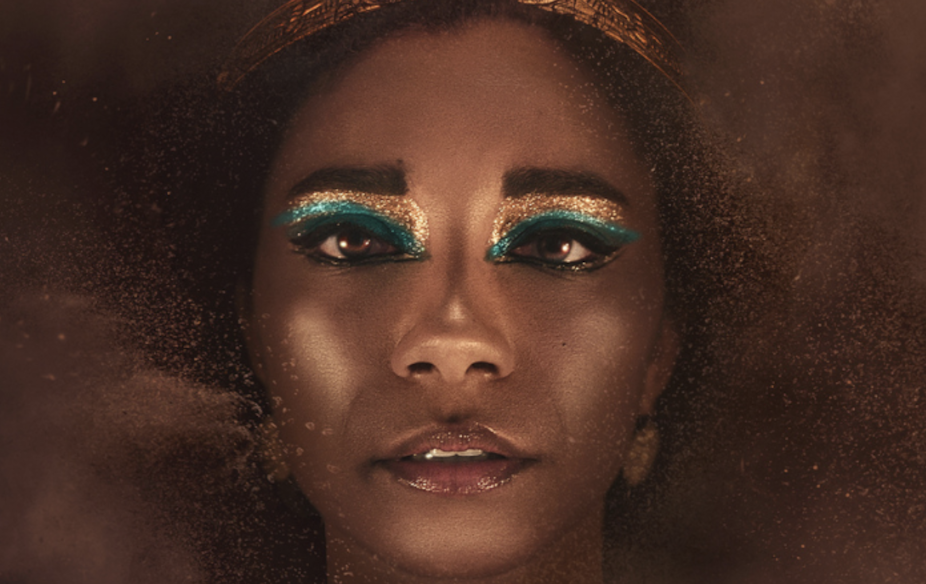
Adele James as Cleopatra (Jada Pinkett Smith’s “Queen Cleopatra,” Netflix, 2023). Parle Magazine
Nineteenth-century medical literature also considered nymphomania a pathology leading to insanity and suicide, associating excessive sexuality and mental imbalance.
To rationalize Cleopatra’s supposedly unbridled sexuality and her suicide, unacceptable in a moral framework marked by religion, this analytical framework was useful to White American society.
At the same time, seeking to express their blackness while attenuating the sexual stereotypes anchored in the White imagination, African-American figures, such as Henry Highland Garnet , decided to depict Cleopatra without addressing an erotic dimension.
“I will hardly allude to the beautiful Cleopatra who swayed and captivated Antony’s heart,” he declared in 1848. Some have even preferred to see in her a chaste, mixed-race heroine .
In the 19th century, Cleopatra became a mirror of American concerns about sexuality, gender, and race. By turns femme fatale, modest queen, or figure of emancipation, she embodied the tensions between erotic fascination and the struggle for feminine dignity. The American imagination, by reshaping her image, made Cleopatra a figure deeply rooted in the social and cultural debates of the time.
In 2023, the controversy surrounding the Netflix series reveals how Cleopatra remains a contemporary issue, at the intersection of debates on race, identity, and the reappropriation of historical narratives. The portrayal of the queen as a Black woman has been divisive: for some, a gesture of cultural rehabilitation; for others, a historical distortion. This debate underscores how the past, far from being neutral, remains profoundly political.
About Post Author
