Bilal Cyrus, a community volunteer, talks with Lucas Moran and Charles Rowe in the Manchester Food for the Soul Community Farm on Thursday, June 19, 2025, in Manchester. (Photo by Caleb Kaufman/PublicSource)
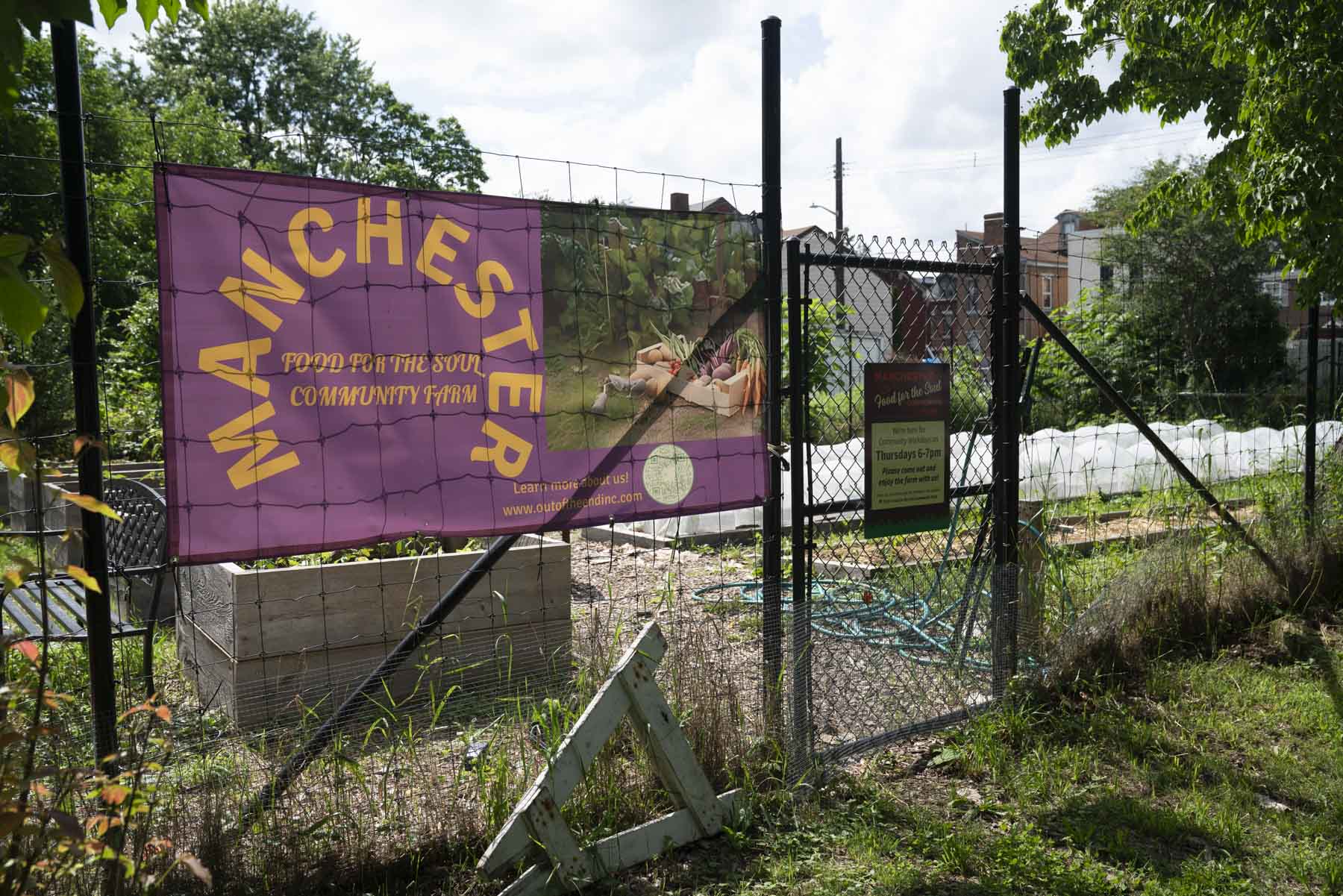
A community garden on the North Side may lose its land to a housing development. The city councilor who urged the pause says there’s still hope for compromise.
“PublicSource is an independent nonprofit newsroom serving the Pittsburgh region. Sign up for our free newsletters.”
A last-minute motion from a city official has stalled a path forward for a Manchester community garden seeking to buy the land it cultivates, leaving its future uncertain weeks before its lease expires and a competing affordable housing plan could advance on the site.
Last Friday, the Pittsburgh Land Bank board considered buying the lots on Fulton Street from two city entities and then selling them to Ebony Evans, who runs the Food For the Soul Community Garden. The garden’s current lease with the city expires at the end of July.
The land bank sale would have stopped a plan for a housing development on the site and allowed the garden to remain. During the land bank meeting, dozens of city residents called in to voice their support for the sale.
Board member and City Councilor Daniel Lavelle pushed instead to delay a decision, in what he described as an effort to negotiate a deal between Evans and a community organization called the Manchester Citizens Corporation [MCC]. LaShawn Burton-Faulk, who runs MCC, previously stated there are other places for the community garden, and the housing development is more urgently needed.
“I would ask for members not to support this today,” said Lavelle, who represents the Manchester neighborhood.
Lavelle said the Urban Redevelopment Authority, which owns some of the land the garden sits on, should take the issue up first before the land bank takes a vote.
“What all the commenters never stated was, yes, when Evans took over it was clearly stated that this was a temporary lease for the land,” Lavelle said. “Housing was always supposed to go on this site. Unfortunately COVID-19 hit and put a pause.”
Lavelle then asked his fellow board members to vote against the sale of the land to Evans so that he could “convene all stakeholders,” including Evans and representatives of the proposed housing development, to ask: “Can the two really coexist and design housing that incorporates a garden?”
He said he hopes to reach an agreement where all parties get what they need regarding housing and gardening goals.
Lavelle didn’t immediately return a request for comment this week about meeting details or other next steps.
In a prepared statement, Burton-Faulk said Manchester Citizens Corporation [MCC] invested more than $80,000 in the garden site for “architectural, engineering, and pre-development services tied to the development of deeply affordable housing.”
She noted that the site is needed for affordable housing in order to follow the Manchester-Chateau Neighborhood Plan’s call for an equal amount of affordable housing and market rate units.
Burton-Faulk also noted that the garden’s lease is set to expire next month
“At the time of signing, it was clearly understood that the site would be repurposed in the future for housing. Despite MCC’s efforts to offer meaningful alternatives that would preserve the gardening mission, Ms. Evans declined. We reiterate: no one should be forced to choose between food access and affordable housing,” Burton-Faulk wrote.
The garden’s role in Manchester
The Food for the Soul Community Garden opened in 2021 with help from the Adopt-A-Lot program of the Urban Redevelopment Authority [URA] and the City of Pittsburgh.

“Back in the ’90s whenever I was a teenager, young girl, Manchester was full of crime and drug abuse,” Evans said during the board meeting, recalling a fight with shots fired she witnessed on the current garden site that scared her away from the neighborhood.
She told the board she was approached by a community member in 2020 to start the garden.
“I met the new Manchester and the old Manchester, and what I saw was a lot of friction at first going on,” Evans said. “I saw such community being built there, it became more than a garden. I saw friends. I saw families. I saw so many people coming into this space and loving on one another and learning how to grow food. It has been that ever since.”
Evans told the board that since opening, the garden has provided more than 12,000 pounds of food to the community and various organizations in the city.
Last year, Evans said she was informed by the city that the garden’s lease would not be renewed after it expires.
In a previous interview, Burton-Faulk said the Food for the Soul Community Garden is on a site that was slated for a new affordable residential building prior to the pandemic.
Burton-Faulk said plans to create housing for people making 30% of the area median income or less were halted by COVID-19. Details on the planned housing development have not been finalized and there are multiple versions still to be considered, according to Burton-Faulk.
Last year, a petition began to circulate and eventually garnered more than a thousand signatories calling for the city and Pittsburgh Land Bank to protect the garden.
A number of community members called on the Land bank to approve the sale to Evans at last week’s meeting and since.
“We’re here to once again advocate for Farmer Girl Eb,” as Evans is known, said Raqueeb Bey, founder and executive director of the Black Urban Gardeners and Farmers of Pittsburgh Co-op. “She is an urban farmer and food justice advocate. She is an educator who has helped and led to change the face of urban agriculture here in Pittsburgh with holistic programs that expand beyond our bridges. This profound program on the North Side is necessary for the continued growth of urban farming in our city.”
Bey said that the urban garden aligns with Burton-Faulk’s strategic plan for the neighborhood by promoting environmental justice, green space and healthy communities. “Let’s stick to that plan because this is what Food for the Soul urban farm has been doing for the last five years.”

Lisa Freeman, founder and owner of the Freeman Family Farm Store who had her own adversarial encounters with the MCC and Burton-Faulk, responded to the land bank’s deferred decision with a statement calling for an audit into Lavelle and Burton-Faulk’s involvement in public land deals, among other demands.
“We are done begging for justice. Farmer Girl Eb, a Black woman, a land steward, and a protector of her people, has been shut out of public land access by two of the most powerful political players in this city,” Freeman said in her statement.
Elaina Brown, a representative of the Pittsburgh Food Policy Council, said at last week’s meeting that the farm has become a “vital third space.”
“This garden is deeply rooted and a community-led effort that addresses food insecurity, wellness and equity head on,” Brown said.
Fate of the farm
Lavelle’s motion gained enough votes to deny the sale of the land to Evans. Three of the eight board members opposed Lavelle’s motion.
“It’s kind of embarrassing that Ms. Evans and her supporters and volunteers have had to do so much to convince people that this is the right thing to do,” said Tammy Thompson, a land bank board member and a housing justice advocate. “It’s getting very close to the date of the end of the lease. I don’t think it’s fair to leave this in limbo.”

Lavelle said he will try to convene a meeting with all parties involved. The issue is scheduled to come back to the land bank board for a vote when it next convenes, which will be held after the lease ends.
“This is probably a two-month long conversation working through the various dynamics at place here,” Lavelle said.
Eric Jankiewicz is PublicSource’s economic development reporter and can be reached at ericj@publicsource.org or on Twitter @ericjankiewicz.
This story was fact-checked by Hannah Johansson.
This article first appeared on PublicSource and is republished here under a Creative Commons Attribution-NoDerivatives 4.0 International License.
About Post Author
