Mayor Ed Gainey speaks to Kendall Pelling, executive director of Rising Tide Partners, during an event showing the progress made in redeveloping homes in East Hills on June 13. (Photo by Caleb Kaufman/PublicSource)
Nonprofit Rising Tide Partners aims to transform a neglected East Hills block by acquiring, stabilizing and rehabbing 22 homes. If more funding solidifies, those plans could encompass 33 more — all at below market rates.
“PublicSource is an independent nonprofit newsroom serving the Pittsburgh region. Sign up for our free newsletters.”
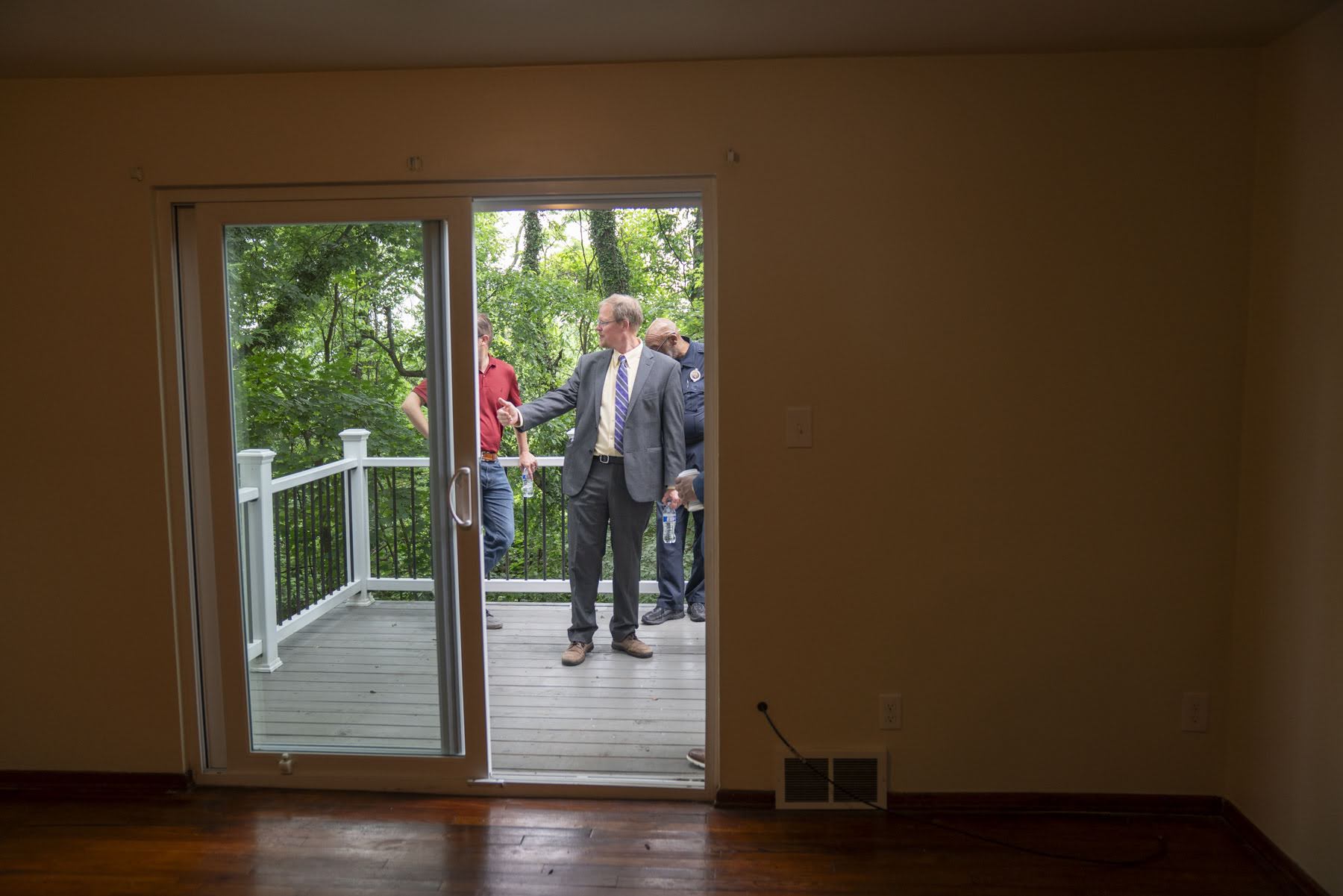
 Ross Kronenbitter, the construction manager for Rising Tide Partners, holds open the door for people to enter a recently rennovated home in East Hills on Friday, June 13, 2025. (Photo by Caleb Kaufman/PublicSource)
The nonprofit development group, along with community stakeholders, recently celebrated the house as the first completed rehab in an effort to revitalize the block and create 22 units of affordable housing. That could extend to 33 more units if $12 million in PA Housing Finance Agency funding comes through.
Those additional units would be rented on a 15-year lease with mortgages as low as $650 to $700 a month available to tenants at the end of the term, Pelling said.
Strengthening homeownership
The project aims to revitalize the neighborhood as a homeownership community — the same goal that spurred its original construction in the 1960s, Pelling said. That means, for one, supporting The East Hills Homeowners Association by offsetting maintenance costs and including them as a partner on Rising Tide’s neighborhood development board.
Patricia Madison of the Homeowners Association lived on Park Hill for three decades. In the changing neighborhood, where some lots house abandoned cars and others are littered with old toys, Madison said absentee landlords are a major agent of decline.
“The main problem is people having properties and not taking care of it,” said Madison, who hopes to see more resident appreciation and “people come in who take pride in their homes, who take pride in their communities.”
The HOA was created to share maintenance efforts across the community, but when dues-paying members dwindled, it wasn’t able to keep up with costs. Recently, though, membership jumped from 13 to about 100, Pelling said. Madison hopes it will spur more attendance at the annual HOA meetings.
The way to lift a neighborhood where many residents can’t afford to pay monthly dues, Pelling said, is to lighten the financial burden of maintenance and development costs. The average median income in East Hills was less than half of the City of Pittsburgh’s average median income, according to the 2022 East Hills Community Visioning Plan.
“If we want to prevent displacement, we need to protect people where they actually live because that’s where you get displaced from,” Pelling said.
The Park Hill Drive project has already received $6.7 million in combined funding, according to Pelling, including pre-development loans from the Urban Redevelopment Authority and a Local Share Account grant from the City of Pittsburgh.
From rot to revitalized
The revitalization project, which began in 2019 with an initial $37,000 planning loan from the URA, has now actualized some of its goals to gain site control and renovate abandoned properties, including ones that caused damage to neighboring occupied homes.
Initial redevelopment funds went toward fixing leaking, collapsed roofs, gutters, broken windows and other structural issues.
Between regular maintenance calls, Rising Tide construction manager Ross Kronenbitter and his team were able to finish the renovations on one unit, which is now move-in ready, and are nearing completion on another.
“It took a year, but it … is insulated, all new doors and windows, all new heating and air conditioning,” Kronenbitter said, standing in one of the renovated upstairs rooms of 2413 Park Hill Drive.
Diane Daniels, executive director of the East Hills Consensus Group, approves of the changes to the neighborhood: new residents, increased homeownership, new ideas and support to current residents.
“I think the strength of the whole situation is that collaboration and resources,” Daniels said. “We have been a forgotten neighborhood through so many administrations … what we’re doing now, it’s bringing some … positive notoriety to East Hills.”
Rising Tide, which now controls about half of the 176 properties on Park Hill Drive, acquired site control of some houses through conservatorship — a process that grants a non-owner party legal domain over a property. Many houses were also bought from absentee landlords, Pelling said.
“We can now say that all the abandoned properties in this community are under our control
and they’re under roof,” Pelling said.

Stephen Catarinella, whose father originally built many of the structures, remembers his great uncle, a slim Italian cigar hanging from his mouth, walking to the East Hills shopping center — the crown jewel of the community. His grandparents lived on Park Hill when it was a lively neighborhood.
In recent decades, the once-thriving neighborhood began to experience decline. Properties went vacant and stayed that way, succumbing to rot, PublicSource reported in 2021.
Catarinella inherited eight properties from his father, which he later sold to Rising Tide. He said the changes were a long time coming, joking that they didn’t have granite countertops when he owned them.
The second total renovation, 2415 Park Hill, is nearly ready to move in and will be available for rent through Section 8. Pelling said plans to improve the neighborhood’s overall infrastructure, including road repairs and turning the street’s main parking lot into a hub for the HOA, are key to ensuring lasting change.
“You can’t sell someone a house and then leave them by themselves,” he said.
Ember Duke, a PublicSource editorial intern, is a recent graduate of Duquesne University and one of 10 Pittsburgh Media Partnership summer interns. She can be reached at ember@publicsource.org.
This story was fact-checked by Femi Horrall.
This article first appeared on PublicSource and is republished here under a Creative Commons Attribution-NoDerivatives 4.0 International License.
About Post Author
