
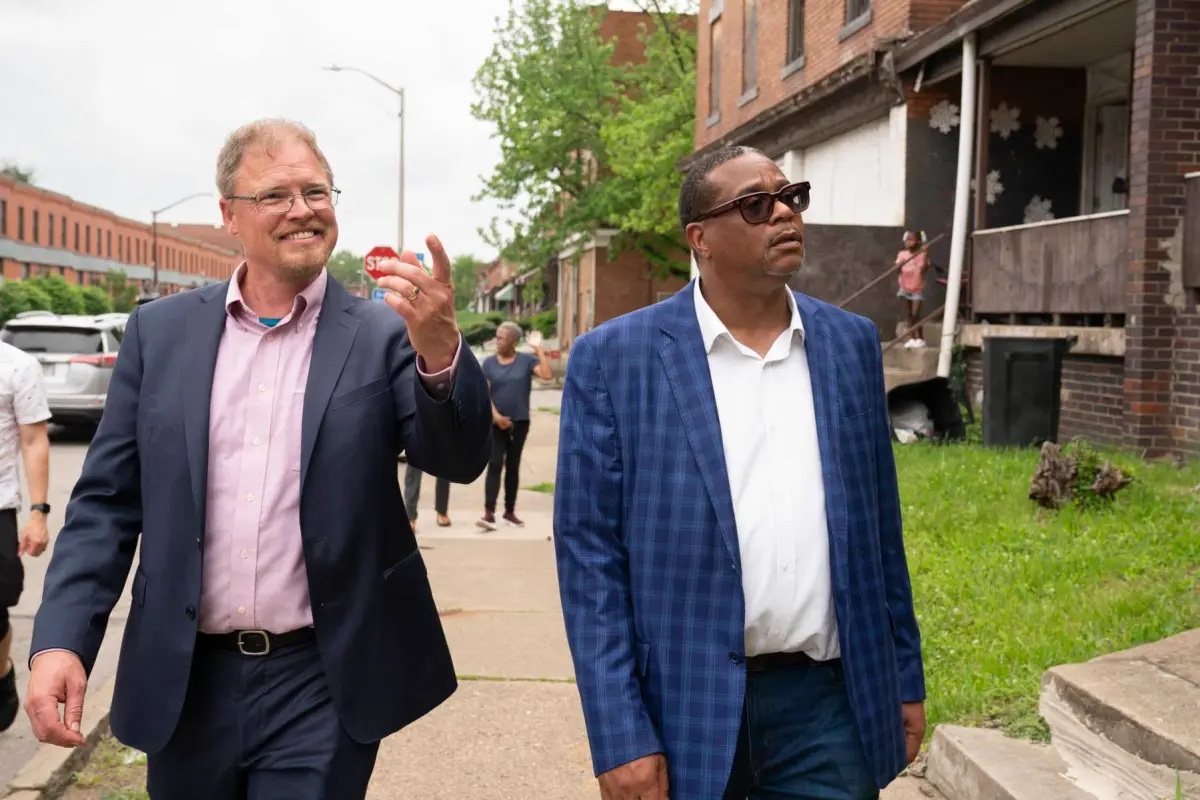
Kendall Pelling, executive director of Rising Tide Partners, leads Mayor Ed Gainey, reporters, and community members on a tour of properties that are to be renovated by his nonprofit on Friday, May 16, 2025, in Homewood. (Photo by Caleb Kaufman/PublicSource)
Six blocks of Hamilton Avenue could see 100 new homes, but the road from disinvestment to redevelopment has been complex — and it isn’t over.
“PublicSource is an independent nonprofit newsroom serving the Pittsburgh region. Sign up for our free newsletters.”
Dozens of houses on Hamilton Avenue in Homewood sit vacated and decaying, their windows smashed, wooden porches splintering and lawns overgrown — as they have for at least two decades.
It wasn’t like that, however, when resident Amber Sloan grew up in the area. She remembers block parties and people sitting out on their porches talking to neighbors. Now, the population has dwindled and the properties have become an eyesore, community group leaders said.
Sloan hopes a new housing redevelopment project, led by nonprofit Rising Tide Partners, will return a spirit of community to the area. The project has the potential to fix up approximately 100 units in Homewood. During a sunny, mid-May event on Hamilton Avenue that celebrated the start of property stabilization, community group leaders said it’s a step toward restoration.
“It would be a lovely thing to see homes open up,” Sloan said.


Rising Tide Homewood LLC, a subsidiary of the citywide nonprofit, now controls 93 properties in Homewood as part of this effort, and is starting revitalization efforts to make houses habitable for current residents and newcomers, Executive Director Kendall Pelling said.
The redevelopment comes after a three-year struggle for site control which began as a bid for conservatorship over the properties and ended with Rising Tide buying them after the California-based owner filed for bankruptcy.
Rising Tide needs roughly $1 million more in pre-development funding — some of which it has applied for through the Urban Redevelopment Authority.
Long-term development is modeled after the Homewood Comprehensive Community Plan, designed through a collaboration between several community organizations.
The subsidiary ownership was designed to involve the community in every step of the process, Pelling said, standing on the front steps of a home on Hamilton Avenue during the launch event. The subsidiary’s board includes two community representatives.
While the goal is to bolster housing for all income levels in the area, the community plan prioritizes affordable housing options, Pelling said.
Long road to a new Hamilton Avenue
Rising Tide received a $1 million loan from Bridgeway Capital, an investment company focused on underserved areas, to buy a portfolio of 46 properties from a California-based realty company. Another $500,000 from the Neighborhood Community Development Fund went toward acquiring 44 privately-owned structures, demolishing 19 vacant buildings and clearing 27 vacant lots, said Mark Masterson, the fund’s executive director.
All properties Rising Tide has acquired will need to be completely gutted and some will have to be demolished, Pelling said.
“Several properties have rear brick walls that are coming apart … because they’ve been allowed to be wet for the last two decades,” he said. “The city has already torn down a lot of these properties because they became hazardous.”

In the first redevelopment phase, nonprofit Pennsylvania Affordable Housing Corporation will renovate 20 units in a housing complex on El Court starting in late summer.
The development team will need to submit applications for financing for each phase, said Pelling, “so it’s going to be a multi-year process.”
Rising Tide is also in the process of buying approximately 38 lots on and around Hamilton Avenue through the Pittsburgh Land Bank, but the final sale number is still in flux as some lots have structures which might not be available for acquisition, said Sally Stadelman, land bank manager.
Rising Tide and community partners are vetting future developers for the Hamilton Avenue and nearby properties through a request for proposals, which has already received seven responses.
A major roadblock for large-scale redevelopment is site control, Pelling said on a neighborhood walk, pointing out several Rising Tide-owned houses which couldn’t be demolished due to their shared construction with publicly owned structures.
Hope … and conservatorship cases
Laier-Rayshon Smith, housing and development coordinator for Operation Better Block, which hears community feedback at monthly public meetings, said he is “hoping to see these properties redeveloped into something that is useful for the community … We would love to see more homeowners moving into Homewood as well.”
Rising Tide originally sought to manage many of the properties through conservatorship — a legal process which allows an outside party to maintain a property if the owner has let it fall into disrepair. The original owners, RFS Investments LLC, however, filed bankruptcy three weeks after a court granted conservatorship. Rising Tide had to buy them out to acquire site control. The bankruptcy case was closed in February 2024.
Seven tenants occupied properties when Rising Tide acquired them. The non-profit has relocated two occupants into one of its other Homewood properties, which has already been refurbished, and is in the process of evicting two others who didn’t communicate with property management, Pelling said.
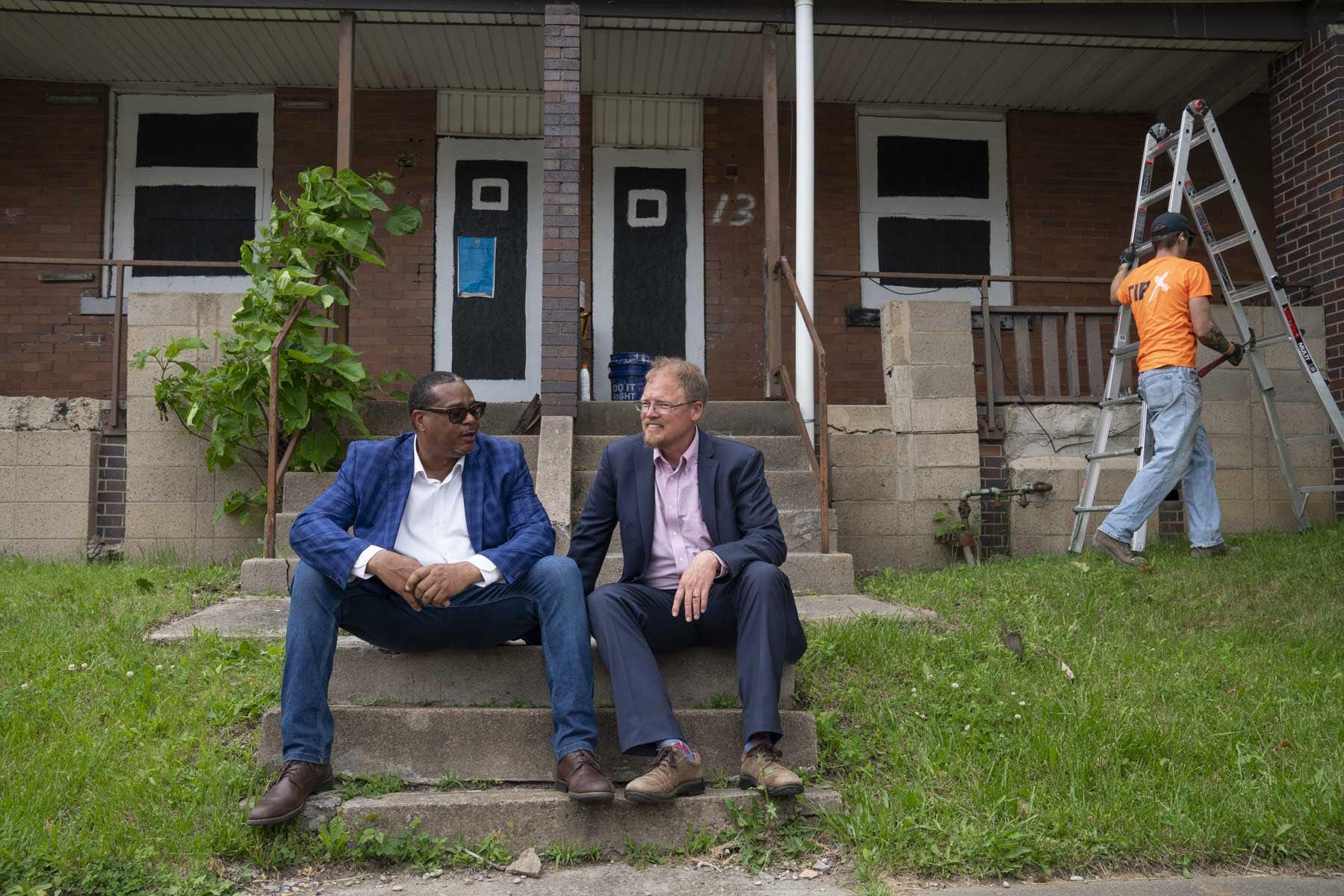
Jay Gilmer, executive director of OBB, said run-down housing pushes people out of the neighborhood and can perpetuate violence in the community.
“It takes away people’s hope,” Gilmer said.
The redevelopment project is the “best chance” at improvement, he said.
Even inhabited homes bear the burden of the disinvested ones. Michelle Thaxton, whose Kelly Street home — just two streets away from Hamilton Avenue — is sandwiched between two uninhabitable houses, said animals, such as groundhogs, skunks and possums, run rampant on her property. She’s lived in Homewood for 55 years and watched the neighborhood fall into disrepair.
But she’s not going anywhere, she said. She is hopeful that the new development efforts will restore the area and plans to watch from her porch as her community is rebuilt.
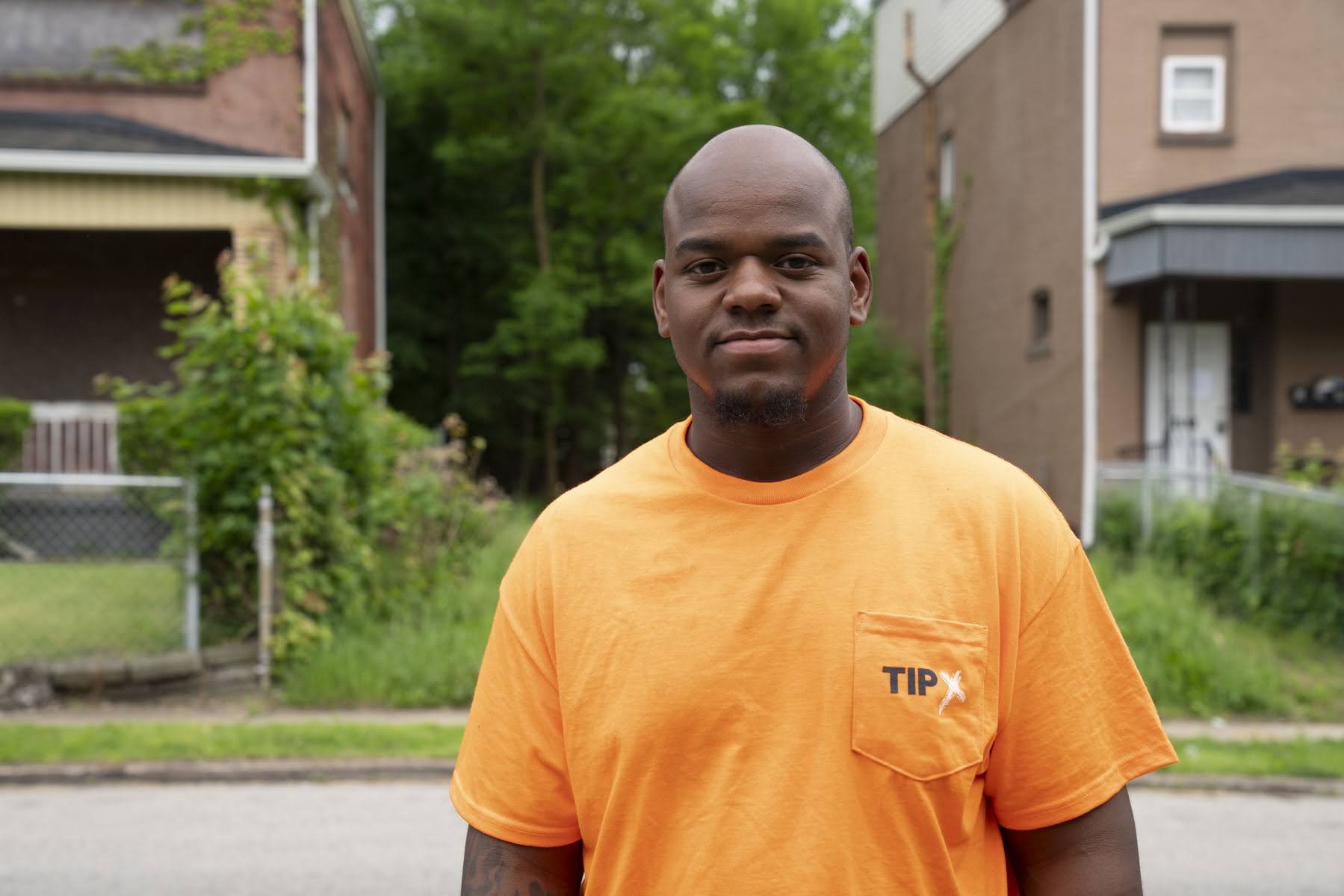
Initial efforts to clean yards, board up windows and make the properties less of an eyesore are being led by the Trade Institute of Pittsburgh. The institute employs students, some of whom are from Homewood or nearby areas, including Malik Minard, whose grandmother lives on the corner of Hamilton Avenue.
Minard said he always wanted to “give back as much as I can, the way I can,” and helping with stabilization was a way to do that for his community.
Walter Lewis, chair of the Homewood Community Development Collaborative, said the community couldn’t gather the resources for development by itself.
“If we do this [the] right way, there’s opportunities for everyone in Homewood to benefit,” Lewis said.
Ember Duke is an editorial intern at PublicSource through the Pittsburgh Media Partnership and can be reached at ember@publicsource.org.
This story was fact-checked by Rich Lord.
This article first appeared on PublicSource and is republished here under a Creative Commons Attribution-NoDerivatives 4.0 International License.

