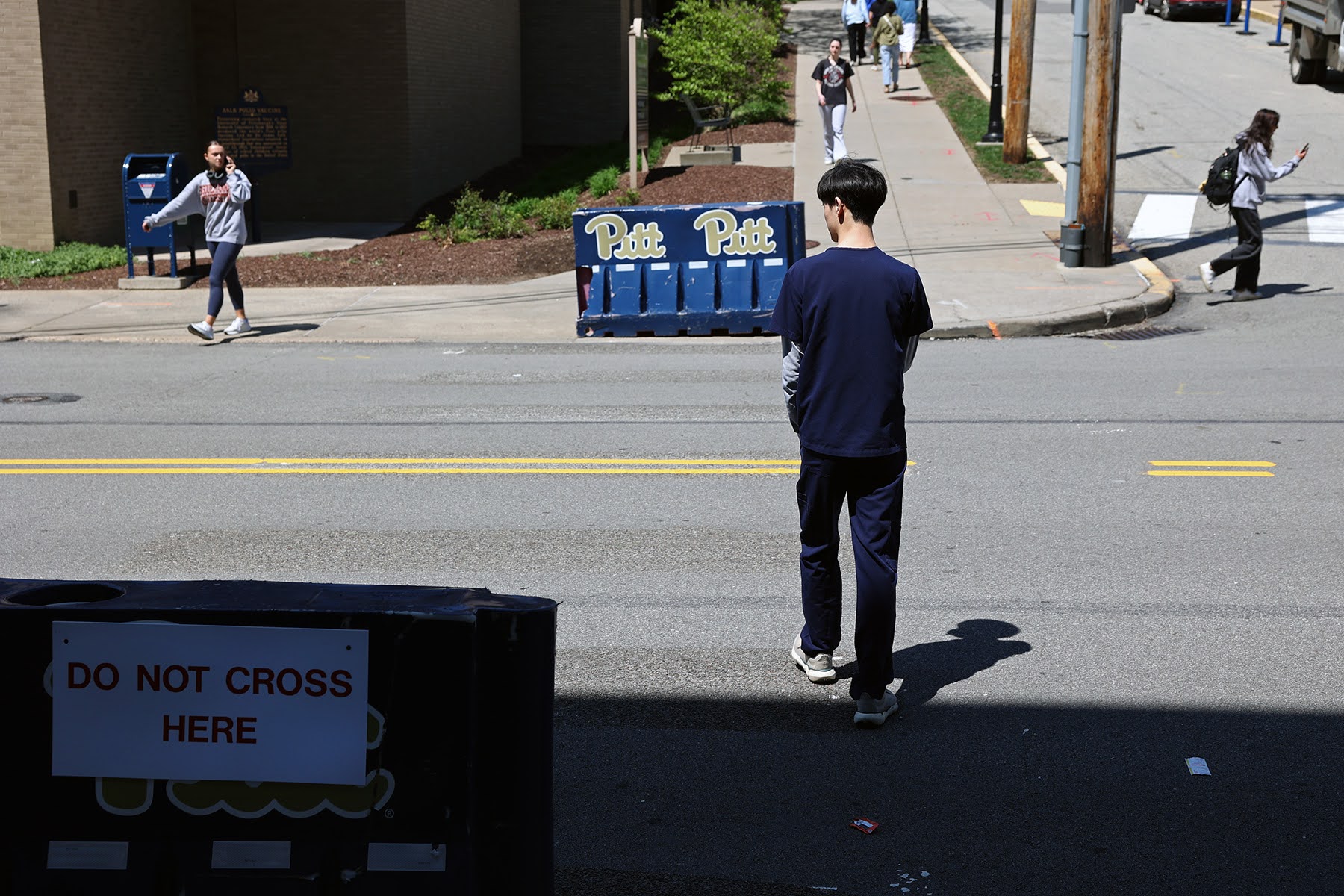
A person waits to cross Terrace Street on Wednesday, April 23, 2025, outside the University of Pittsburgh School of Medicine in West Oakland. (Photo by Anastasia Busby/PublicSource)
A city Fatal Crash Response Team identified fixes to Terrace Street in December, and four months later, some measures remain undone.
“PublicSource is an independent nonprofit newsroom serving the Pittsburgh region. Sign up for our free newsletters.”
Over the last two years, three pedestrians have been killed in the area, either hit by vehicles or construction debris. Following the third fatality in December, the city and Pitt began making changes to the corridor, but a full list of planned improvements and the timeline for completing them were never made public.
PublicSource obtained, through a records request, a document in an email sent to city officials and Pitt administrators that outlined several “action items” for the city’s Department of Mobility and Infrastructure [DOMI] and Pitt. These items were identified after a walkthrough conducted by the city’s Fatal Crash Response Team on Dec. 18, which some Pitt administrators also attended. The timeframe for implementation ranged from four weeks to “spring/summer 2025.”
!function(){“use strict”;window.addEventListener(“message”,(function(a){if(void 0!==a.data[“datawrapper-height”]){var e=document.querySelectorAll(“iframe”);for(var t in a.data[“datawrapper-height”])for(var r,i=0;r=e[i];i++)if(r.contentWindow===a.source){var d=a.data[“datawrapper-height”][t]+”px”;r.style.height=d}}}))}();
Progress reports by location
Asked about the progress of the items, DOMI spokesperson Jacob Williams said the department and Pitt were looking into a “more comprehensive project,” and he couldn’t provide details.
Pitt spokesperson Jared Stonesifer also did not answer questions about the progress of items in the document. Instead, he pointed to a safety study the university commissioned in June 2024 to identify potential improvements for the area. The study was finalized in February and shared with the city, which owns most of the streets in the corridor.
“While the city alone has authority to implement most of the safety recommendations,” Stonesifer said, these were shared in order to “support a mutual effort to improve safety.”
Recommendations in the study are broken into short-, mid- and long-term actions that would stretch into 2028, to be carried out by the university and/or its partners, including DOMI and UPMC.
Pitt did not respond to follow-up questions about the status of a collaboration between the three by publication time.
Most of the corridor changes made so far were identified in the document, though some that have taken effect were not. Pitt repainted curbs in restricted parking zones on Terrace Street and DOMI added a “cross traffic does not stop” sign at the Terrace-Sutherland Drive intersection.
Other planned updates not in the document include adding temporary posts to narrow the Terrace-Lothrop-Sutherland Drive intersection and changing a crosswalk so disabled individuals can utilize it. DOMI wrote that these would begin in early March, but they had not been conducted as of late April.
Darragh and Terrace streets proposed improvements
These action items were outlined in a Dec. 18 document that PublicSource obtained through a records request. Responsibility for implementation was split between the University of Pittsburgh and the city’s Department of Mobility and Infrastructure [DOMI]. Unclear items were omitted.
| Change red flashing lights to 24/7 “stop and go” | DOMI | January-February | Complete |
|---|---|---|---|
| Add “no turn on red” to all four approaches | DOMI | January-February | Complete |
| Include a three-second leading pedestrian interval | DOMI | January-February | Complete |
| Check and adjust “yellow, red and flashing don’t walk” signals | DOMI | January-February | Complete |
| Relocate UPMC shuttle stop | Pitt | January-February | Not complete |
| Relocate UPMC hospital signage | Pitt | Spring-summer | Not complete |
| Assess stop bar locations for turning vehicles on all four approaches | DOMI | Spring-summer | Unknown |
| Change pedestrian signals heads to newer countdown ones | DOMI | Spring-summer | Not complete |
The corridor, which includes parts of Terrace, Darragh, O’Hara, De Soto, Allequippa and Lothrop streets along with Sutherland Drive, has been described as dangerous and confusing — particularly at night.
Neil Cahill, president of the student infrastructure advocacy group Complete Streets at Pitt, said the area serves as a microcosm of “everything that occurs relating to traffic and transportation safety” — poor visibility, construction, pedestrians and a lot of traffic, including everything from emergency vehicles to shuttles.

“There is such a combination of factors and problems … that lead to unsafe conditions, but even with those conditions that currently exist, there can still be improvements that are made,” he said.
Members of Complete Streets at Pitt have been pushing for change on many of the streets in Oakland, and organized vigils for two of the pedestrians killed to raise awareness about Terrace Street. The group’s Vice President Jacob Evangelista, who also sits on the city’s Complete Streets Advisory Group, said he’s heard “countless complaints” about the area.
Last year, Pittsburgh joined the Vision Zero initiative — a movement to end traffic fatalities and injuries — and created a High Injury Network. This pinpointed roads that have seen large numbers of crashes and is used as a guide for decisions about where to invest in safety measures. Terrace Street and those within its corridor are not identified as a high-risk area by the network. DOMI did not respond when asked about the exclusion.
According to the network’s map, a road can have several crashes involving vulnerable road users — pedestrians, cyclists, mobility device users — but not meet the criteria for the network.
While reported crashes on the corridor may be lower than others in the city, “near-miss events occur frequently and are often unreported,” according to the report that Pitt commissioned.
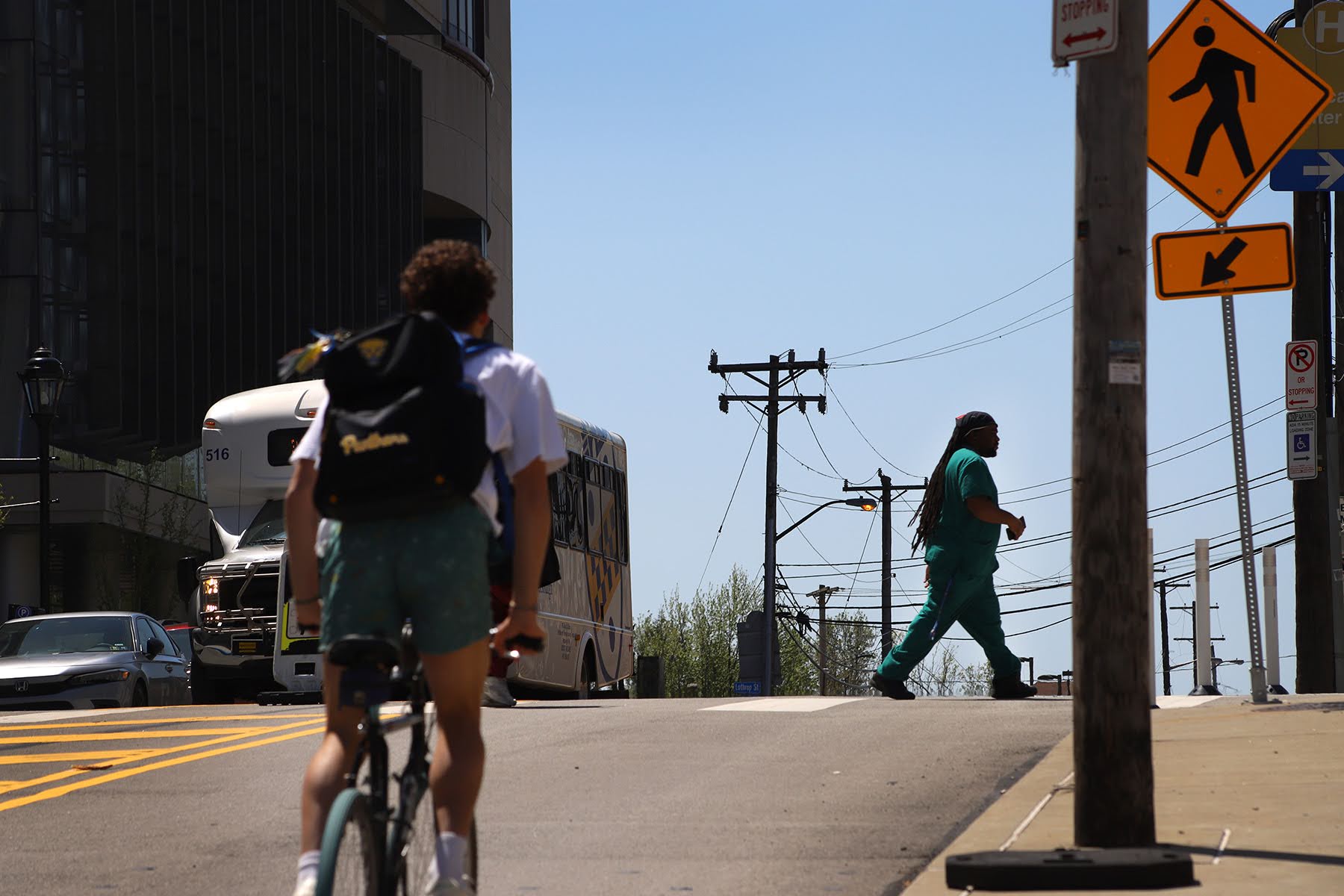
To Seth Bush, BikePGH’s advocacy manager, the fact that the corridor is not in the network despite multiple deaths is revealing.
“It’s a very high-volume area,” he said. Despite it not being listed as high-risk, “it still needs to be a priority and we need to continue making it a priority to make all streets safer — and really make it a priority to make them safer before people get killed.”
Bush, though, doesn’t think the onus falls solely on the city to create safe streets: “They can only do so much.” The problem is there aren’t enough resources, he said.
Sutherland Drive, Terrace and Lothrop streets proposed improvements
These action items were outlined in a Dec. 18 document that PublicSource obtained through a records request. Responsibility for implementation was split between the University of Pittsburgh and the city’s Department of Mobility and Infrastructure [DOMI]. Unclear items were omitted.
| Change to standard ‘T’ intersection with a reduction of one crosswalk | DOMI | January-February | Complete |
|---|---|---|---|
| Check that revised stop configurations works for AutoTURN software | Pitt | January-February | Unknown |
| Add “all-way” to stop signs | DOMI | January-February | Complete |
| Remove stop signs outside of the immediate ‘T’ intersection | DOMI | January-February | Complete |
| Paint and bollard curb extension “Pedestrian safety” project | Pitt for design, DOMI for construction | Spring-summer | Unknown |
The city’s 2024 budget allocated more than $14 million for street safety improvements. Mayor Ed Gainey said last month in the city’s year-one Vision Zero report that this was an “unprecedented level of investment,” which has continued into this year.
In the document PublicSource obtained, all of the mid-term proposed action items were marked as “budget pending.” Bush would like to see Pitt and the city work together to get the funding to implement all improvements.
Many of the changes made so far have been well-received by students, residents and staff, though some question their effectiveness. For instance, people walked around barriers meant to block off a now-removed crosswalk.
Terrace Street’s mid-block crossing proposed improvements
These action items were outlined in a Dec. 18 document that PublicSource obtained through a records request. It was sent to city officials and Pitt administrators, but the responsible party was not identified. Unclear items were omitted.
| Put flex post in painted extensions | Unknown | January-February | Complete |
|---|---|---|---|
| Add additional pedestrian crossing signs | Unknown | January-February | Complete |
| Add additional “no parking” signs as needed | Unknown | January-February | Unknown |
Monica Mehaffey, who lives near the corridor, called the changes a “helpful first step,” but they haven’t made her feel safer. Her home is on a street that feeds into Terrace, which she said is impacted by measures put in place in the area, but wasn’t included in the study Pitt commissioned.
The issues plaguing the corridor have decreased the standard of living for community members, Mehaffey said. And residents have been working to get the city and university to address them “for so many years,” largely to no avail.
“The community is just really tired.”
While Mehaffey said Pitt administrators have attended meetings held by the West Oakland Block Club, of which she is a member, residents don’t receive updates on construction projects or traffic changes spearheaded by the university. UPMC leaders also haven’t been in contact with the club, she said.

“I think we would just appreciate if there was some sort of inclusion of the downflow effect of their traffic decisions as it impacts our community,” she said.
UPMC did not respond to questions about collaborating with Pitt and the city on safety improvements or communication with West Oakland residents.
The mix of stakeholders in Oakland is precisely why Bush at BikePGH considers the neighborhood ripe for substantive safety changes. With meaningful interactions between them, he believes it could serve as an example for other parts of the city.
“There’s a long way to go to make Oakland a truly pedestrian- and bike-friendly community, but I think the ground is fertile,” Bush said.
Maddy Franklin reports on higher ed for PublicSource, in partnership with Open Campus, and can be reached at madison@publicsource.org.
This story was fact-checked by Amber Frantz.
This article first appeared on PublicSource and is republished here under a Creative Commons Attribution-NoDerivatives 4.0 International License.
About Post Author
