Trump, dejected? Canadian Prime Minister Mark Carney and U.S. President Donald Trump engage in a meeting at the White House in Washington, D.C., May 6, 2025. Carney reiterated to Trump that Canada ‘is not for sale … ever.’ THE CANADIAN PRESS/Adrian Wyld
by Stewart Prest, University of British Columbia
In a day of congenial menace at the White House, Canadian Prime Minister Mark Carney picked his spots carefully. He got his key message across — but got a largely unrelated earful in exchange from United States President Donald Trump.
A trip to the White House has become a rite of passage for leaders around the world, with a series of predictable elements in the Trump era — from the blindside on social media to the handshake and the tense sitdown in the newly gilded Oval Office.
Within the first few minutes of the meeting, Carney took an opportunity to interject with a clear pushback against Trump’s repeated assertions that Canada should become the “51st state.”
The comments were carefully calibrated, using Trump’s own preferred language of real estate. After pointing out that some properties simply are not for sale, like the White House and Buckingham Palace, Carney asserted that Canada “will not be for sale, ever.”
Carney to Trump: “There are some places that are never for sale … having met with the owners of Canada over the course of the campaign, it’s not for sale. It won’t be for sale ever.”
— Aaron Rupar (@atrupar.com) May 6, 2025 at 12:19 PM
Trump repeatedly demurred in response, replying “never say never” and later in the meeting, “time will tell.” Carney, however, mouthed “never” as the president spoke — ostensibly joking but, in fact, clearly serious.
Much of the rest of the meeting was dominated by Trump’s commentary, holding forth on everything from Carney’s recent election victory — for which the president claimed credit — to American attacks on Yemen and trade with China.
Carney didn’t bite
Without mentioning them by name, Trump also found time to remind the assembled media of his contempt for Carney’s predecessor, Justin Trudeau, and Canada’s former finance minister Chrystia Freeland — now handling the transport and internal trade portfolio for Carney — referring to her as “terrible.”
On USMCA, Trump goes after the previous Canadian government.
“I won’t say this about Mark, but I didn’t like his predecessor.”
He then calls Freeland (not naming her) “terrible.”
Carney responds that the U.S. has “taken advantage of existing aspects” of the deal.
“It’s going to have to change.”
— Rachel Gilmore (@rachelgilmore.bsky.social) May 6, 2025 at 1:47 PM
Carney didn’t take the bait, and for the most part, seemed content to let Trump hold court, interjecting a couple of times to correct or redirect points Trump raised.
In particular, Carney made clear that he sees the United States-Mexico-Canada trade agreement (USCMA) as a basis for future talks, committed Canada to a “step change” in its military investment and vowed to contribute to the president’s war on largely fictional fentanyl trafficking across the Canada-U.S. border.
Carney also pushed back against Trump’s insistence that the U.S. does not need Canada, noting that the country is America’s “biggest client.” He was alluding to the fact that Canada buys more goods from the U.S. than any other country.
Carney’s verbal pushback was further reinforced with some very effective face acting, reminiscent of Kamala Harris’s debate performance. The Carney head tilt seems destined to join the internet meme pantheon, a shortcut for “that’s sus” — “suspect” — that belongs to the ages.
Whatever else comes of today’s meeting, Carney’s head tilt will be with us forever—the newest edition to the pantheon of “that’s sus” memes.
— Stewart Prest (@stewartprest.ca) May 6, 2025 at 1:33 PM
At the same time, almost everything Carney did say was met with skepticism and rebuttal.
Indeed, the very idea of a new trade agreement and an end to tariffs on Canada was treated as an open question by Trump, who suggested that while USMCA was a “fine” agreement — miles better in his view than the very similar NAFTA agreement that preceded it — such a deal may no longer be needed.
At one point, he even suggested USMCA be terminated outright.
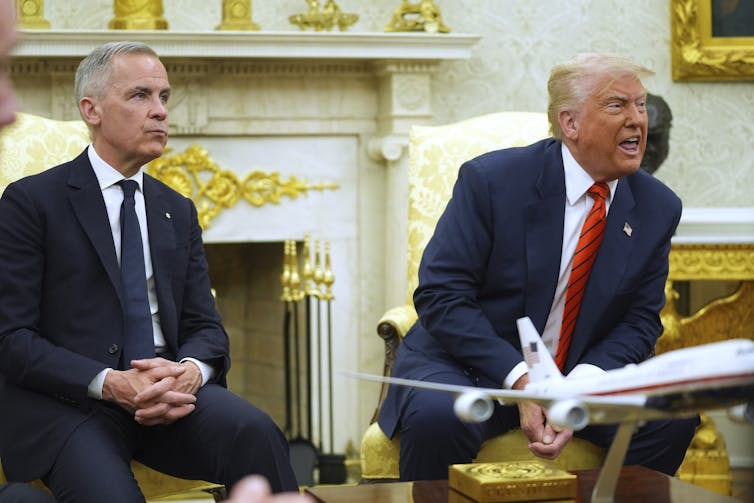
Prime Minister Mark Carney sits next to a sneering U.S. President Donald Trump in the Oval Office of the White House on May 6, 2025, in Washington, D.C. (AP Photo/Evan Vucci)
False claims
As always, misinformation featured prominently in the president’s comments throughout the meeting with Carney. He returned repeatedly to his false claims about the U.S. subsidizing Canada. In doing so, he again confused a trade deficit with a financial subsidy. These falsehoods, moreover, were never directly rebutted by Carney.
At another point, Trump said Canada could do nothing to convince him to remove tariffs.
He later expanded on the point, returning to the idea that tariffs on things like Canadian energy, steel, aluminium and cars were not part of a trade negotiation, but rather an explicit attempt to end trade between the two countries in an attempt to reindustrialize the American economy.
Simply put, under a thin veneer of supposed friendship and convivial conversation, Trump implied the U.S. no longer wants fair trade between the two countries, but no trade — unless it comes with an end to Canadian independence.
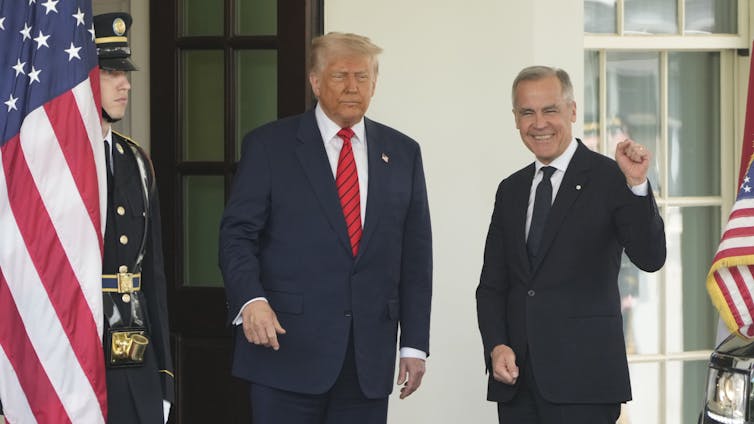
Prime Minister Mark Carney is greeted by U.S. President Donald Trump as he arrives at the West Wing of the White House on May 6, 2025, in Washington, D.C. (AP Photo/Mark Schiefelbein)
Given the importance of the bilateral relationship, the meeting went as well as Canadians — and sympathetic Americans — could reasonably hope. Trump and his assembled cabinet secretaries did not gang up on Carney as they did on Ukraine’s Volodymyr Zelenskyy earlier this year.
Instead, the meeting reinforced the idea that the two countries are indeed friends and they will continue to talk about the issues that divide them.
Carney came across as polite yet assertive, and was largely treated with the respect due to a foreign head of government.
Tariffs, trade
At the same time, the two sides could not even agree on what they disagreed on. Carney emphasized the need for a refurbished agreement between the two countries addressing trade irritants in much the same way the two countries have done for decades. He went so far as to point out that the U.S. has taken advantage of the agreement with its approach to tariffs.
Trump, conversely, remained committed to a project to fundamentally reorganize the American economy in a way that does not include Canada as an independent trading partner.
As the president said, “time will tell” whose vision ultimately triumphs. But in the meantime, Canadians should expect a decidedly frosty friendship to continue.
Stewart Prest, Lecturer, Political Science, University of British Columbia
This article is republished from The Conversation under a Creative Commons license. Read the original article.
About Post Author
