
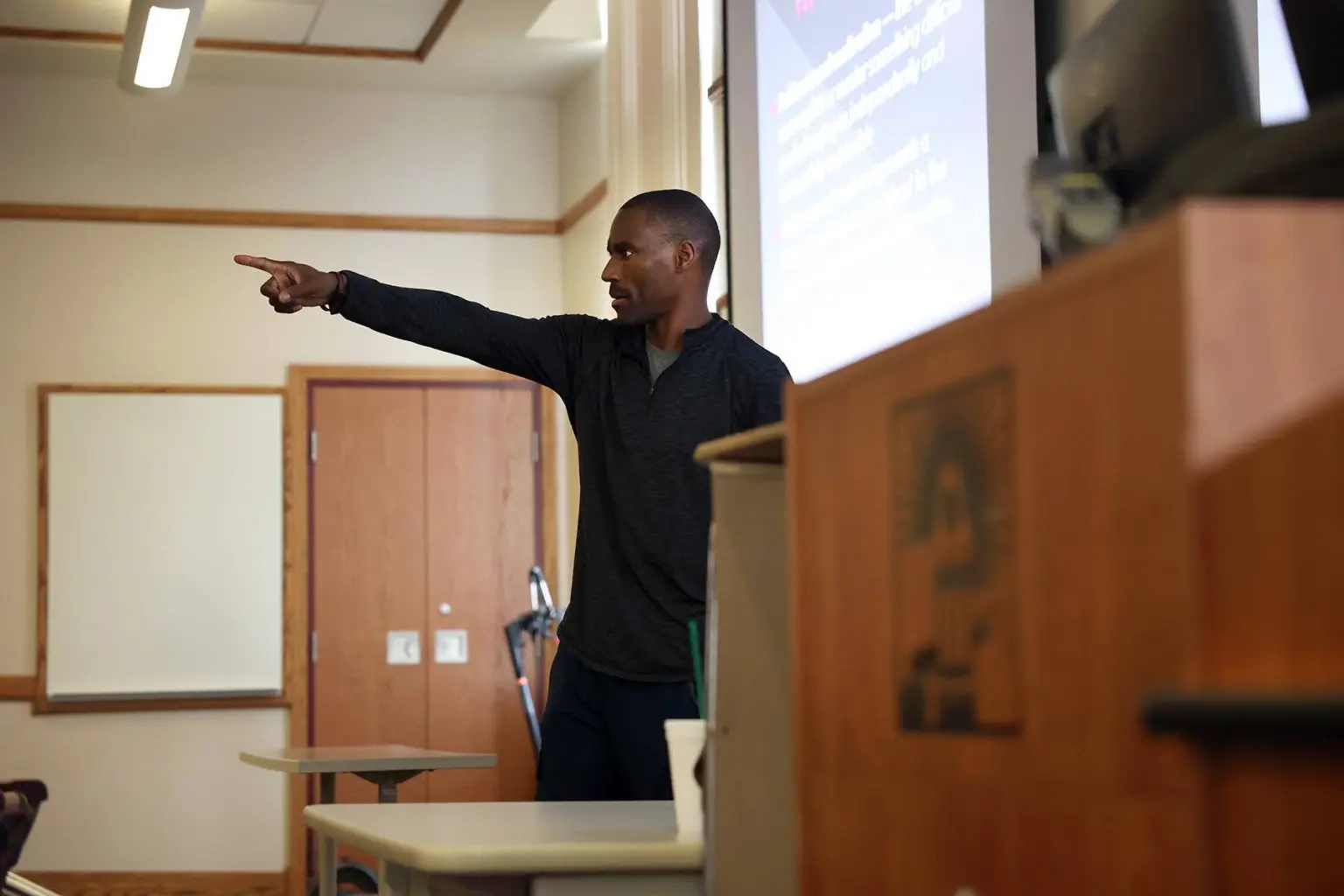
Dr. Rueben Brock calls on a student to speak on Wednesday, Feb. 26, 2025 at Pennsylvania Western University in California, Pennsylvania. (Photo by Anastasia Busby/PublicSource)
For young people with disabilities, one person saying “you can be somebody” can mean so much.
“PublicSource is an independent nonprofit newsroom serving the Pittsburgh region. Sign up for our free newsletters.”
When you’re “special,” there are many people who tell you what you can’t do, or roll their eyes at your dreams. If you’re lucky, there’s at least one person who does the opposite.
For me, it was Mom. I was in my 20s, still feeling my father’s suicide that shook our family when I was 7. From my teen years on, my life had slowly fallen apart. I had attempted suicide, but didn’t die — just spent a week in a hospital. I dropped out of college. I was going nowhere.
Sitting in the kitchen one day, Mom asked me: “So what do you want to do? What’s your plan?”
What I said to Mom was: “I want to be an expert. I want to be one of those people that news outlets call when they need a voice, who then appears when you turn on the television. I want to be one of them because I believe I could do that. I think I’m as smart as they are.”
Mom didn’t laugh or say it was pie in the sky. She said: “OK, then do it. Nobody can tell you not to. If that’s the life you want, go do it.”
Today I have a Ph.D. in psychology, a healthy practice focused on teens, a teaching position at Pennsylvania Western University (formerly California), a published book and a movie on the way. I get calls from reporters. So I guess I did it.
But what if something like that conversation had happened a decade earlier? How much time would I have saved? It’s not an academic question. There’s a point at which schools are required to have the “what’s your plan” conversation with any teenager with special needs.
‘Ornery’ or autistic?
At Washington High School, teachers would always say I was special. I never understood what that meant. What I have come to realize is that they could see in me a difference — something unique and interesting, that they couldn’t put their finger on. I had all this potential, but it didn’t always come out. I hated listening to anyone. I needed to do things my way. Sometimes I did the wrong thing just to see what would happen. I would refuse to do things when I didn’t see the point, but I didn’t lie about it. There was an honesty that sometimes veered into “ornery” territory.
In schools, stopping “ornery” behavior — rather than finding an individual’s best path forward — sometimes ends up being the focus.


Just a few weeks ago, I had a conversation with a school employee who told me a young student was getting aggressive and scratching people. The employee was asking: “What am I supposed to do to get him to stop?” And I said, “Well, why are you attempting to get him to stop? This child is nonverbal, but is communicating with you. Your goal should be to figure out what he’s communicating.”
I fundamentally believe that a lot of what we see in kids and adults that really, really struggle is their reaction to the fact that people around them aren’t listening, but are instead communicating that they’re useless, that they’re a burden, that they’re a problem. When you walk into a room and people are annoyed because you’re grunting or you can’t stop flapping and you see their furrowed brow, you recognize that. Even infants know what that furrowed brow means.
Today I understand that what teachers were seeing in me is now referred to as Level 1 Autism Spectrum Disorder. Back in the ’90s, no one identified it, no one diagnosed it. There was no recognition of a natural hurdle for me to get over. There was no individualized education plan, no accommodations, and no one sat me down and asked me what I wanted to do. I was diagnosed in 2020, decades after it could have informed my teachers.
Had my “special” nature been recognized and diagnosed earlier, I could have avoided a lot of issues. It wouldn’t have been so strange for me to ask for help with things. Maybe someone would have said: Well, shoot, what if we got him some help? Maybe it wouldn’t have taken me a decade to complete my bachelor’s degree — or if it still took that long, at least I would have had an explanation for my struggles!
Speak life into them and see what happens
Increasingly, we see how autism, ADHD and other neurological differences are gifts. You’re gifted with the ability to think outside the box. Does it come with some challenges? Of course it does. But what if we redefine the way we see it?
Autism reflects my strength and my challenges. You should see how focused I can be at times, especially if I’m doing something that interests me. Ask me to write a dissertation about a thing that I actually care about, and I’ll give you two. But ask me to write a short email on something that I see as silly or pointless, it’s going to take me four days when it might take someone else four minutes. That’s not an exaggeration — but it doesn’t make sense if you don’t understand autism.
Put us in the right environment and we’re going to be the best doggone fill-in-the-blank that you’ve ever seen. But I frequently see people talking about their young person, saying, “Wow, what are we going to get him to do? Can she do this?” You can see it in their eyes that they don’t have a lot of faith that this could go well.

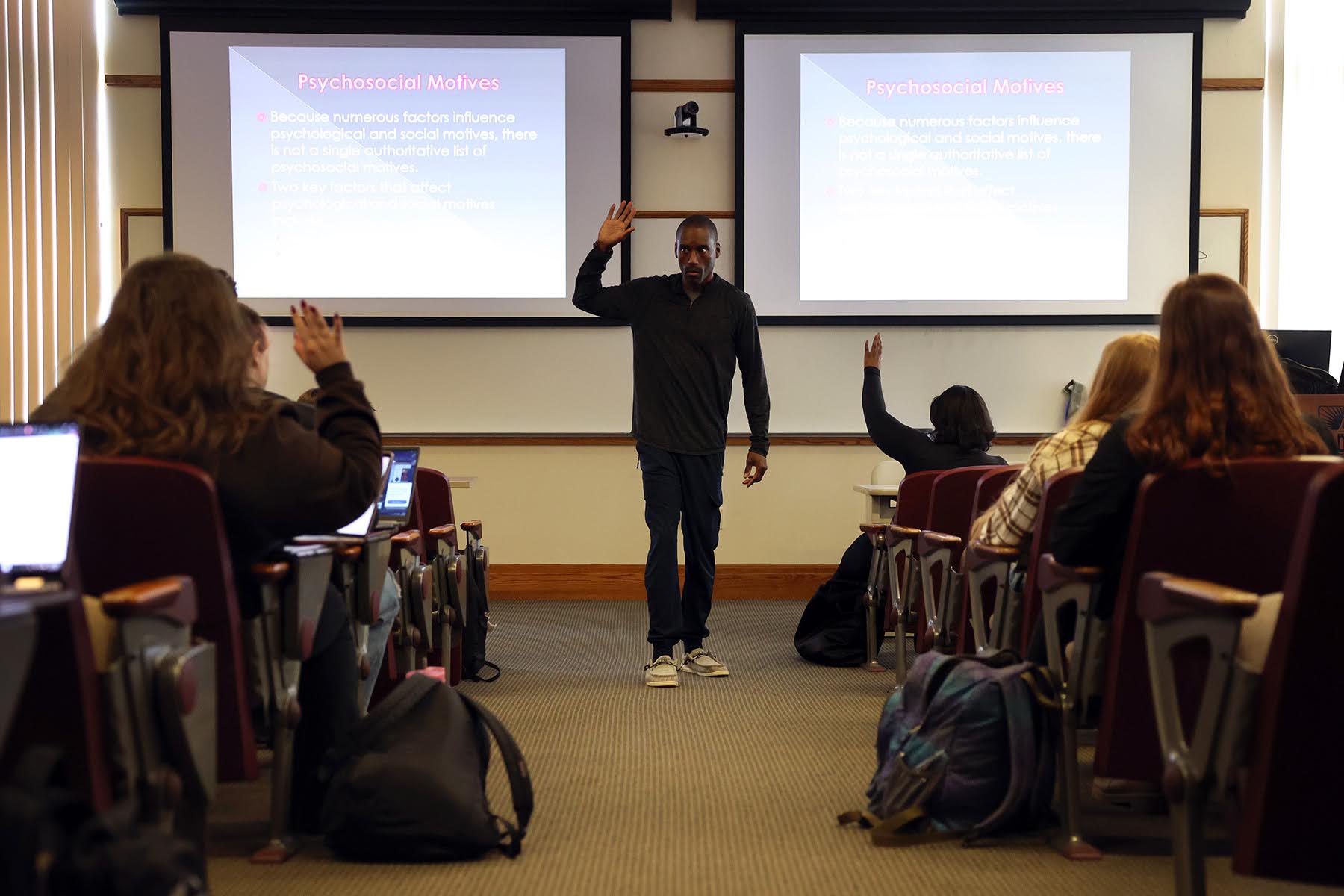
I’m saying: I don’t care what level they are. I don’t care what you see as their aptitude. You don’t know what they can do. Just speak life into them and see what happens. There’s no downside.
That’s not to say everybody is going to college or even going to work. If you’re level three autistic, it’s possible that you’re never going to hold a job, but you can have a fulfilling life. And I’ve seen young people working at McDonald’s, mopping the floor, loving it, happy-go-lucky. Maybe nobody else wants to mop the floor. In that situation, doesn’t everyone win?
What do you mean by ‘can’t’?
There was a point in my life when I was meeting the statistics. Poor, Black, small town, raised largely by one parent, I was living the life that they would say I should live. And for whatever reason, Mom said, “Get up and do it.” And I said, “Fine, then. I will.”
Now I’m in a position to be encouraging to people at that same age. In addition to teaching college kids at PennWest, I run a practice focused on teens, primarily assessing them for developmental or intellectual disabilities or delays. When I announced my presence in that space, I got flooded with calls from moms who said there was a yearlong waiting list for assessments at many offices.
When someone in my classroom or my office says they “can’t do it,” I have to stop them. If you know me, you now have to accept that anything is possible. It may very well be that the odds are so stacked against you that it feels ridiculous. But you can no longer say it’s not possible.
That said, there’s no reason to make it as difficult as it is for a lot of autistic people, and a lot of people with disabilities. We know how to build a wheelchair ramp to make it possible for people who are differently mobile to use sidewalks. We also know how to accommodate people who think differently. Every person is capable of something. What if we started to see it that way?
Rueben Brock is a professor of psychology at PennWest California (formerly California University of Pennsylvania) and a licensed counselor in private practice in McMurray. He’s a husband and father and resident of Washington County. He maintains an active presence on Facebook and can be reached by searching his name.
This article first appeared on PublicSource and is republished here under a Creative Commons license.

