
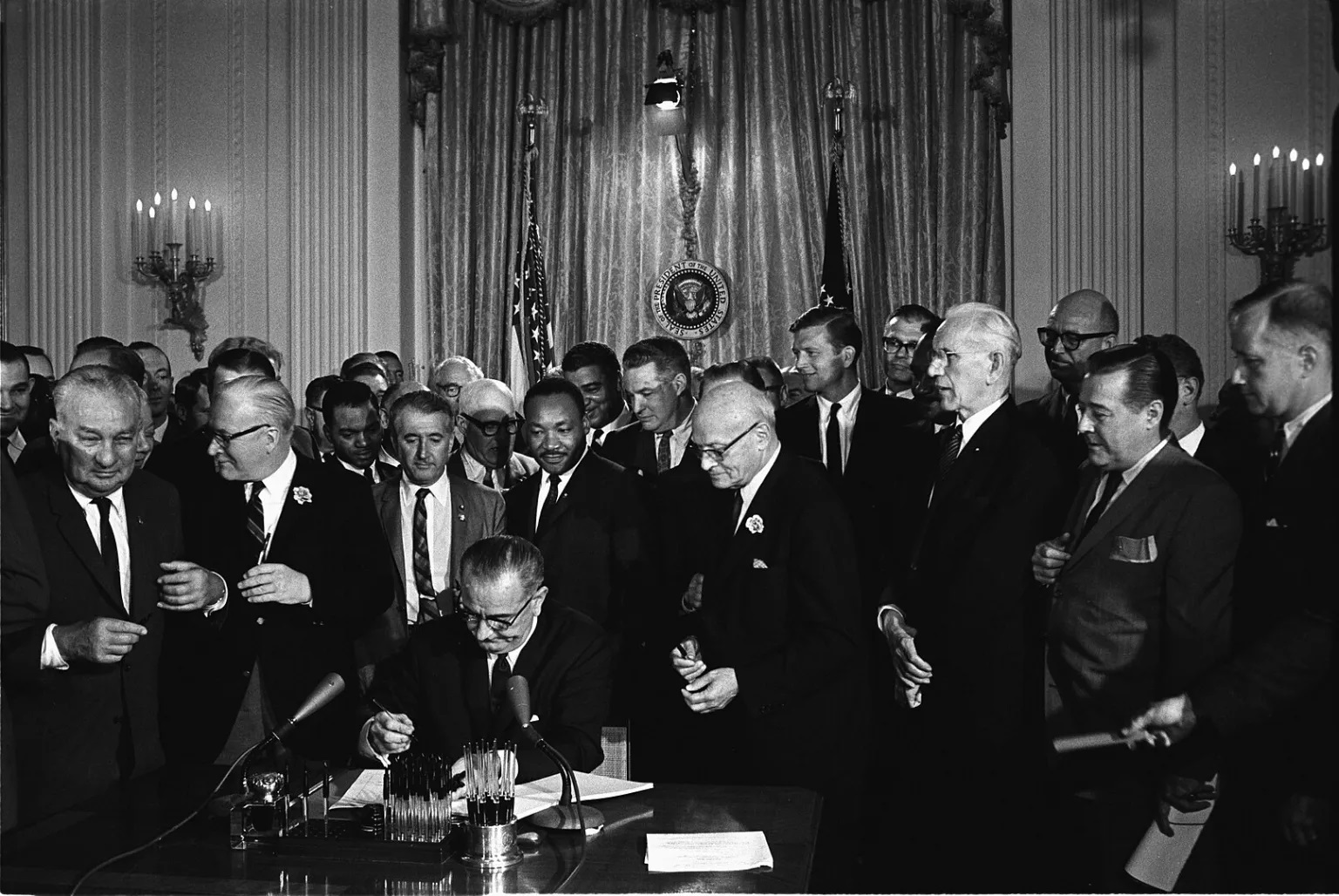
President Lyndon B. Johnson signs the Civil Rights Act of 1964 Credit: Public Domain photo
Thanks to a recent article by Johnathan Smith in “Poverty & Race,” a publication under the aegis of PRRAC (Poverty & Race Research Action Council), we are reminded that the Civil Rights Act of 1964 is now 60 years old. Smith’s focus on this landmark edict is on Title VI that declares that recipients of federal financial assistance cannot discriminate based on race, color or national origin.
Title VI, among several others discussed by Smith, is often referred to as the “Sleeping Giant,” that is, the unutilized potential of the ruling. “For decades, many civil rights advocates, especially in the environmental justice movement, have demanded that the federal government use Title VI more aggressively to address the discrimination and pollution impacting frontline communities and other communities that are most directly impacted by environmental harms,” Smith writes.
He then notes that in the aftermath of the killing of Michael Brown, George Floyd and Breonna Taylor, Title VI should have been utilized to hold law enforcement agencies accountable and withhold “funding from agencies involved in such conduct.”
The recent wave of protests on the nation’s campuses has also made Title VI a primary legal instrument, and another reason to awaken the Sleeping Giant. However, as Evelyn Douek and Genevieve Lakier of the Knight First Amendment Institute at Columbia University observe, the application of Title VI and how university administrators should respond to protests on campuses like the one that engulfed Columbia “is a difficult and contested question.”
“The Department of Education (DOE), which enforces Title VI, has made clear in its recent guidance that university administrators are right to be concerned about their Title VI liability if they fail to take what the department views as adequate steps to regulate how students speak to one another, not only one-on-one but when they engage in collective protest and symbolic action,” Douek and Lakier write. “The DOE has also launched over a dozen investigations into how universities responded to student protests over the past year and reached settlements with several universities over their handling of antisemitic or Islamophobic incidents on their campuses. And it has met privately with administrators at schools affected by student protests to advise them about their legal risks under Title VI.”
Smith cites the Department of Transportation (DOT) in his article and the steps it has taken to move creatively and to ensure compliance with Title VI. “But they only represent the beginning phases of a process under which federal agencies can reimagine how they use Title VI proactively and innovatively to work with their recipients and work to prevent discrimination. After 60 years, it is past time to wake up the sleeping giant,” he concludes.
Douek and Lakier warn that there is “good reason to worry that the DOE, in its recent efforts to enforce Title VI in the context of the campus protest movement, may be violating the important First Amendment rule against jawboning—that it may be leveraging its power to regulate discrimination on campuses to get universities to crack down on protected student and faculty speech by threatening them with legal sanctions or investigations if they do not comply.”
At the conclusion of their article, the writers insist that “more constraint and transparency are necessary to ensure that through its informal communications with universities about Title VI, the government does not end up doing an end run around First Amendment protections. The DOE’s mission to prevent discrimination in education is an important one, but it must be pursued within constitutional limits. The DOE should not undermine this important goal with enforcement efforts that threaten protected political expression.”
Obviously, much more needs to be said about the “Sleeping Giant” and “Jawboning” and we shall return.
(Reprinted from the New York Amsterdam News)