Wrestlers brawl near the crowd at the Brawl Under the Bridge on July 13, 2024.
After more than a century and a half of smackdowns, Pittsburgh’s professional wrestlers bring outsized personalities to epic matches in studios and under a bridge.
“PublicSource is an independent nonprofit newsroom serving the Pittsburgh region. Sign up for our free newsletters.”
Between the valleys of the Monongahela, Allegheny and Ohio, the roots of professional wrestling run deep.
Some of the earliest documented matches began in the 1870s, when factory workers slapped chests as a pastime at shift’s end along the riverbanks in McKeesport.
In the ’50s, studio wrestling brought national prominence to the local scene, forging Steel City stars like Bruno Sammartino, Domenic DiNucci and Jumping Johnny DeFazio.
Today, that act continues beneath bridges and above cemented city park plazas, along the resurgent streets of riverside steel towns and under the fluorescent lighting of American Legion halls.

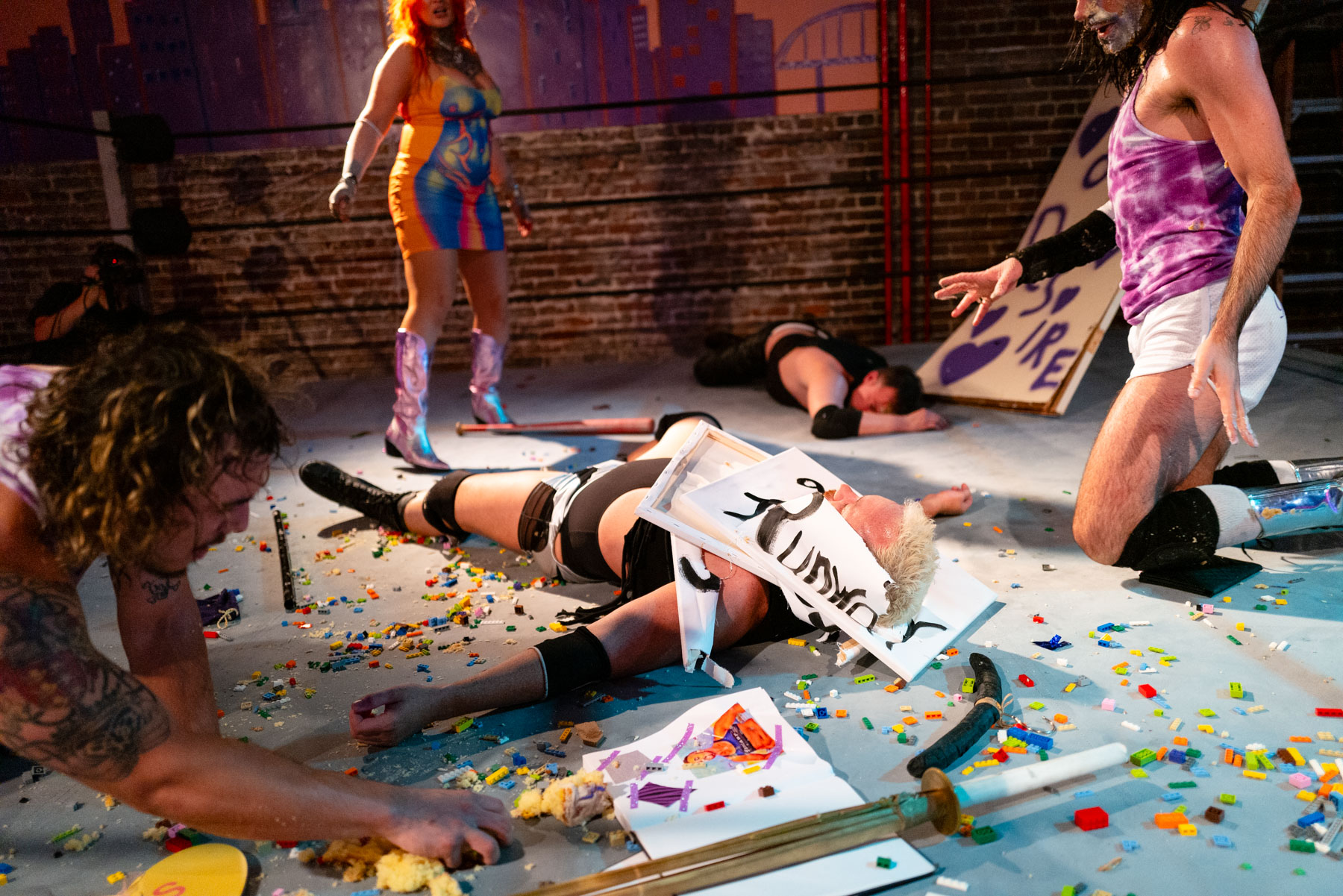
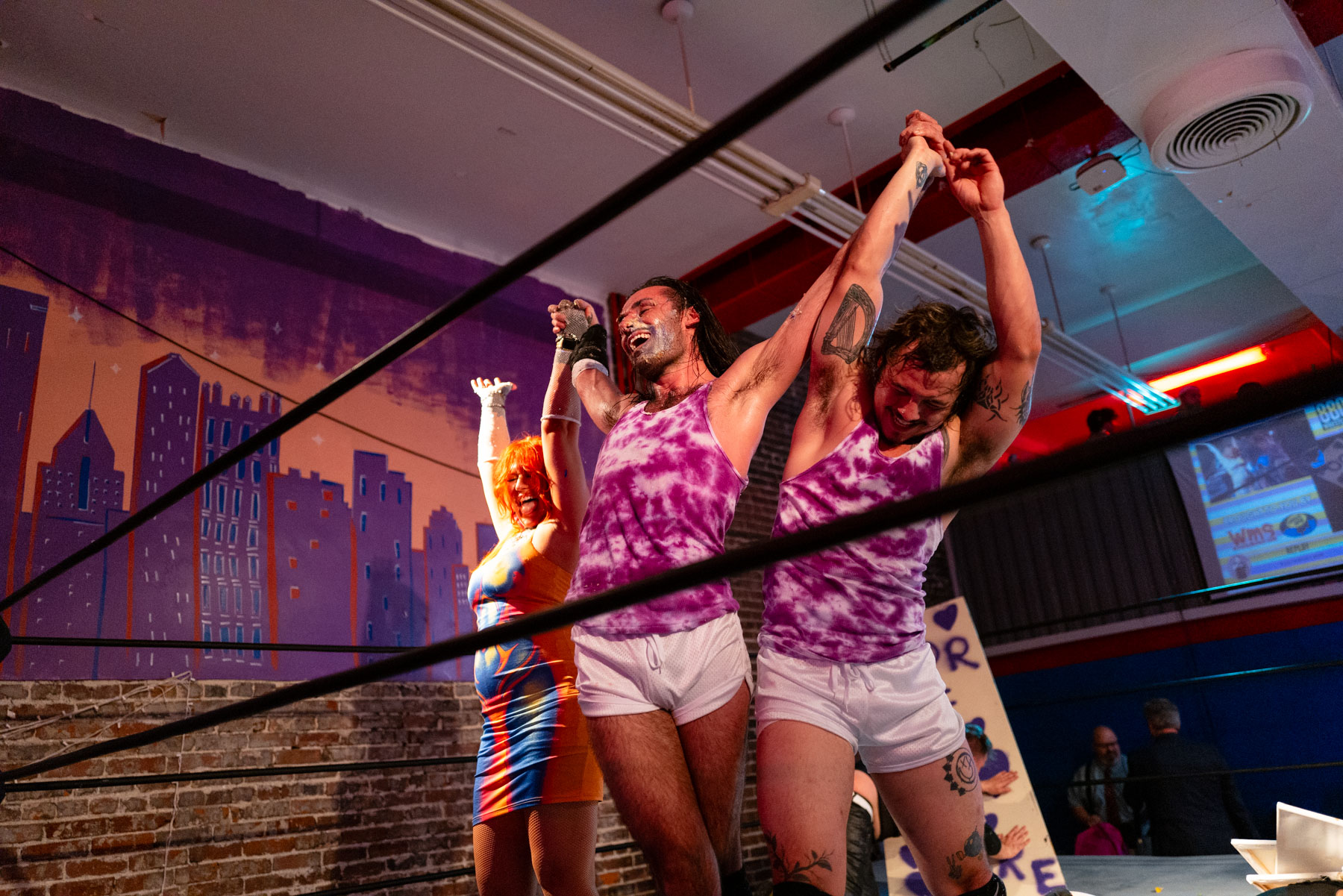
Behind the ropes, wrestlers leave their daytime identities behind, becoming someone — or something — entirely different.
Most go home with $40 at the end of the night, if they’re lucky.
The No. 1 rule? Never say it’s fake.
Despite showmanship and pageantry and hard-rocking walkout songs, spectators and performers say the craft is no less legitimate than other sports, requiring precision, practice and daring athleticism. The high-flying stunts and slapstick trauma are no less grueling.

Ringside on Saturday, July 13, “The Face of Pittsburgh” Lou Martin emerged from between the black curtains that veiled a makeshift tent locker room below the Homestead Grays Bridge.
Nearly 25 years ago, now 49-year-old Lou founded the Keystone State Wrestling Alliance [KSWA] with some friends. All the KSWA’s key figures say it’s the longest running independent pro-wrestling promotion in Western Pennsylvania.
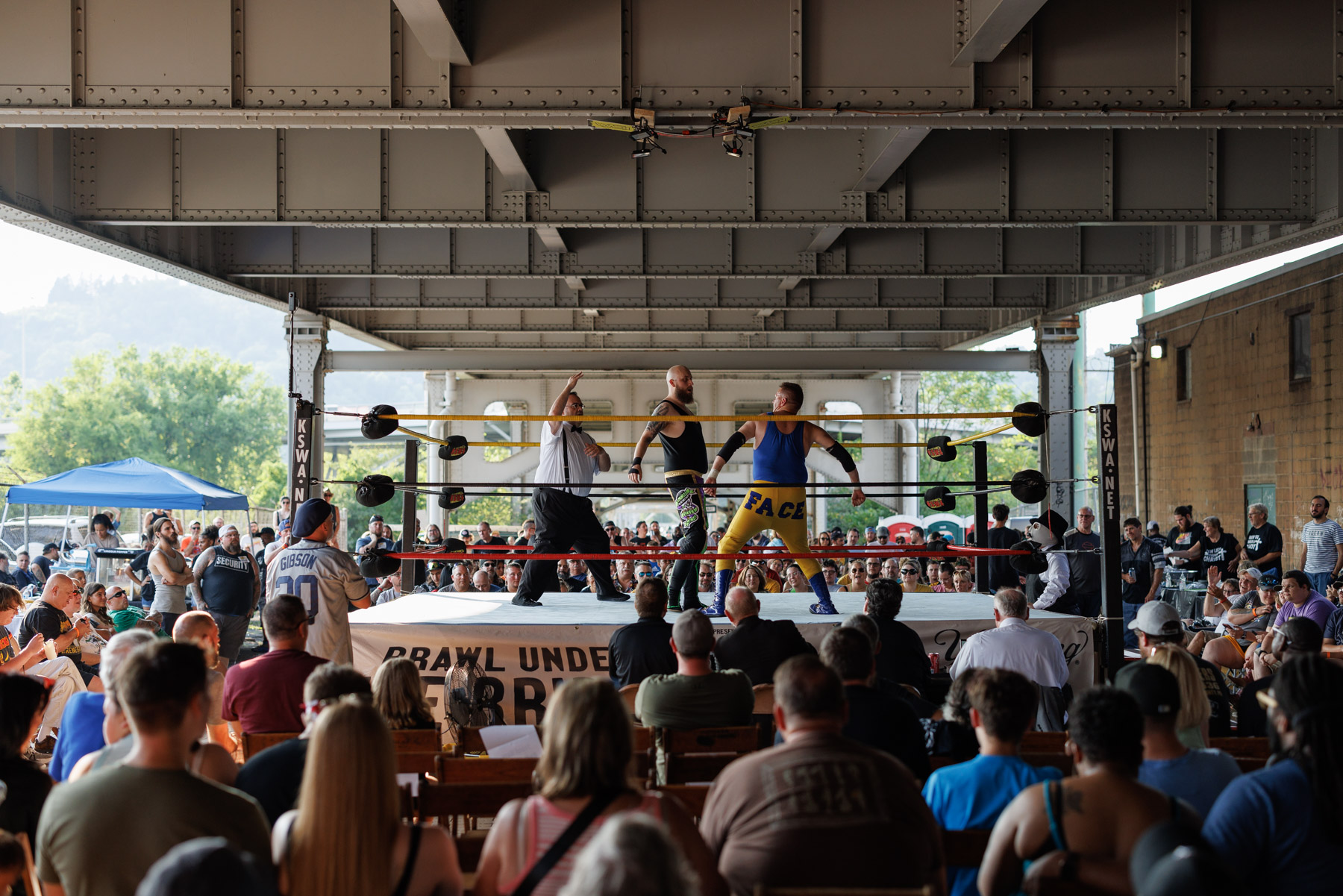
Lou had picked up the U-Haul that morning at 7 and packed it with 300 chairs and nine tents. In its ninth iteration, the Brawl Under the Bridge had become their biggest show of the year, locally renowned for its post-industrial location, squeezed along 7th Street near the railroad tracks.
“Many wrestling shows aren’t happening in this type of setting” Lou said. “It’s pretty unique.
“We’re usually in a bingo hall or a lyceum.”


“Pittsburgh has a wonderfully rich pro-wrestling history dating back before 1900,” explained “Trapper” Tom Leturgey.
“Anyone who has been anyone in pro-wrestling has wrestled in Pittsburgh,” he said.
Resident historian at the alliance and editor of the award-winning blog KSWA Digest, Tom has written more than 800 articles throughout his 19 years with the KSWA and occasionally teaches pro-wrestling history at the Community College of Allegheny County.
As early as 1871, he said, factory workers would stage events after the shift-change whistle.
Beginning in 1958, local matches were broadcast across the United States from a studio in Fineview, bringing a new national prominence.
“Pittsburgh believes in pro wrestling as fervently as anywhere,” Tom said. “The city, to this very day, is one of the very best markets for pro wrestling.”
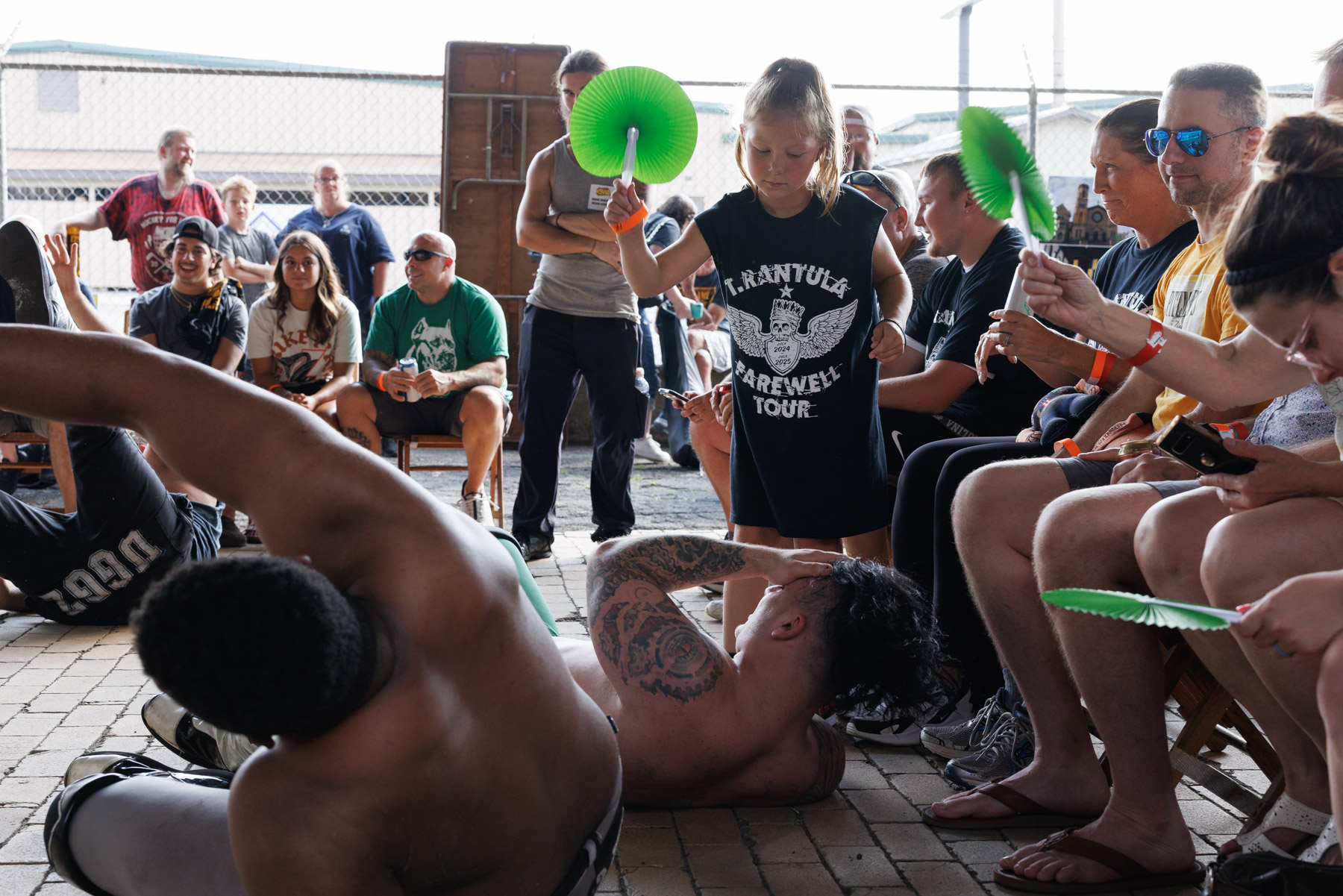
The KSWA continues that legacy — a mauling style of old-school wrestling, maintained by dedicated locals with day jobs.
“Just a bunch of Pittsburgh guys living a dream that few have been able to live,” Tom mused. On weekdays, he works as a clerk for a magistrate in Allegheny County.
“This is my family. These are my brothers.”
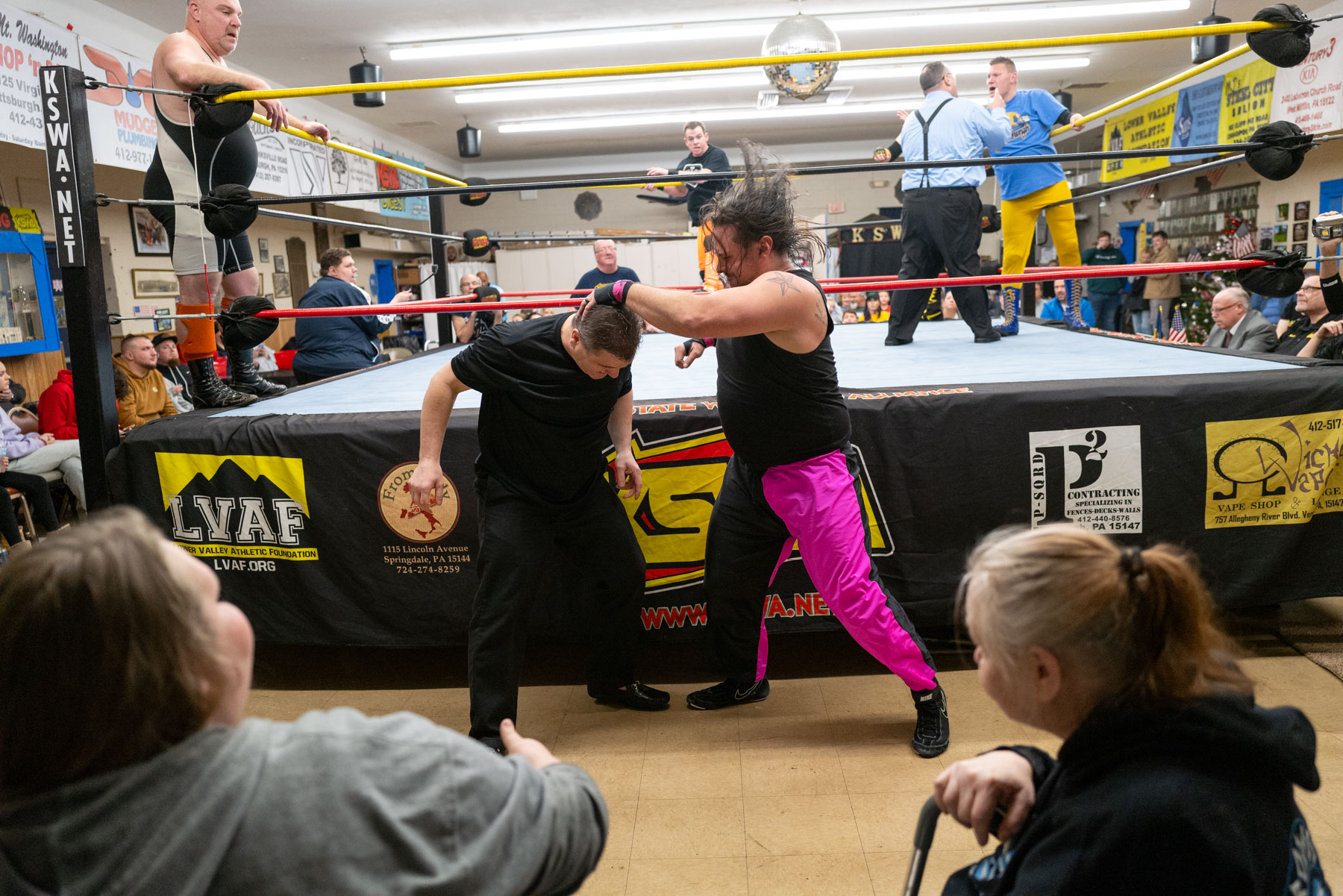


Freek E. Doyle (left) and Shawn Blanchard (right) lay in defeat during a KSWA show at the American Legion in Sheraden in January.
“It’s like community theater,” explained Mark Kinan, who referees for KSWA under the moniker Mark Charles III. A neutral arbiter, the referee is no less important to the production, maintaining an air of intensity and an illusion of order.
“A wrestler’s job is to sell the pain,” Mark said. “The ref’s is to sell the urgency.”
Beyond the duties of mock exasperation and urgent restraint, the referee’s role is to arbitrate the ring, to facilitate communication between warring wrestlers while maintaining the ever-important wall between the audience and reality.
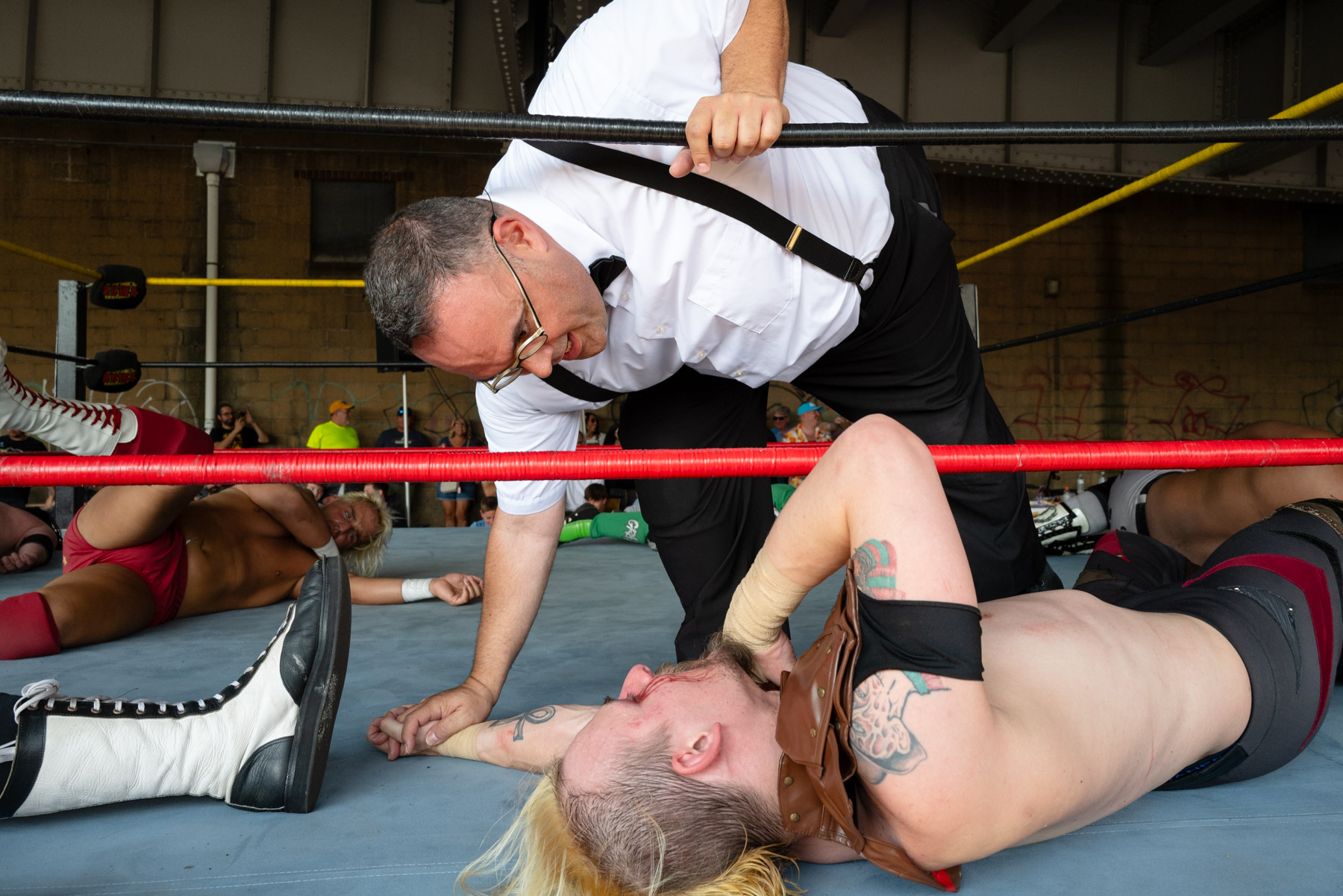
Three matches into the Brawl Under the Bridge, “The Face of Pittsburgh” was squaring off against Freek E. Doyle beneath steel beams. After three consecutive slams — each with a resounding gasp from the crowd — Lou lay on his back. Panting. Motionless.
“You OK, Lou?” Mark whispered, his face inches from Lou’s, his voice barely audible from the photographer’s position inches outside of the ropes. Lou nodded slightly.
“Really what we’re doing is checking in with the wrestlers,” Mark said.
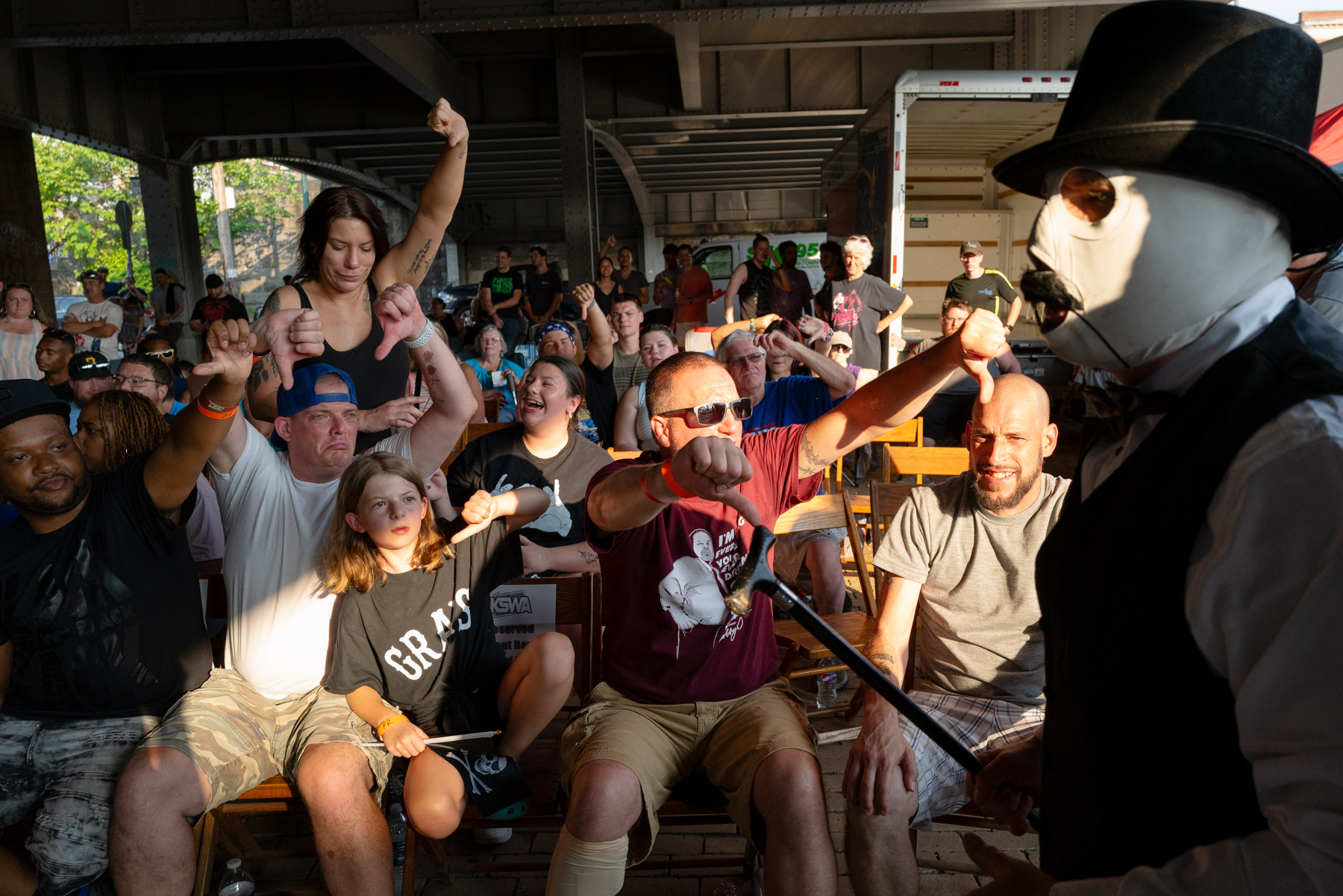
“There’s a lot of fans that come all the time that are almost like family,” Lou said. “You see them more than some of your own family.”
One of those fans is Bree Orner.
Growing up not far from the American Legion in Sheraden, her grandmother watched Pittsburgh’s studio wrestling stars on television.
“My grandmother was a huge Bruno Sammartino fan watching studio wrestling,” said Bree, now 52. “Bruno was in her prayers at night. … That’s how embedded professional wrestling is in Pittsburgh.”
The longtime “KSWA Krazy” (what the alliance names their most dedicated fans) had brought her sister to her first match at the Brawl Under the Bridge. “I love it,” she said, standing at the edge of the ring.
“It’s classic indie wrestling,” Bree said. “Some guys who have day jobs are running a wrestling organization because they love what they’re doing and they love doing it for the people who appreciate it.”
“I love watching people do what they love.”
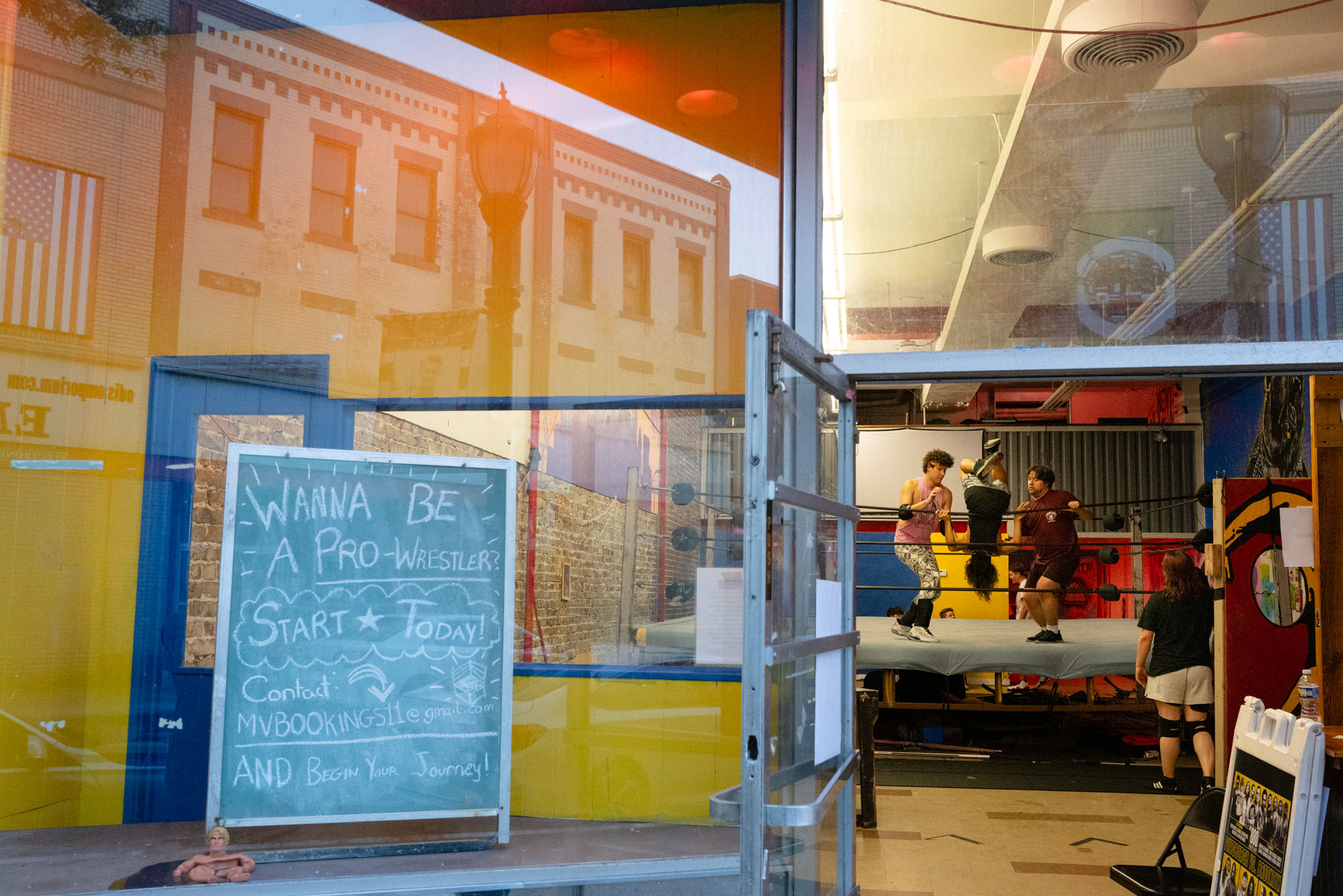
At 6 p.m on 5th Avenue in New Kensington, one can’t help but notice the loud slams coming from a nondescript storefront, mostly empty except for a chalkboard resting in a dusty window: “Wanna be a pro-wrestler?”
Inside, surrounded by students, wrestler Chris LeRusso — attorney Christopher Kenny by day — demonstrated how to safely perform a vertical suplex in early July.
“Clean up your footwork! Be crisp!” he instructed, stressing economy of movement. “Remember, it’s an 18-foot ring — nine feet to the center.”
Since 2022, Technique 2 Training Wrestling Academy has been training a new generation of wide-eyed wrestlers, eager for their shot at the big leagues— a chance to be noticed and make their way to the televised upper echelons of sports entertainment.
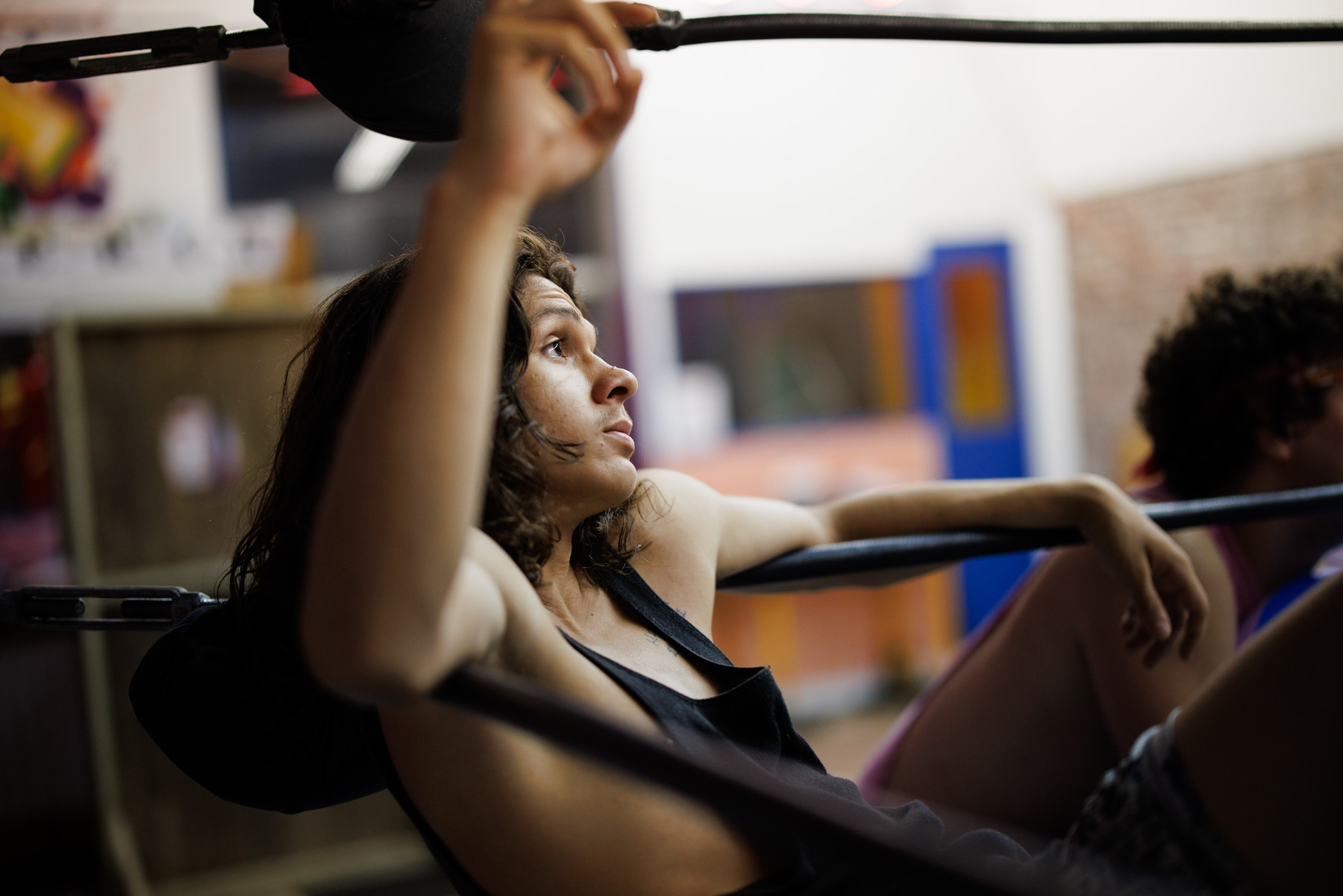
“I’ve dreamed about it since I was 5,” said Tony Fahling, a 16-year-old wrestling student from New Kensington. “This is everything to me.”
“Pro-wrestling is more an art form than anything,” Tony said.
James Cleaver, a 22-year-old electrician at a steel mill in New Castle, drives an hour and a half several times a week to train.
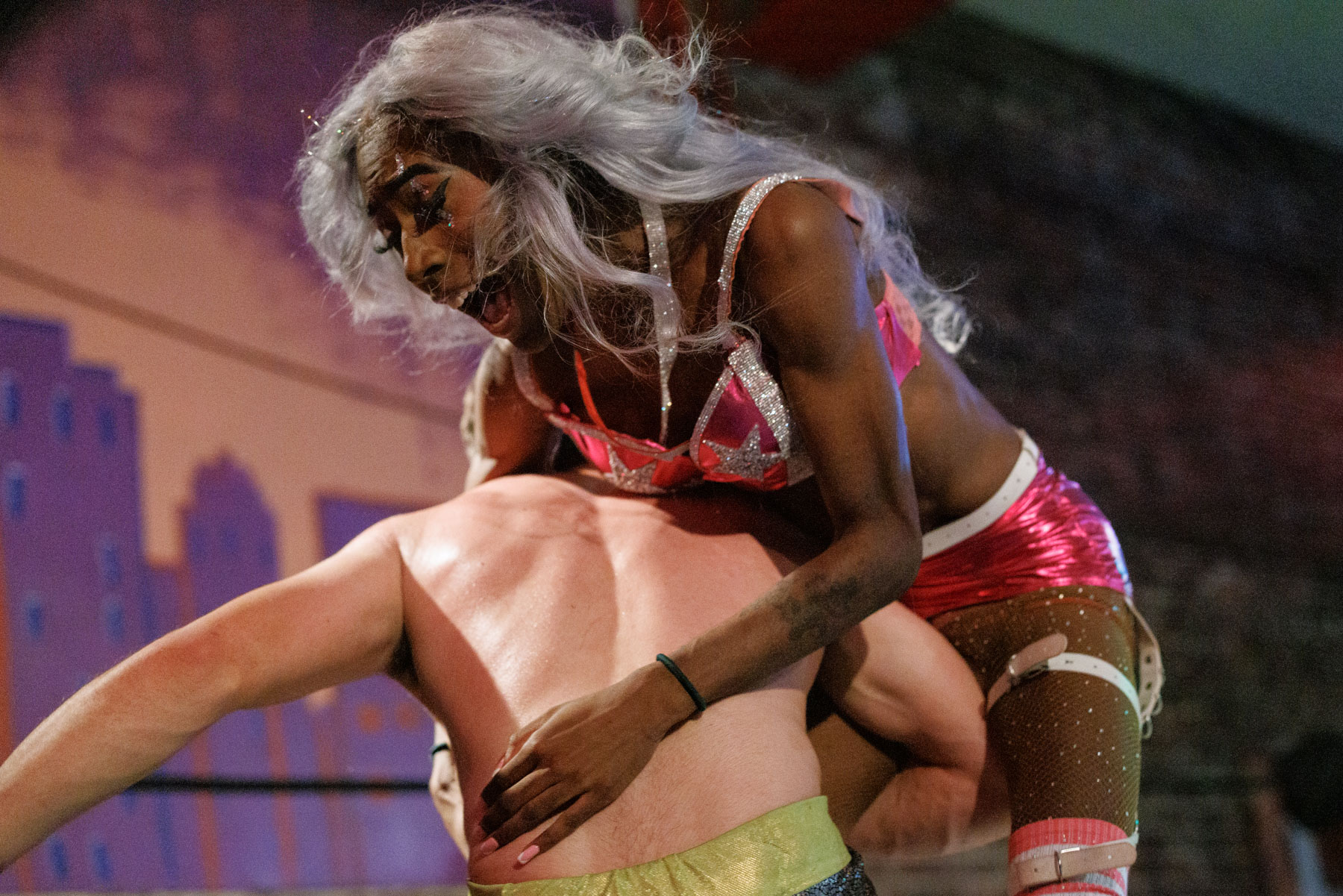
Every Thursday, there is a free show at the Academy, put on by the promotions group 880 Wrestling. It’s an opportunity for fledgling performers to try a new persona, or gimmick, and to test their chops in the ring.
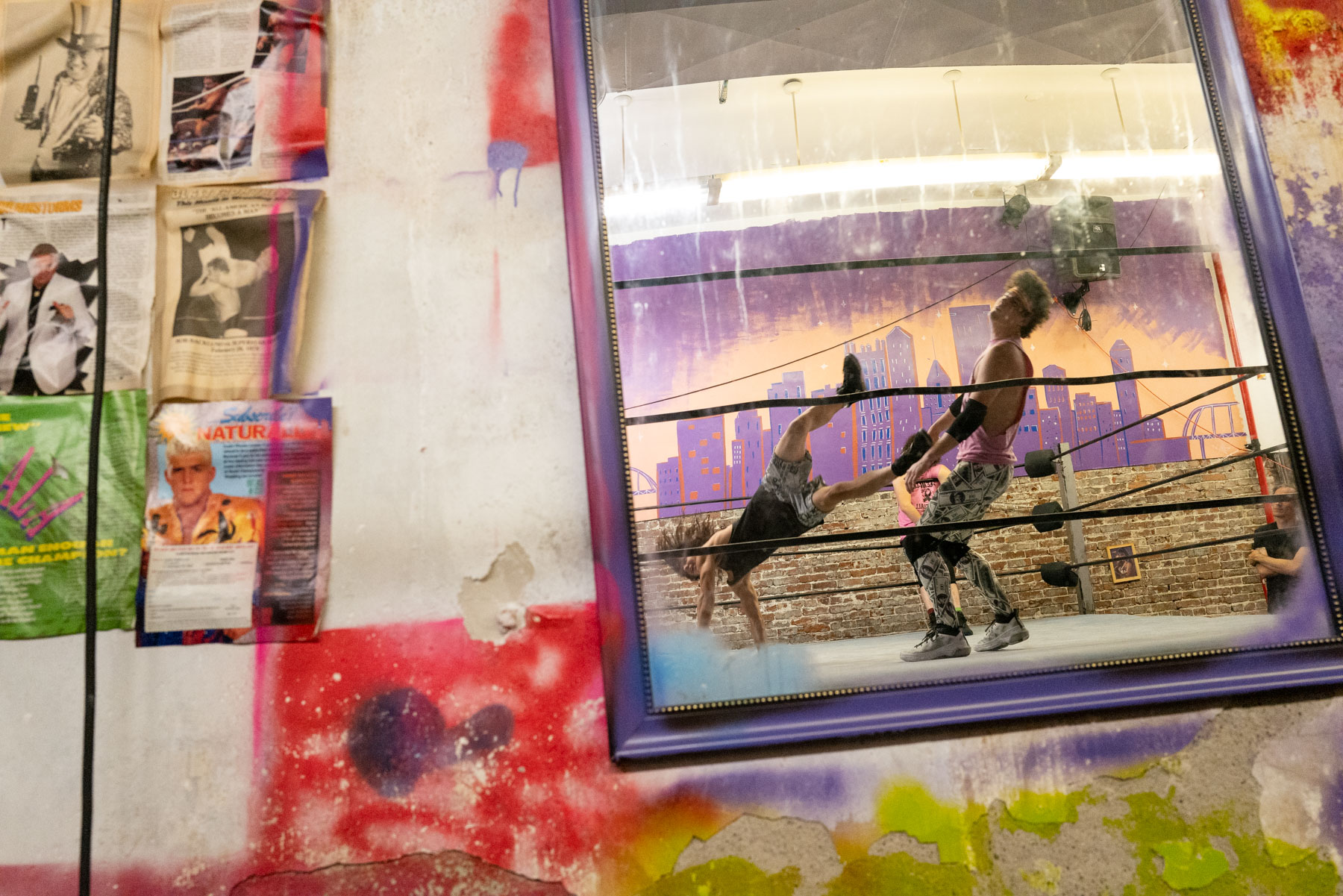
Wrestling is in the midst of a renaissance, Chris said. Young people are making money as more promotions become more prominent.
The world has also become more welcoming: There are positive portrayals of gay wrestlers and people of backgrounds that had been portrayed as stereotyped gimmicks in decades past.
“There was a time when wrestling was very toxic,” Chris recalled. “Now, people with all identities, everyone can come in and thrive, be a main event at a show.”
Marco Narcisso stood outside smoking, waiting to use the weight room. Relatively new to wrestling, Marco had recently relocated to New Kensington to be closer to the training ring.
“I was looking for my next theatrical endeavor,” Marco said. “I used to do drag, but this is way more fun.”
Back in Homestead, 45 minutes before the first bell of the Brawl Under the Bridge, T. Rantula loomed behind the porta-johns beneath the Homestead Grays Bridge, admiring his Harley Davidson motorcycle. He had picked it up from the detailer that morning. Having spent $14,000 in restorations, it was freshly painted with flames and fixed with no muffler.
Listed at 6 foot 5 inches and 310 pounds, the 62-year-old moves like an older wrestler; slow, strong and lumbering, he towers over his opponents. It was the Munhall native’s 34th year in the ring.
Years ago, he brawled in the ring for World Wrestling Entertainment — the WWE. In 1998, T. Rantula found himself on the receiving end of Dwayne “The Rock” Johnson’s first “peoples elbow”.

Outside of the ropes, T. Rantula is David Younkins, a retired correctional officer who once patrolled the Allegheny County Jail.
“The inmates knew me as T. Rantula,” he recalled. “They watched me on TV.”
In 2022, T. was elected to Munhall’s council, joining the ranks of the late former Allegheny County Council President Jumpin’ Johnny DeFazio, the late Swissvale mayor and county Councilor Charles Martoni and other local pro-wrestlers turned Western Pennsylvania politicians.
“I’ve had an amazing life, man.” T. said. “Wrestling was the reason why.”
He’d toured much of the United States, wrestling in rings from Pennsylvania to Texas. He’d brawled for crowds in Puerto Rico and South Africa.
“Everywhere I’ve went, I’ve been from Munhall, Pennsylvania,” T. said. Now, he was home. “At home, it’s a little bit more special.”
But the day’s match would mark the beginning of his last — the first in a yearlong farewell tour.
“I’ve always said that my body would tell me when it’s time.” T. had said days earlier. “It’s time.”
He was planning a grand entrance: a ringside ride in on his Harley followed by his son, David, also on a motorcycle.
“This is my town!” T.’s voice bellowed as he crossed beneath the bridge among throngs of fans wearing shirts bearing his name. “I grew up here.”
But T. never stepped inside the ropes.
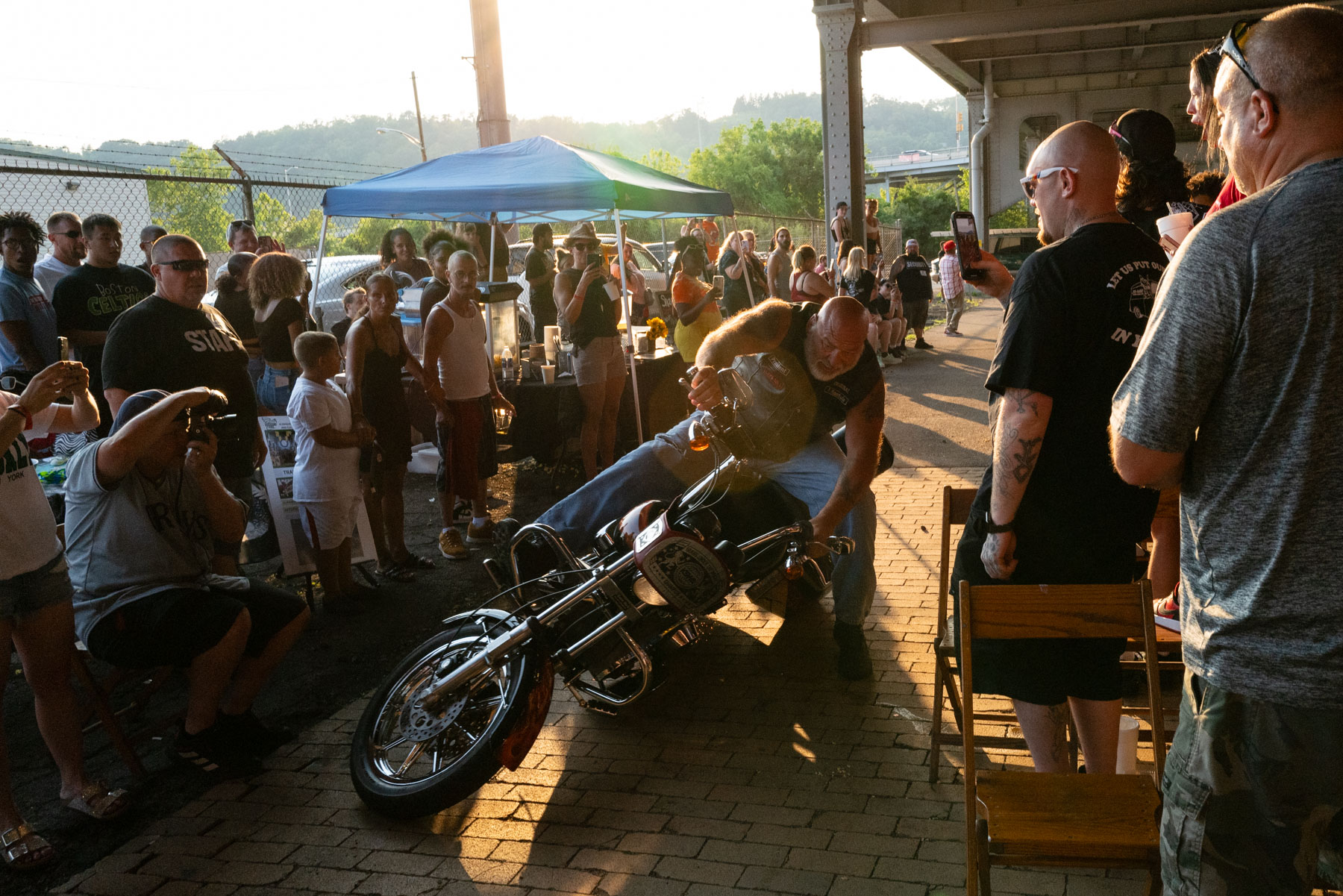
In a screeching skid, T. and his son crashed sideways into a crowd of spectators, including a PublicSource employee who was hospitalized with injuries.
Four ambulances later, the brawl’s final match was canceled.
Photographs by Quinn Glabicki.
Quinn Glabicki is the environment and climate reporter at PublicSource and a Report for America corps member. He can be reached at quinn@publicsource.org and on Instagram and X @quinnglabicki.
This article first appeared on PublicSource and is republished here under a Creative Commons license.
About Post Author
