
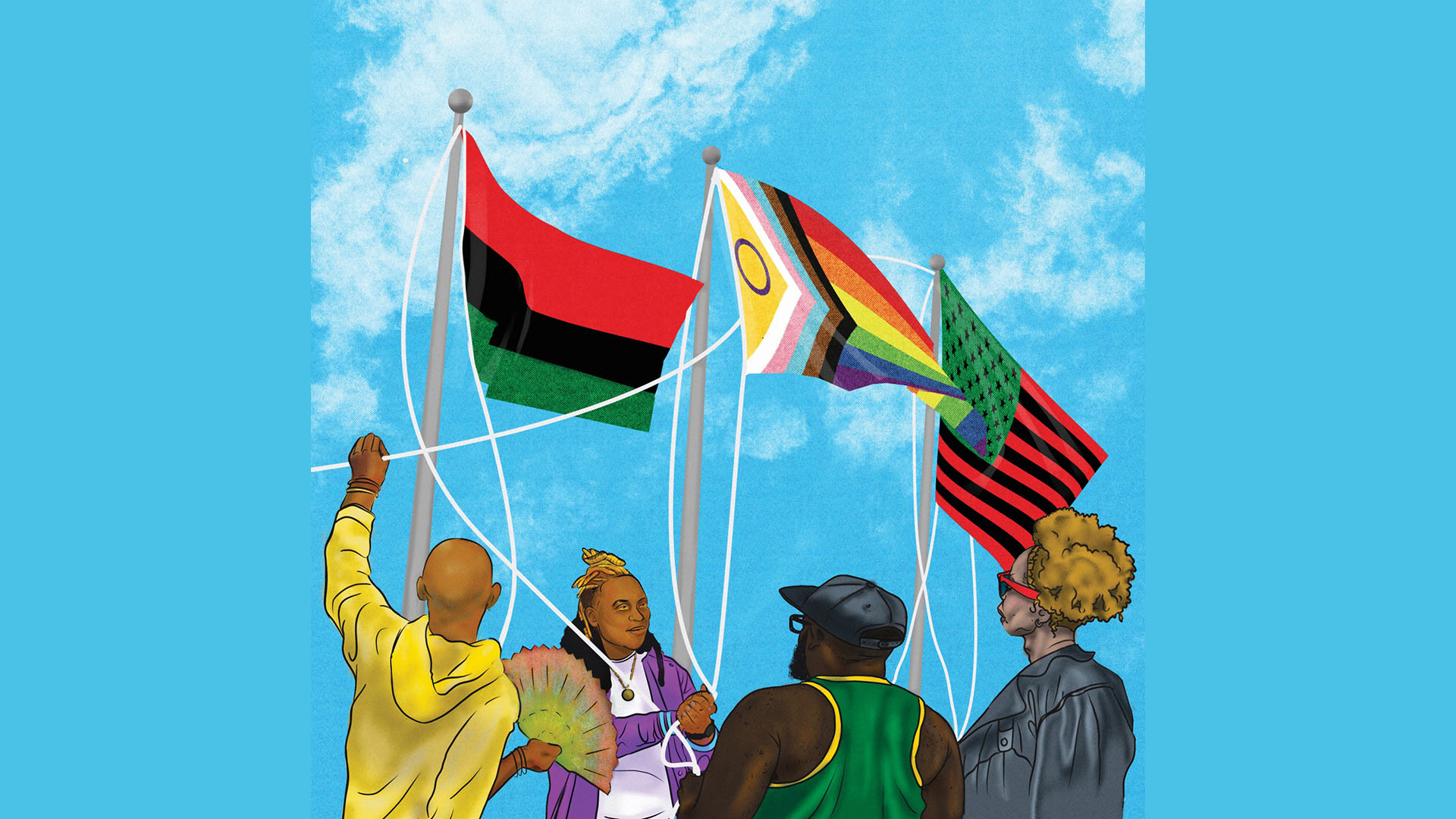


It’s because of my early education in Black newspapers that I was well aware of the history and impact of the New York Amsterdam News before I accepted the role of news editor in February of this year. I’ve worked in all types of newsrooms and outlets, each with their own strengths and weaknesses; the AmNews is not unique in this regard. We, like any other publication, face the challenge of delivering quality journalism in the face of an ever-changing, sometimes terrifying, news business.
But one thing about the Black press is that it’s unquestionably Black and thus, a story like that of O’Shae Sibley, who was stabbed to death on the penultimate day of July last year, would have no problem getting through decision-makers and gatekeepers in a newsroom. Holding the rank of decision-maker is why I came here, because I could not only push a story like Sibley’s with my direction and oversight, but can empower other staffers to do so as well. And I had a specific mission of making sure that stories at the intersection of Blackness and queerness would not be overlooked on my watch.
The AmNews did cover Sibley, to be clear, but in my short time here, I wanted to know where our paper stood with Black and queer New Yorkers, and if there was an opportunity to tap into those communities for story ideas. A story that went under the radar in most of the New York press was the closure of the Hangar Bar in West Village, the leading Black gay hangout in that neighborhood.
I came to the newsroom with coverage like that in mind, but was cautioned to assess how we’ve covered the LGBT community before. “We’ve never covered Harlem Pride,” one staffer said during one of many (many) meetings over the course of a typical working week in a newsroom, and I was caught off guard by my incorrect assumption that it had been. One of the Blackest pride celebrations in arguably the most iconic Black neighborhood in the country, incidentally where our offices have been for a century…and…never?


An uneven legacy
As much as the Black press has been there for Black people, historians both trained and casual can agree that our coverage of Black queer communities is solidly mixed.
From a journalist’s standpoint, the staffing of Black newspapers has historically been small. Few Black newspapers anywhere will have as many staff journalists as the major mainstream local newspaper. The AmNews, though, would be comparable to a non-Black publication of a similar size—think the Village Voice.
New York is a big city and it is impossible for small papers to get to all the news. With more Black people in this town than anywhere else in America, that makes it just as hard for us to get to all the Black news. But my, oh my, let me just say for the record: After 114 years, we’ve gotten to a lot of it.
With smaller yet nimble staffs, decisions in coverage clearly have to be made. I was tasked with assessing a century’s worth of archives here at the AmNews to see how we covered queer people, queer issues, queer anything. Again, keeping the dynamics of our news business in the forefront, it’s easy to understand why some historic queer topics—the Lavender Scare of the 1940s, for example—did not get as much coverage as the things that did.
Much of the AmNews’ first 75 years of operation runs the gamut of the entire Civil Rights Movement, the documentation of Harlem from destination for Southern migrants to the center of New York’s Black middle class and subsequent rise of a cultural capital of the Black diaspora at large, and the many notables at every level of recognizance—from neighborhood legends like Hazel Dukes to world-changers like Malcolm X—in between. And that’s just to name a few.
From a reader’s standpoint, though, and if you are someone who carries both Black and queer identities, you would wonder why you’d only feel half or part of yourself when reading the paper of the week. The Black press has owned, and is revered for, its role in documenting Black America where mainstream newsrooms didn’t—and, even if they tried, couldn’t. This is our historic record, born from the refusal and inability to chronicle our time when we were enslaved in this country.
Just as much as the Black press holds the identity of Black America, it has also molded our audience’s impression of it. Its influence on how communities at large view ourselves, particularly during subscription and circulation booms that came with more and more Black folks being able to buy a newspaper as they formed larger and larger economic classes in the mid-century, cannot be understated. That’s why going through the AmNews archives just now, I found myself both in awe of the things we did cover in the line of Black queerness, recoiling at other things we covered with a not-so-gentle touch, and a little bewildered at what didn’t make it in at all.
In short, the AmNews, like every other paper regardless of size, audience, or publication frequency, also has a mixed legacy when it comes to how we’ve historically covered the queer community.
Searching for ‘gay’
Search “gay” in the online archives of the AmNews (which you, dear reader, can do at the Schomburg Center in Harlem), and you find a lot of coverage of social groups and events. “Gay” was used in the names of a lot of well-to-do clubs and organizations for the prim and proper— where galas and debutante balls were fixtures of the social calendar alongside the regular trips upstate. Rare is it used as a descriptor of a person attracted to the same sex in the first few decades of the paper’s operation.
It’s important to note this because of how society at large came to assign the term gay to those people, and what other terms were used throughout the decades. Gay didn’t quite enter the mainstream—and as a caution, a mostly white one—as what it means now until the 1960s and 1970s. The term was used before then, often as code or in-jokes for people who were homosexual, and in some contexts as a derogatory put-down. The actual put-down used at large during most of the early century was the term “homosexual,” which had taken on a psychological identity that sounded, in those contexts, more like a condition. An affectation. A mental illness. Something that was wrong, or needed to be fixed.
The term “homosexual” first appears in the AmNews in the April 27, 1932, edition in a book review. The book, a “miscegenation novel,” is a tawdry, scandalous (for its time) tale about a white woman who gets drunk and wakes up married to a Black man; a side plot includes the white character’s “homosexual” brother who’s actually in love with the guy. Said character is also described in the novel as a “pansy.”
From the 1920s until roughly the late 1940s, several coded words were used alongside or in place of homosexual: pansy, fairy, queer, dandy, bull, queen, “feministic male.” Sometimes these terms were used as mere descriptors to identify someone who is gay or lesbian. More often than not, it was used in a mocking or derogatory context.
The ball culture that we all came to know and love through seminal media works like “Paris is Burning” and “Pose” have deep roots in Harlem and greater New York City—and we have this on record because the AmNews covered ball culture since its inception in the 1920s; by that time, as many reports in the paper noted, balls had been going on for decades, and were tradition by that point. But it’s here where that “mixed” feeling comes in full force: On one hand, we have this indelible record of the earliest days of a uniquely Black and queer form of expression, but on the other is how such events were described.
“3,000 people gathered…to watch the antics of 2,000 more who are regularly attracted to the annual masquerade and civic ball which Hamilton Lodge No. 710 G.U.O. Oddfellows has been giving for the past sixty-one years,” reads a dispatch from an infamous masquerade ball in the February 20, 1929, edition. The ‘3,000 people’ constituted the normal ones who looked on in mirth at the girlish antics of the other 2,000, whose acts certainly class them as subnormal, or, in the language of the street, ‘fairies.’ Among those who looked on were some of Harlem’s best known people…Among those who seized the opportunity of a masquerade to get off some of their abnormality in public were some of the most notoriously degenerate white men in the city.”
I’m not sure if even Elektra Evangelista could deliver a read that nasty.
Coverage of similar gatherings—almost all of them are fundraisers for various causes and charities—throughout the 1920s and 1930s reads the same each time. There will be attention paid to gorgeous outfits, fine fabrics, and jewels—“gossamerlike crepe silk” in a 1937 issue. Mentions of finery alongside the elite guests, money raised, and big turnouts are overlaid with sardonic descriptions of men behaving like “pansies” and “blossoms,” or behaving like the women guests also in attendance.
We should not, obviously, hold coverage of a ball in 1924 to editorial standards in 2024, but the associations made between queerness and the then-socially unacceptable would echo throughout in many different coverage areas of the paper.


Growing pains
The growing pains of booming Harlem in the 1940s and 1950s become evident in the pages of the AmNews as more reports of narcotics abuse, sales, and crime begin to become the norm in weekly headlines.
Dope—picking your poison depends on the decade—was always around Harlem and the rest of New York. “Reefer Madness”-style panic hits near-comical peaks in some AmNews coverage in the 1930s and lingers well into the 1960s, but heroin becomes the big moneymaker by the 1950s. As a result, reporters found themselves covering more and more of society’s “degenerates,” and the paper’s commentators over these years began issuing more and more warnings to readers about the dangers associated with drugs.
In the January 27, 1951, issue, a story caught my eye about weed and smack hitting the streets at the same time and the lengths, allegedly, people would go to for a fix. I say allegedly because the piece is unbylined and relies on anonymous sourcing, but it hones in on growing drug use among teenage girls, and the direct path between casual drug use to being “enslaved by pimps” once they get strung out.
“‘Once teen-age girls become confirmed users of heroin, they’ll do anything to get a shot. That’s when the pimps get them, but many times the procurers for lesbians get them first. This is quite easy because they are sold the idea that there is no risk of pregnancy involved,’” an unidentified police officer told the AmNews back then.
By the 1940s, a strong correlation between queerness and all things both illegal and immoral begins. “Perverts,” “inverts,” and “deviants” begin to appear more frequently alongside lesbians, gays, and homosexuals—all or some of these words used in tandem. And while the decades-long fear of infiltration by “degenerate” whites in these scenes were still a concern, there were increasing worries of grooming at the hands of adults.
For three consecutive weeks in February 1955, the AmNews ran a three-part series titled “Are the Fairies Running Harlem?”, an investigation that, albeit laced with unsavory undertone, essentially details how gay men—called “queens, swishes, gays, homosexuals” in this context—were becoming more visible in Harlem. It’s possible this series has many firsts, or at least some publishing milestones: the use of the term “trade” (“Queens do occasionally pick up a stray young man (trade)”; a photo of two Black men kissing each other on the mouth (caption: “A queen and his mate…openly display their tendencies”); and, in a roundabout way, a challenge to the gender binary—albeit, very awkward in hindsight, as some gay men here are perjured as “the third sex” while others are acknowledged for not wanting to identify as men at all because “they think of themselves as more female than male.”
Throughout the entire series, and peppered throughout the decade, there are cautions about older gay men going after younger men, and the perceived fears within.
In efforts to either investigate, educate, or pontificate, AmNews staffers found themselves on the wrong end of criticism for some of its coverage. In 1957, under the headline “Singer Says Many Men In Harlem Choirs Are ‘Queer,’” the opening paragraph questions whether society should “take steps to curb sexual perversion” by essentially bringing men suspected to be gay out of hiding—we might classify this as “outing” now—or leave people and their “abnormalities” alone. But when a locally popular tenor singer went on to say that most folks in Harlem’s music scene were a little bit queer, readers were incensed and wrote responses by the ream before the next issue hit stands. Some readers said another person’s business isn’t the paper’s to print, others were shocked at the level of “perversion” in the piece. But a hopeful, progressive comment comes at the end of a follow-up report to that story: “Many current men of great ability are homosexuals…but they are not degenerate.”
Making inclusive strides
Amid the more fear-mongering tones of some archival coverage (which, as I must reiterate often, were in lockstep with the attitudes of the day), the AmNews was concurrently positioning itself as a future journal of Black queer upstarts and pioneers who’d become legends with each passing issue on newsstands.
James Baldwin, and his outsized presence in the culture during his lifetime, was regularly featured in the paper’s pages; it would be incorrect to say all queer coverage in the paper was negative. And although Langston Hughes was not out during his lifetime, it’s worth noting that the frequent AmNews coverage of him makes the paper essential to archiving his timeline, allowing for future historians to contextualize his work in modern queer contexts.
Hughes’s assistant and confidant, Raoul Abdul, makes his first appearance in the paper as a featured performer in a preview of a night at the opera in a May 16, 1958, issue. Abdul, a trained baritone whose performances are covered regularly well into the 1960s, makes his debut as a writer in 1962, and between gigs and hosting star-studded parties, starts regularly writing a column for the paper in the mid-1970s, going on to become the AmNews’ long-running classical music columnist—and occasional chronicler of POVs directly from a gay man; several of his columns frequently included personal anecdotes from the colorful singer’s day-to-day life.
Throughout the 1960s and 1970s, as the term “gay” becomes more widespread, the AmNews previous style of reporting on gays in the context perverts and druggies starts to become old hat among increasingly progressive—or perhaps just fed up—readers, with no starker change in tone than in November of 1975. An unbylined piece in one issue that week charged that “lesbian gang members” were wreaking havoc on an all-girls’ school in Manhattan by molesting or attacking students.
The problem with the story? It was all based on rumor; no students interviewed on the record could confirm any such rumor. Printing a rumor did not go over well with readers; gay rights’ activists swiftly and publicly condemned the story, with a leading activist writing a letter to the editor hoping that “your journalism will show the respect for gay people that you show toward other minorities.”


Gradually, subsequent coverage did just that, but not without discourse. The 1970s brought increased awareness of the Gay Liberation Movement, increased mention of out gay and lesbian personalities, and increased attention to how politicians were grappling with attracting support from voters of color and LGBT voters. In many ways, combing through AmNews archives chronologically from 1970 until the end of that decade reads like a real-time conversation about the further intertwining of Black civil rights with gay civil rights—today, progressive activists see both as one and the same.
In that same time period, however, the paper frequently printed opinions from clergy condemning gays and lesbians, and incited a new kind of fear that echoed the Black is Beautiful mantra of the era: a (less homophobic than it is podcast-level chauvinistic, actually) perception that if a single woman can’t find a man, she’s destined to become a lesbian. All along the way, though, readers increasingly wrote letters to the editor, and we published rather than ignored them, with more calls for the paper to more and more consider not only Black readers who are also gay, but also to be more considerate of the queer community period.
A pronounced tonal shift in coverage of gay communities comes as AIDS ravaged Black and Brown America in the 1980s. After decades of winks, teasing, and innuendo, the AIDS crisis, for better or for worse, prompted many members of the Black LGBT community to firmly take a stand and let people know that they weren’t hiding anymore. Institutions like the Black church, Black political elite, and Black press especially, were forced to take notice.
“The press in general, and especially the Black press, has never gone into homosexuality, although a fair portion of Black males—10 percent—are homosexual, and until a few years ago the number was rising,” longtime AmNews writer Abiola Sinclair writes in the first piece of a series exploring AIDS in Black communities, partially titled “New face of homosexuality.”
That was in August 1985, a month before President Reagan would acknowledge the virus by name for the first time, two months before Rock Hudson became the first celebrity to die from it, and a few months before Dr. Anthony Fauci would deduce that nearly 1 million Americans had died from the virus so far.
“Every Black family, if it is large enough, has one gay member somewhere—a brother, a cousin, or nephew. Blacks deal with it by not dealing with it. They simply accept them, providing they’re not too outlandish,” Sinclair continues.
A new era
The AIDS epidemic, which is still ongoing, was not the only extent of covering Black queerness in the AmNews. Well into the 1990s and 2000s, Black queerness in general was difficult to ignore, as evidenced by increased coverage of LGBT-owned businesses, queer film festivals, and other events that would be commonplace in the gay community.
That said, I looked at our coverage of the aforementioned Harlem Pride. We were there when Harlem Pride kicked off its first celebration in 2010; technically, my coworker’s assertion that the paper had never covered it was incorrect, but you wouldn’t fault them for being totally wrong. In 14 years since Harlem Pride has been established, one might guess there would be 14 archival pieces in the AmNews vault. There aren’t, and I’m not here to throw anyone under the bus because of that. That we covered it at all is a powerful testament as is.
I’m here with 114 years’ worth of digging to ask out loud: What role did we have in shaping the identity of people who are Black and queer all that time, and what role will we play going forward?
We can stand in the legacy that we have chronicled the likes of Hughes and Baldwin, but also Audre Lorde, E. Lynn Harris, Barbara Jordan, and Richard Bruce Nugent. We have published—in some cases, been the first to publish—queer writers like Charles Michael Smith and James Earl Hardy, who have done the work to amplify LGBT culture not just in our pages, but in other mediums beyond our weekly product.
We can also look ahead to all the possibilities for more, while acknowledging the journey, however arduous it might have been, along the way. Our archives are part of the long-running conversation about where Black people who are also queer stand in this community—yes, even if the language is a bit crude and cringe-worthy at times. Queerness in Black communities has shifted over the century from being mocked, feared, silenced, ignored, scandalized, misunderstood, and—at least I’d like to think—almost equalized. It sounds very much like the journey of Black Americans regardless of how else they might identify.
Both paths—and by now, yes, they do run parallel—are not complete, and we’ve got so far to go in many respects.
Even as we celebrate the progress we’ve made, as a news organization and as a community, it is vital that we examine and remember our past so when future generations look back at us, they understand that we did our best to fully represent the Black experience in all its diversity and glory.
This story originally appeared in the NY Amsterdam News.