Affordable housing is a major problem in the City of Pittsburgh.
Many African Americans who once lived in East Liberty, Uptown, the South Side Flats area and parts of the Central North Side have been uprooted, with sparkling, flashy new apartment developments that, if the developers had their way, would have all the units priced at market-rate.
But in the words of Pittsburgh Mayor Ed Gainey, the city’s first Black mayor, “if you’re coming to ask me for city subsidy, I’m gonna tell you what I need; I need affordability. In providing affordability we are re-establishing neighborhoods,” the mayor told the New Pittsburgh Courier during his 75-minute exclusive sit-down with the Courier editorial board, Jan. 23.
This article is the third installment of the Courier’s series, “Mayor Gainey Unfiltered.” The first two reports focused on the mayor’s “culture change” that he brought to the City of Pittsburgh Mayor’s Office, including making the workplace safer for many of its Department of Public Works employees and establishing a new contract with the city’s police officers and firefighters; and the mayor’s strategy towards fighting gun violence.
More than 10,000 Black people left the City of Pittsburgh between 2010 and 2020, according to U.S. Census data. Most of them probably didn’t want to leave, but when rents started going up, or in the case of the Penn Plaza Apartments, a mostly-Black set of buildings in East Liberty that were torn down to make way for a new development anchored by Whole Foods, it left African Americans no choice but to flee.
“When we came in, there was no plan for affordable housing,” Mayor Gainey told the Courier when he took office in January 2022. “We had to create this, so we’re creating it as we go and we’re being able to make sure we use the tools that we have to be able to do it.”
One of those tools was the announcement of a $31.575 million bond, about $30.6 million of which to be used to make “unprecedented investments into affordable housing that Pittsburgh residents so urgently need,” according to a City of Pittsburgh press release from Dec. 28, 2023. That collaboration between the city and the Urban Redevelopment Authority of Pittsburgh has come to fruition with an announcement on April 3, 2024, of the “Affordable Housing Bond Spending Plan.” The plan estimates the creation or preservation of 1,000 affordable housing rental or for-sale units within the next three years. Half of the funds used for the plan would benefit families and individuals at or below 30 percent of the Area Median Income, 25 percent of the funds would benefit those at or below 50 percent of the AMI, and the remaining 25 percent would support homeownership opportunities for people at or below 80 per cent of the Area Median Income.
As of 2022, the Area Median Income in Allegheny County was $94,800 for a family of four, or $66,400 for an individual. Most African Americans in the county fall beneath the AMI, which would qualify them for the affordable housing percentage programs that stand at 80, 50 and 30 percent, respectively. As an example, if a newly created apartment building in East Liberty is marketed to those families at 50 percent of the AMI, then a family of four making up to $47,400 (as of 2022) would qualify to live in the building. In many cases, however, market-rate apartment buildings are only allowing, for example, 15 percent of the units to be classified as “affordable.” This means that if the apartment building allows 15 percent of the residents/families to rent one of the units at “80 percent AMI,” then an individual that makes up to $53,100 annually would qualify to live there, and 85 percent of the residents would be paying higher, market-rate rent costs.
“In essence, the Affordable Housing Bond is not just a financial instrument; it’s a testament to our collective commitment to building a more inclusive, equitable, and prosperous Pittsburgh where everyone can have a place to call home and thrive,” read an excerpt from the Bond Spending Plan, acquired by the Courier on April 7.
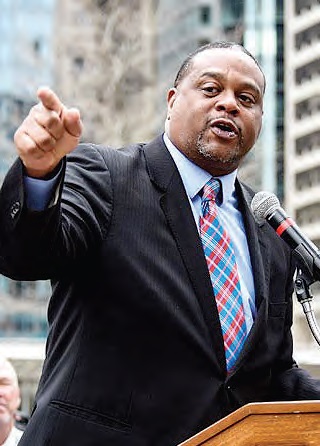
PITTSBURGH MAYOR ED GAINEY
Not surprisingly, Mayor Gainey was blunt in speaking to the Courier. Even before he became mayor, then-state Rep. Ed Gainey knew all-too-well about the affordable housing crisis. In May 2016, while he was a state representative for a district that included East Liberty, the city’s Affordable Housing Task Force reported “a defined affordability gap” of 17,241 units for households earning up to 50 percent of the city’s median household income.
Thus, the Pittsburgh Black population is on the decline, while the Black population is on the incline in places like McKees Rocks, Stowe Township, Penn Hills, Bellevue, etc. Pittsburgh’s Black population, once upwards of 28 percent in 2000, is now under 23 percent.
“Everything was market-rate, market-rate, market-rate,” Mayor Gainey told the Courier about the apartment building boom that happened in the East Libertys of the city in the past 10 years. “Yes, it grew a tax base but at the end of the day, it shrunk population.”
A realist, Mayor Gainey said he’s not asking every developer to make their apartment buildings all “affordable.” “We’re not saying give us all affordable housing,” the mayor said. “Just give me 15 percent of what it is you want to do and we can make a deal.”
Mayor Gainey told the Courier that affordable housing “stabilizes neighborhoods,” just like jobs. “We know that technology is very big in this city now. We’re talking to the technology community about how we continue to see the advancement of that and how we diversify that in a way that everybody feels they have an opportunity to thrive here. That’s how you begin to grow population.”
The mayor also pointed to how affordable housing is being preserved in the Hill District with a major investment into Bedford Dwellings, the sprawling housing complex on Bedford Avenue. Mayor Gainey said a $50 million federal grant was the final piece the city and the URA needed to make it happen. Eventually, each housing unit at Bedford Dwellings will be replaced and hundreds of new units will be created. Part of that reinvestment will include the creation of a seven-story building called “City’s Edge,” where the vast majority of the 110 units would be marked for those making up to 60 percent of the AMI. Pittsburgh City Council President R. Daniel Lavelle estimated the entire revitalization would take six years.
Between Mayor Gainey, his staff and other elected officials and stakeholders, they know how important it is to fix the affordable housing crisis in Pittsburgh. There are a number of Downtown building owners who are struggling with keeping the lights on with business contracts, so they’re turning their buildings into housing spaces. The mayor, Allegheny County Executive Sara Innamorato and others are working to make sure a good number of those Downtown housing units are classified as affordable. The mayor’s communications director, Maria Montano, said the city is working with VisitPittsburgh on a marketing strategy “to target residents who have left home (Pittsburgh) and to reintroduce them to the city and say, ‘come back home.'”
Mayor Gainey spokesperson Olga George added: “Pittsburgh is home. Those who have left, we want you to come back home and see the value that is here. The city is leading. The city is saying, ‘hey, there are jobs here,’ and there’s jobs within the city as well, so you can make this home.”
About Post Author