
Acquisition of the once-giant steelmaker will be a blow to the sense of self of many Pittsburghers. But though the company has been an icon, it hasn’t always been committed to the community.
It is a fitting end for United States Steel that its long history as a corporate behemoth ends with plans to be acquired whole by Japan’s Nippon Steel. Once a world leader, the steelmaker has long been in decline, and locally it has long been more a part of the region’s self-image than a partner in regional development.
Few places have retained an indelible moniker for as long as Pittsburgh has been known as the Steel City. It makes sense that a city and region that were the home to an unparalleled cluster of metals industries since long before the Civil War would be known for what they produced and exported to the world.


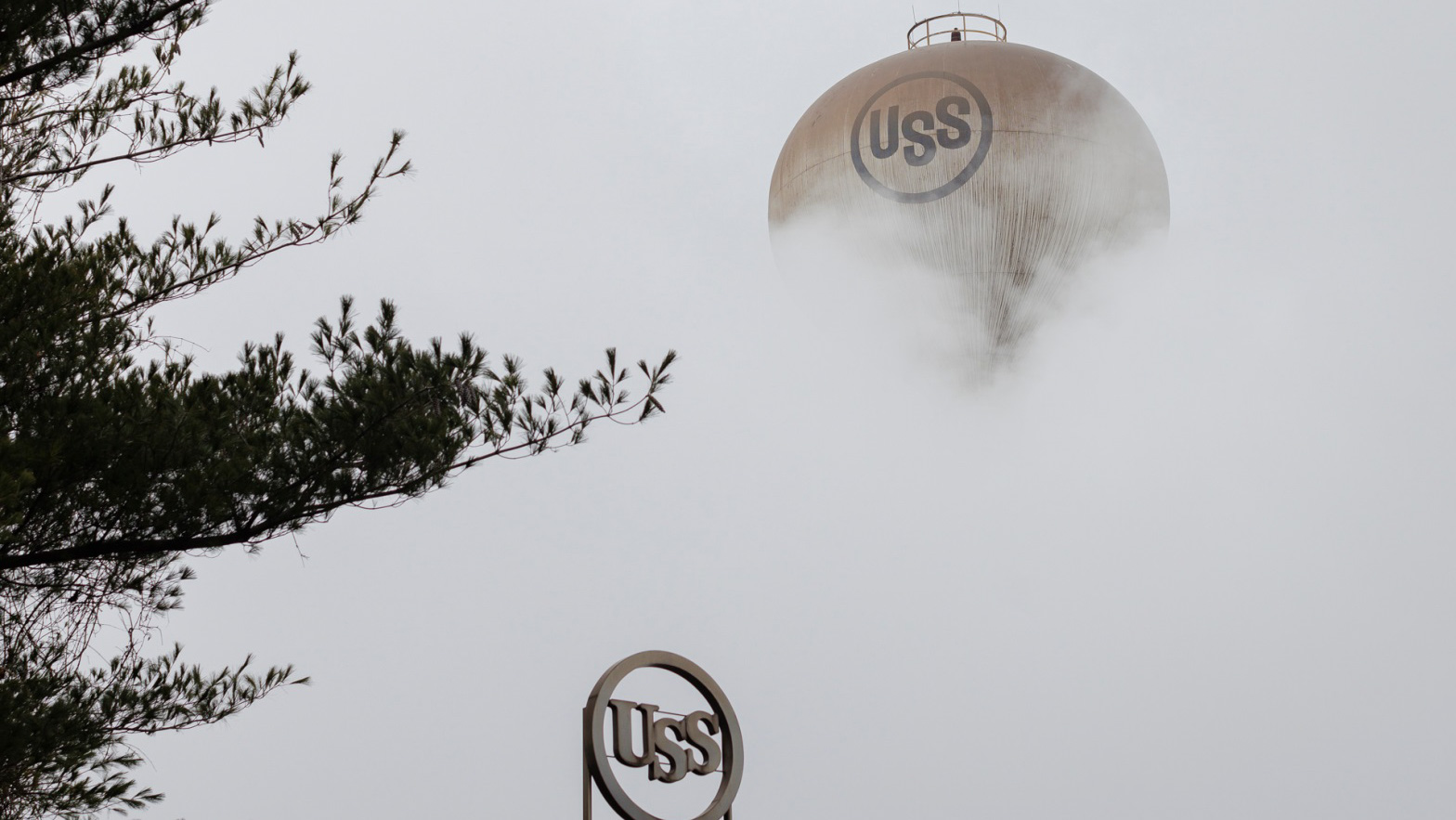
Emissions linger at street level at U.S. Steel Edgar Thomson Works in Braddock on Jan. 30. (Photo by Quinn Glabicki/PublicSource)
But the painful truth is that U.S. Steel, long the dominant local player in the industry, has never had anywhere near the commitment to Pittsburgh as Pittsburgh had to the corporation. And now a company that became moribund in strategic direction and management practices will be acquired by one from a country — Japan — that had no modern steelmaking when Andrew Carnegie first built the Edgar Thomson Works at Braddock, but continued to innovate long after U.S. Steel stopped doing so.
Born in NYC, U.S. Steel’s marriage to Pittsburgh was fraught
When first contrived by J.P. Morgan and his collaborators, the behemoth U.S. Steel was not a Pittsburgh-based firm at all, even if the core of its assets were formed from Andrew Carnegie’s plants clustered along the Monongahela River. Like many a financier since, Morgan valued proximity and made the Empire Building in lower Manhattan the home of the new corporation. Decades would pass before U.S. Steel officially moved its headquarters to Pittsburgh in 1931, where it remained for further decades — but not forever.


Just a few years after U.S. Steel was created, the new conglomerate built its largest steel works in Gary Indiana, prompting questions about its future in Pittsburgh. By the end of World War II, it was almost heretical to question steel’s role in Southwestern Pennsylvania. But as postwar demand for steel increased, U.S. Steel looked east and built its most modern plant, the Fairless Works, outside of Philadelphia in the 1950s.
Nonetheless, Pittsburgh looked the part of the nation’s steel capital. For the last half-century, downtown Pittsburgh’s tallest building has been the steel-clad skyscraper originally built as U.S. Steel’s headquarters. Before rust became a symbol of decline, the entire building was intentionally transformed by the company’s patented weathering steel giving it an oxidized sheen visible to the horizon.
Yet a few years after the 64-story U.S. Steel Tower opened in 1971, the company placed full-page advertisements in local newspapers asking, “Did we make a mistake locating our headquarters in Pittsburgh?” The unambiguous threats stemmed from local efforts to regulate the nearly unabated pollution that remained endemic to carbon steel production. U.S. Steel may have wanted to move, but a century of sunk investment made any such move inconceivable at the time. Pollution from the plants remained, an artifact of the failure to make sufficient investments to keep many of the company’s legacy plants in Southwestern Pennsylvania competitive into the future.
By contrast, as Japan emerged from World War II it built a steel industry around modern basic oxygen blast furnaces, a technology US Steel eschewed until it was too late.