
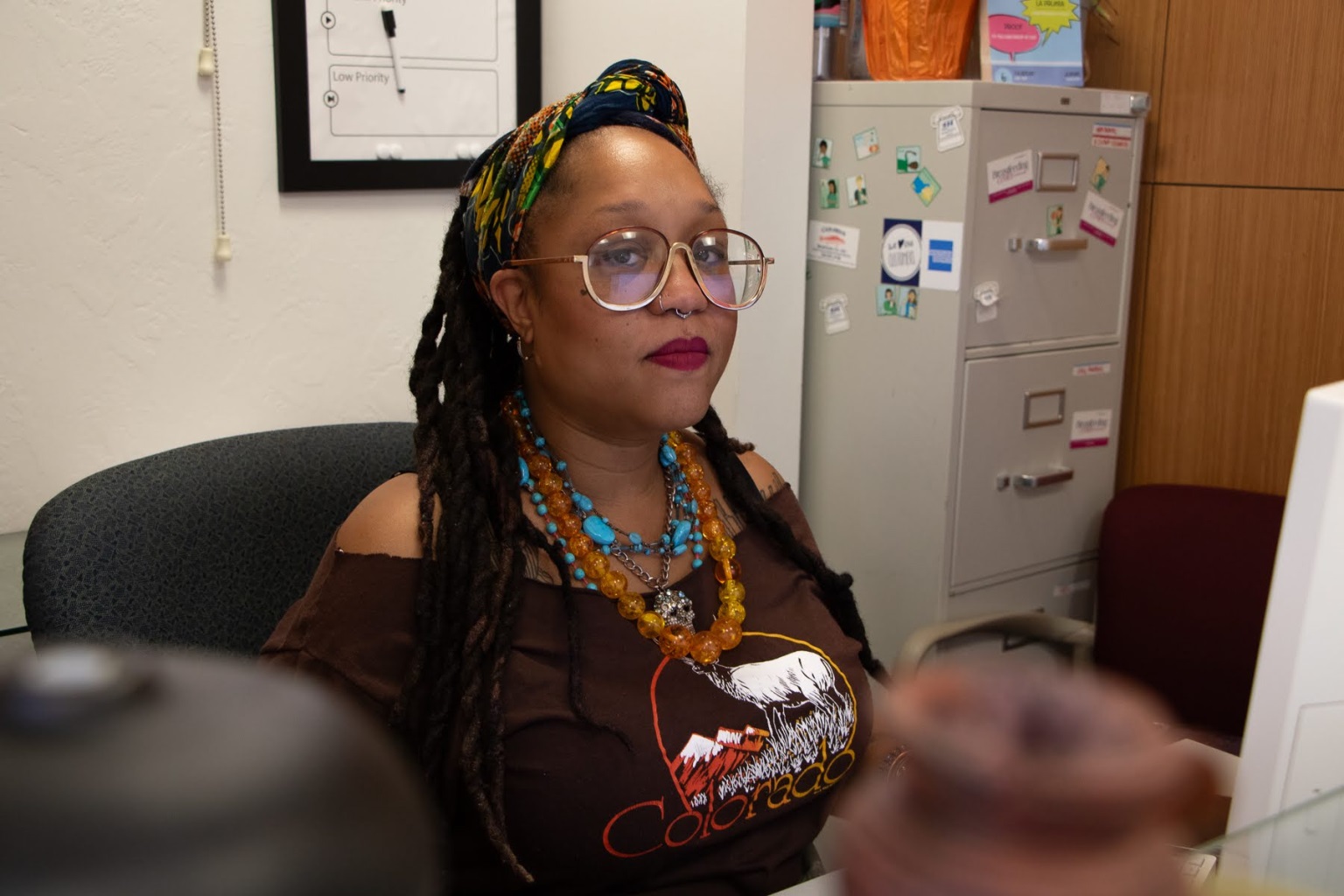
Amber Edmunds at her desk at the MAYA Organization offices in Swissvale on July 12, 2023. As the director of civic engagement at MAYA, Edmunds works to challenge the lack of support that society provides to Black mothers. (Photo by Alexis Wary/PublicSource)
First-person essay by Amber Edmunds
I grew up surrounded by women: an army of moms, some single, all occupied by the bulk of the child-rearing. Even as a small child, I saw how exhausting it was to be a mom, witnessed the lack of support for moms, and noted the way they were able to lean into each other to provide encouragement that didn’t come from anywhere else. Then, I didn’t want any part of it. Now, I celebrate those powerful women who triumphed over such challenges and adversity.


For Black women, being a mom is a special struggle, and becoming a mom is very often filled with medical trauma. Providers are neglectful and dismissive; examinations can be violent; structural and personal racism is revealed at every turn. I have a friend who lost as many as eight babies, and her doctors never gave her any explanation, much less support. At one point, she had an ectopic pregnancy and lost her ovary. And there was nowhere for her to put her grief. Her experience isn’t uncommon: You hear about it all the time in Black communities. Women talk about loss like it’s grocery shopping.
I was very young when I had my first child, and while there were many challenges, I was nourished by the company of those other moms. Just as I had watched my mothers do, we leaned into each other, shared our pains and joys, and raised our children together. At the time, I worked in a spa where I was surrounded by women, many of them sharing the hard work of raising children. Before my son’s birth, I had an outsider’s interest in reproductive health, and so I was there to listen to the other moms in the spa: to hear about the baffling doctors’ appointments, the loneliness, the struggles with money and so much more. So often women, especially Black women, don’t have a space to be heard as they go through the ugly parts of motherhood. It’s supposed to be such a polished, joyful time, but it really isn’t: There’s pain and hardship and isolation in mothering.
The racial discrepancies in women’s experiences of birth and motherhood became glaring to me when I moved from a spa in the city to one in the suburbs. The suburban women were mostly white, and they seemed to have a very different experience of mothering from my sisters in the city.
Both groups had the same questions about sleeping and breastfeeding, bonding and crying, but the white moms very obviously had more supports in place and their experiences of medical care were largely positive. No one was gently explaining to Black women what our bodies were doing.
We had learned to dread obstetric care since our first gynecological check-ups as teenagers. Then, doctors’ aggressively probing fingers were accompanied by their voiced biases about what it meant to be a Black teenage girl. Later, many of my friends had intense, negative experiences giving birth in hospital, some losing their reproductive organs, losing their babies — and nobody ever took the time to explain what had happened. They just had to keep living as if nothing was the matter, as if all that pain and loss wasn’t something anybody should talk about.