
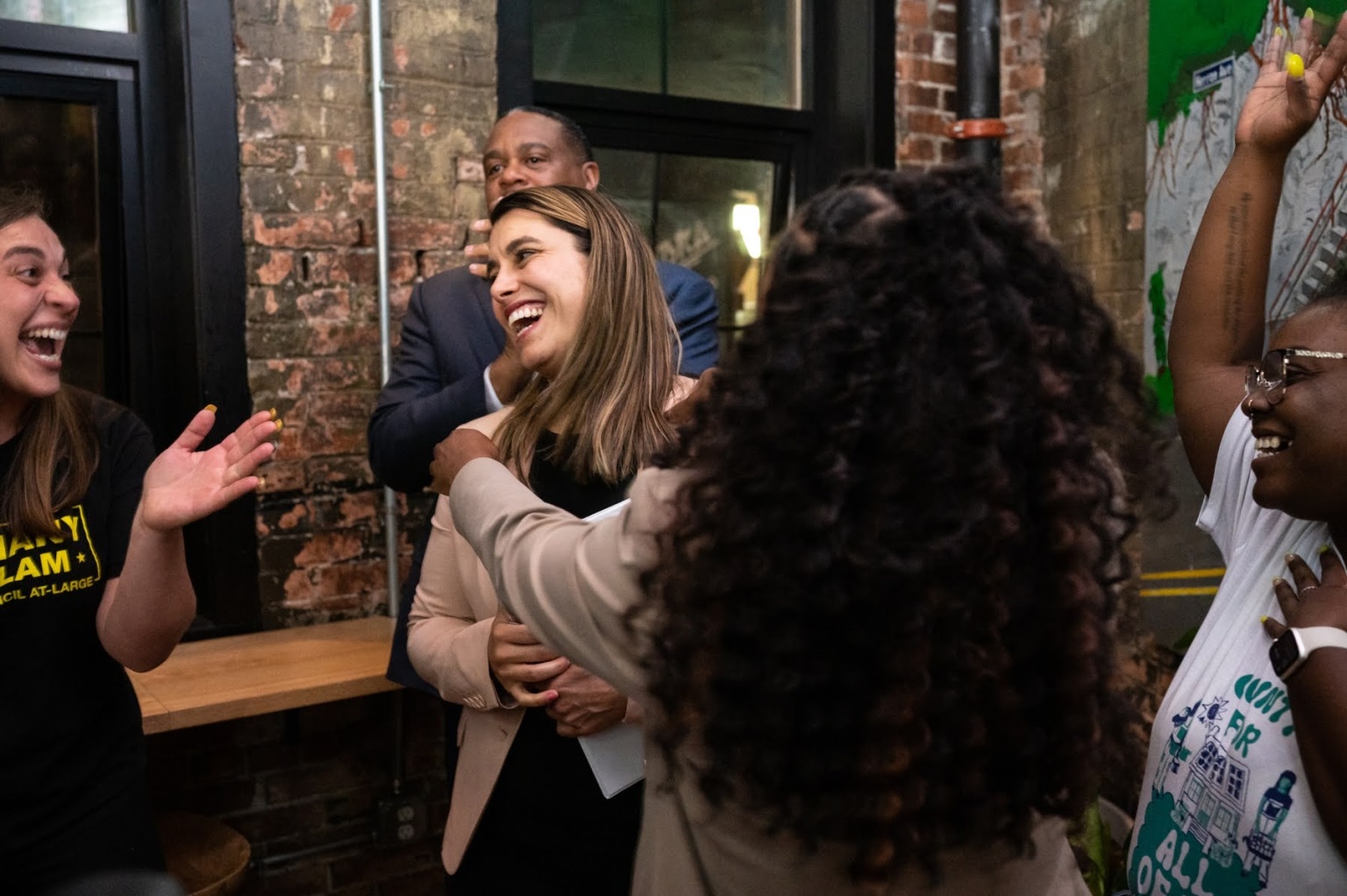
From left, Bethany Hallam, incumbent Allegheny County councilperson at large, Pittsburgh Mayor Ed Gainey, and U.S. Rep. Summer Lee, front, celebrate with Sara Innamorato, center, a state representative running for county executive, on Tuesday, May 16, 2023, as she arrives at her election party at Trace Brewing in Bloomfield. (Photo by Stephanie Strasburg/PublicSource)
A coalition of elected Democrats, labor unions and big business worked together for decades to lead Allegheny County. Will all of those interests still be at the table?
by Charlie Wolfson, PublicSource
Summer Lee and Sara Innamorato helped kickstart Southwestern Pennsylvania’s progressive movement with surprising state House victories in 2018. Tuesday night, Lee introduced Innamorato after the latter ascended to the very top of Allegheny County’s Democratic Party, winning the primary for county executive over well-established party hands — largely without courting the business community.
A decades-long custom of cross-cutting cooperation — between Democratic factions and Republicans, big labor and big business — could be on its way out. Innamorato and her allies could trade a tradition of collaboration between power brokers for a more direct connection with voters — a shift that may have major consequences both in future elections and in the function of government.
“What we’ve shown them in every single election cycle since we started is that the power of the people is always greater than the people in power,” Lee, now a member of Congress, said Tuesday night.
Now Lee, Innamorato and their friends are the people in power, at least in the Democratic Party, which has dominated county elections for the last two decades. Progressive Matt Dugan won the Democratic nomination for district attorney, and could join incumbent and primary winner Bethany Hallam (county council at-large) and fellow progressives Pittsburgh Mayor Ed Gainey and Lee in government. And if November general elections go their way, their movement will get a chance to govern without major opposition in local office.
Innamorato will face Republican Joe Rockey in the general election in November.
“The county executive position is far more powerful than the mayor or a member of Congress,” said Joe Mistick, a Duquesne University law professor and political commentator who was an aide to former mayors Richard Caliguiri and Sophie Masloff. If Innamorato wins in November, “She can define how the government should work with this new alignment.”
In a Wednesday afternoon interview, Innamorato suggested the local power structure is evolving to be more inclusive, not going away altogether.
“There’s this conversation around being anti-establishment, but I reject that because I’m an elected official currently,” she said. “I’m a part of that political power structure. But it doesn’t mean you need to use that political power structure as it’s always been used. We can be less status quo and use those institutions and establishments for greater good and greater access.”
‘Single voice’ or clear-eyed debate?
Outgoing Executive Rich Fitzgerald said in an interview Wednesday that collaboration with pro-business groups like the Chamber of Commerce and the Allegheny Conference was key as leaders “worked together to try to dig Pittsburgh out of the economic hole from when steel collapsed.”
Some of the region’s big achievements have been logged when it has spoken with a single voice that includes institutional Pittsburgh and labor unions, said Tom Murphy, who served as Pittsburgh’s mayor from 1994 through 2005 and is now a senior resident fellow at the Urban Land Institute.