CHIEF IKHANA marches along Brighton Road, on the North Side, Jan. 30. (Photo by Rob Taylor Jr.)
B-PEP demands that what happened in Memphis never happens in the future in Pittsburgh
The video of Tyre Nichols being beaten by Memphis police officers, then receiving no care from EMTs, leading to his eventual death, was so bad that officials decided to wait until Friday night, Jan. 27, to release it.
Officials wanted all the people in Memphis and elsewhere who were working “traditional” hours of 9 to 5 to be able to get home safely, fearing that the country would be turned upside down by rioters and protesters.
Except…that didn’t happen.
Sure, there were protests and rallies around the country for Tyre Nichols, the 29-year-old Black man seen in the video being apprehended and then beaten like he was not human, by police officers of his same race, on that fateful Jan. 7 evening. But they lacked the destruction that came following the unwatchable death of George Floyd, captured by a teenager in Minneapolis in May 2020.
If you’re Chief Ikhana, a Black woman from Pittsburgh, you’ve been through this before. A number of her friends were killed by police in the Pittsburgh area, including Bernard Rogers, who was 26 years old in 2002 when he was shot by a Pittsburgh Housing Authority officer in Bedford Dwellings, Hill District. In reports from the Tribune-Review, Rogers’ sister, Vaughnette, was quoted as saying that “regardless of what they said, they (the police) killed him. You killed him even if you said it was an accident.”
Authority Police said Bernard Rogers was the target of a drug investigation, and, according to the Tribune-Review report, they said Rogers tried to grab an officer’s gun after he pushed an officer and knocked down another.
“If you’re selling drugs, then that makes you eligible for public execution I presume,” voiced Chief Ikhana in disgust.
Chief Ikhana was among the few dozen who marched from Brighton Road and Western Avenue on the North Side, to the Zone One Police Station a few blocks up the road, Jan. 30. It was the second protest in the City of Pittsburgh to show support for Nichols, while chastising police in general. The Pittsburgh Feminists for Intersectionality and Black Liberation Autonomous Collective were the primary organizers of the protest.
“It’s important to make sure that people’s rights are protected, that this violence against the average man or woman needs to stop,” Chief Ikhana told the New Pittsburgh Courier exclusively at the protest. “They really need to look into before the cameras were rolling. This has been going on for a long time. There’s a lot of people who died just like Tyre Nichols and George Floyd.”
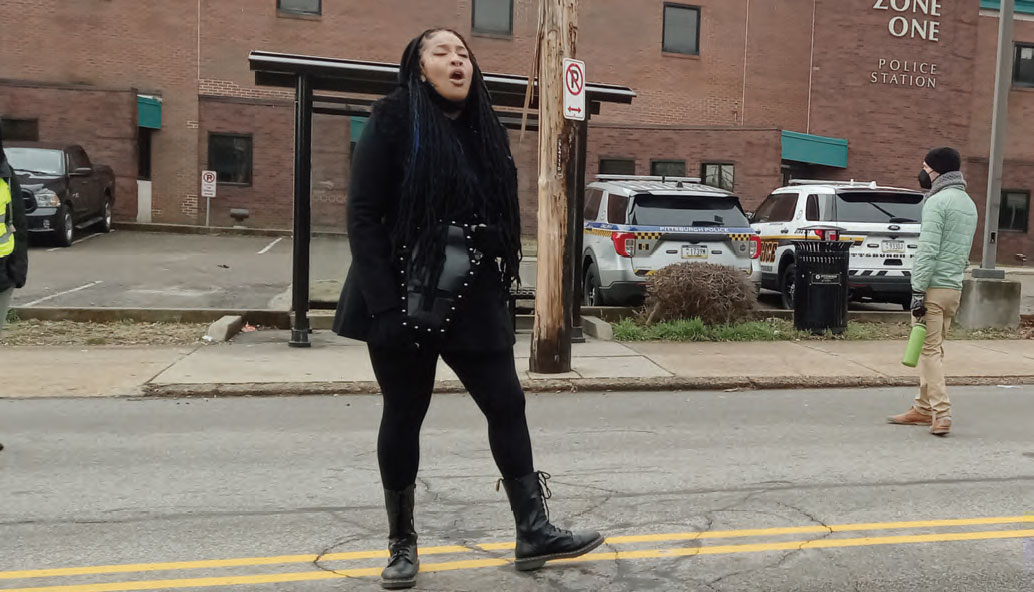
TOY SLAUGHTER SPEAKS AT THE PROTEST, JAN. 30, IN FRONT OF THE ZONE ONE POLICE STATION.
Toy Slaughter, a speaker at the protest, said that “as a Black person here in America, it is ingrained in you to be terrified of these racist murderers. My son was 2 years old; if he heard a siren, he would start running down the street to get away. I never taught him that police were bad; it is literally instilled in us from birth to be terrified of these racist (police) who just keep murdering us in the streets in cold blood.”
Saint Valentino, another speaker, asked the crowd: “What are we going to do about it besides protesting today? How are we going to protect our Black people here in Pittsburgh and the Greater Pittsburgh area from preventing that from happening? We already have multiple people who have passed away from the police in Pittsburgh, including Jim Rogers, who has yet to receive justice. Therefore I ask, what are you going to do for the Black community?”
Tim Stevens, with the Black Political Empowerment Project, sent a letter on Jan. 30 to Mayor Ed Gainey, acting police chief Thomas Stangrecki, City Council President Theresa Kail-Smith and Public Safety Director Lee Schmidt, urging that “steps be taken immediately to send an urgent message to your command staff and to each officer of the Pittsburgh Bureau of Police that such behavior as seen in Memphis, Tennessee, or anything even close, will not be tolerated in Pittsburgh.”
But that’s not all. Stevens said he wants them to inform the officers that such behavior would result in “immediate termination of employment, as well as the filing of criminal charges.”
Stevens is also urging Acting Chief Stangrecki to keep in place the policy that prevents city officers from pulling over residents for minor traffic violations. Acting Chief Stangrecki, according to other local media outlets, had reversed the policy in the latter stages of 2022, after City Council, notably Councilman Rev. Ricky Burgess, pushed for the legislation in late 2021, which was passed by City Council.
“Once again, it is the hope of the Black Political Empowerment Project that our City of Pittsburgh be pro-active in setting the tone for positive community-police relations,” Stevens said, “and making it clear to all members of the Pittsburgh Bureau of Police that they are in fact paid to ‘protect and serve’ and that nothing less is acceptable.”
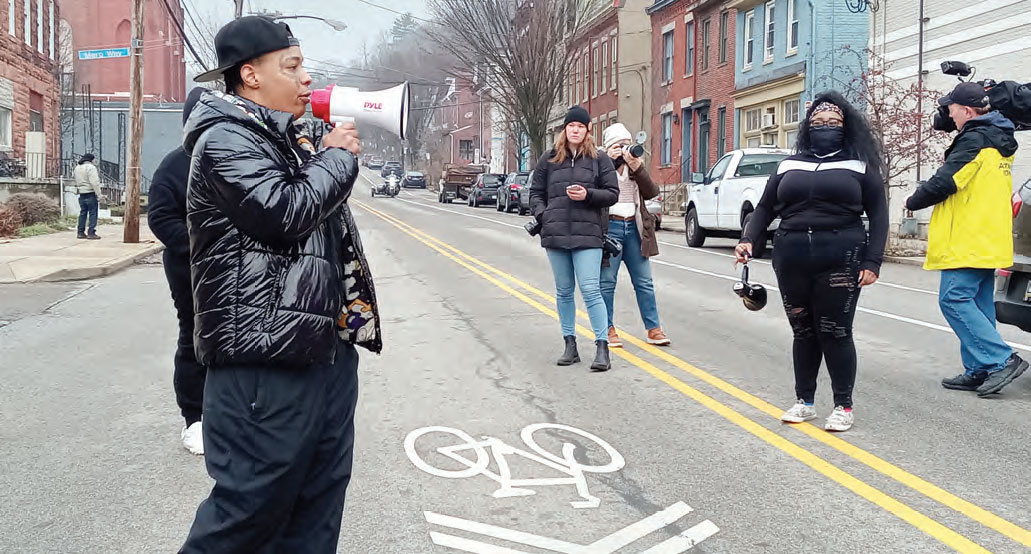
A SPEAKER ADDRESSES THE CROWD DURING THE JAN. 30 PROTEST ON THE NORTH SIDE.
About Post Author