
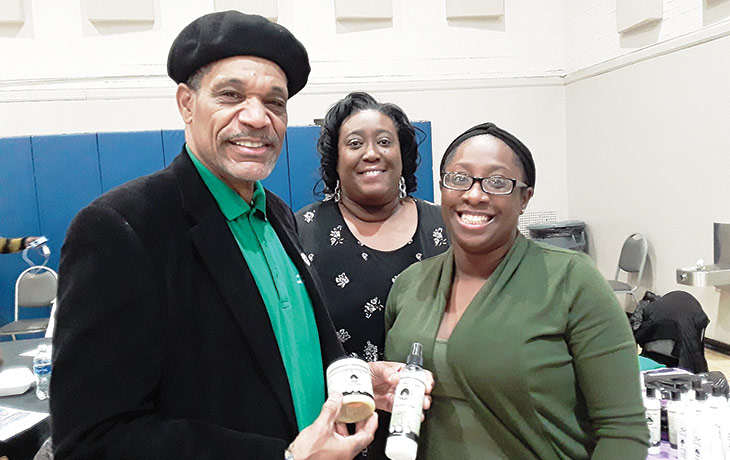
Ernest Bey has been having a problem with a dry, flaky scalp.
So to remedy the problem, on Saturday, Dec. 7, he bought some moisturizers, not from a Walgreens or CVS, but from a local Black business.
Bey said it’s important to him—and should be important to all African Americans—to support local Black businesses such as Mirror Image Salon in Braddock Hills, which sold him the products from their JK Hair Care line during the first annual East End Restorative Black Business Expo at the Hosanna House in Wilkinsburg.
“I think it (the Black dollar) needs to stay in our community,” Bey told the New Pittsburgh Courier at the event. “I’m all on board any time I can, supporting the African American businesses.”
African Americans compose just 14 percent of the U.S. population, Blacks spend $1.2 trillion as consumers, according to a study released by Nielsen in 2018.
“When it comes to African American consumer spend, there are millions, sometimes billions of dollars in revenue at stake,” said Andrew McCaskill, senior vice president, global communications and multicultural marketing, Nielsen, in the report. “With 43 percent of the 75 million millennials in the U.S. identifying as African American, Hispanic or Asian, if a brand doesn’t have a multicultural strategy, it doesn’t have a growth strategy. The business case for multicultural outreach is clear. African American consumers, and all diverse consumers, want to see themselves authentically represented in marketing, and they want brands to recognize their value to the bottom line.”


Major companies have entire teams dedicated to attracting the African American consumer and their dollar, which greatly contributes to the Black dollar leaving the African American community. A report in the Austin (Texas) Weekly News from 2018 stated that just 2 percent, or $26 billion, of the $1.2 trillion in Black spending power is re-circulated into the Black community.
There is no data publicly available on the Black spending power in the Pittsburgh region, but Black businesses here want to make sure fellow African Americans are spending some of their money with them.
The 200 consumers who walked into the Hosanna House gymnasium were greeted with Black business owners like Howard Hanna Real Estate agent Fatinma Olaleye, Lisa Harris’ LL Creations (hand-crafted materials), Alexis Childress’ Lexx Do It All Party Planning Services, Deborah Clifford’s 5 Kays 2 Jays (hand-crafted Artisan jewelry), Destinee McFadden’s Q-Siren Eyelashes, and Ralyn Wright’s The Wright Way Company Events and Crafts.
Some other Black businesses at the event were AK Catering, Young Radiant Scholars Childcare Services, DJ Mightyman Productions, PURSE-n-als, and Bo’s Nachos.
For Ralyn Wright, she specializes in custom glassware…but “now I’m doing the whole entire package for your party,” she said. “The backdrop, cupcake and cake toppers, custom straws, invitations, different types of labels…”
Wright said in February 2020, she’ll begin booking for girls spa parties, ages 8 to 12. “Robes, activities such as making bath bombs and painting nails, pedi/manicures,” Wright said, as many parents like to throw parties for their young daughters.
McFadden hasn’t even reached her 21st birthday, but she is beginning her journey as an entrepreneur with her own line of eyelashes (Q-Siren).

“A woman loves eyelashes just to enhance her beauty,” McFadden told the Courier. “Women are already beautiful, but just to enhance beauty and make you feel beautiful and unique is what a woman needs.”
North Side native Shanon Williams just celebrated two years in business at her company, Self Care Housekeeping.
“We’re a home wellness service, so we deal with stuff in the home that’s affected by mental, emotional, spiritual, physical stress on the body,” Williams, who has a bachelor’s degree in social work from Pitt, told the Courier. “It tends to reflect into your home, so that tends to (reveal itself) in the (inability to) clean the house, not eating properly, bills getting piled up. We do cleaning, organizing the cluttering, meal prep services, and we do home management,” which includes consolidating paperwork, making sure bills are paid on time, etc.
“We’re not tending to a person’s home, we’re tending to a person’s well-being through their home,” Williams added.
Self Care Housekeeping serves homes in Allegheny County, and just expanded into Greensburg, Westmoreland County.
Most of the Black businesses that spoke with the Courier at the Dec. 7 expo said the toughest part about operating a business was marketing to consumers on a large scale. Sure, there’s Facebook, Instagram, and business cards, but many businesses said in order to have billboards or radio and television commercials, there has to be a financial commitment that, as of now, can’t be met.
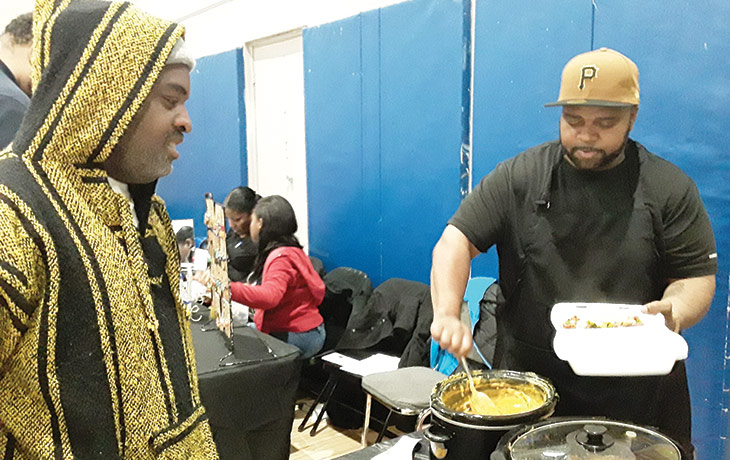
But events such as the East End Restorative Black Business Expo gave the Black businesses one-on-one exposure with potential customers. Anthony Bey, who formed Bo’s Nachos out of his home, said the event was beneficial because they could watch him work his magic.
“It’s nachos, but it’s not a typical nacho, so people look at it and think it’s just a nacho, until they try it and they say, ‘that’s something different,’” Bey said.
Bey places whatever you delight on the nachos—chili, smoked sausage, turkey sausage, ground meat, cheese, veggies—with different layers. “It’s just different, it’s got a unique taste, it’s really healthy for you, too,” Bey told the Courier.
Wright sold some of her custom glassware at the event, as she also labeled the event as beneficial. “You have people here who are selling things, who are like-minded, who are hungry and grinding and who are creative,” she said, “and they’re coming together and they’re here to support you.”
ERNEST BEY, left, purchased moisturizers from Mirror Image Salon’s JK Hair Care line at the East End Restorative Black Business Expo, Dec. 7, at the Hosanna House in Wilkinsburg. Also pictured are Mirror Image Salon’s Tamara Marshall, center, and Brittany Marshall. (Photos by Rob Taylor Jr.) (Feature Photo)
by Rob Taylor Jr. , Courier Staff Writer