Of course there is some occasional bickering that Franklin Roosevelt was more worthy than his cousin Teddy, or Andrew Jackson a more popular choice than Jefferson, but for Borglum’s purposes the presidents he chose symbolized America’s greatness, and their individual contributions to the nation’s emergence and expansion.
But what if a contemporary sculptor were to tackle a similar mountain-sized enterprise featuring the four greatest African-Americans in the nation’s history? Should the world of politics remain the focus, or should it be opened to other worthy candidates in the artistic, athletic, and scientific arenas?
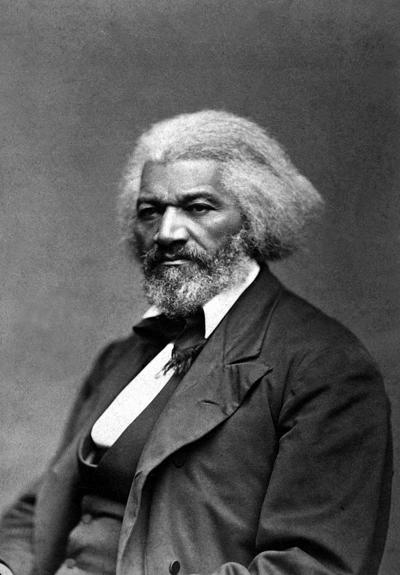
Frederick Douglass — social reformer, abolitionist, orator, writer, and statesman — was a lion in the fight to end slavery and enfranchise Blacks during the 19th century. In fact, it is difficult to think of another individual — regardless of race — who devoted more time prodding and pushing America to live up to its ideals. By sheer force of will, Douglass rose up from the most humble of circumstances to become recognized around the world as a moral giant. As he often told audiences during his many social justice campaigns, “I would unite with anyone to do right and with nobody to do wrong.”
Martin Luther King Jr. is an iconic figure in the African-American struggle for civil rights in mid-20th century America. The son of a Baptist minister as he was himself, King felt the sting of prejudice early on and committed his life to fighting injustice, and advancing his people’s station in life through non-violence and the use of civil disobedience. A leader of numerous social justice and civil rights crusades stretching from the Montgomery Bus Boycott and the founding of the Southern Christian Leadership Conference to his anti-discrimination campaigns in Birmingham, Selma, Chicago, Memphis, and a host of other cities. King was well deserving of winning the Nobel Peace Prize for a life dedicated to combatting racism and discrimination.
Paul Robeson, athlete, lawyer, stage and screen artist and social activist, is arguably the greatest example of a Renaissance man America ever produced. A graduate of Rutgers College where he attained All American football honors, Robeson earned a Columbia Law School degree, but made his mark as an accomplished bass-baritone performer who appeared in dozens of stage shows and dramas as well as films from the 1920s to 1940s including Othello, Showboat, Sanders of the River, and Proud Valley. Increasingly preoccupied with America’s entrenched racism and Jim Crow laws, he grew more politically active, and championed an array of causes in behalf of discriminated peoples, both home and abroad. Though he would pay dearly — both economically and in freedom of movement — for his political stances, he argued, “The artist must take sides. He must elect to fight for freedom or slavery.”
Leon Sullivan was a Baptist minister and civil rights activist who focused on job training opportunities for African-Americans, and campaigns opposing apartheid government in South Africa. Born in West Virginia, Sullivan became a minister, moved to Philadelphia and in Zion Baptist, built one of the largest Black church congregations in America. He would become the first African-American on a major corporate board (Coca-Cola), create job training programs like the Opportunities Industrial Center, but also devote time to issues impacting blacks around the world, including vigorously pushing for political reform in Africa, and an end to apartheid in South Africa.
Unquestionably, all four men contributed mightily to the freedom and welfare enjoyed by African-Americans today. At the same time, no doubt there are readers asking, “Where is the name of W. E. B. Du Bois?” “Why isn’t Thurgood Marshall on the list?” “Or Barack Obama, the nation’s first Black president?”
Others may blanch at the omission of any women. “Why aren’t Harriet Tubman, Ida B. Wells, Mary McLeod Bethune or Sojourner Truth worthy of inclusion? And why leave out those from the entertainment industry or the athletic arena? For example, Muhammad Ali was once the most recognized person in the world, Jackie Robinson a groundbreaking force in America’s pastime, or Jesse Owens and Joe Lewis who single-handedly destroyed the notion of Aryan superiority?
“And what about great writers like Lorraine Hansberry, Langston Hughes and James Baldwin or men of science like Charles Drew, George Washington Carver and Daniel Hale Williams?”
There is certainly room for debate — the historical landscape is filled with qualified candidates. And it is appropriate during African-American History Month that we reflect on those who have come before us, engaged in the struggle, and achieved a level of excellence deserving of its own Mt. Rushmore.
U.S. Rep. Dwight Evans (D-Pa.) represents the 3rd Congressional District and had served 36 years in the Pennsylvania General Assembly. Allen M. Hornblum is a historian and author of seven books on topics ranging from medical ethics to Soviet espionage.
https://www.phillytrib.com/commentary/african-american-greats-deserve-a-mt-rushmore/article_33154c17-b422-55c5-ae25-da2432f52807.html
https://www.phillytrib.com/commentary/african-american-greats-deserve-a-mt-rushmore/article_33154c17-b422-55c5-ae25-da2432f52807.html
About Post Author
