

The artists involved say that’s no accident.
Rizzo’s supporters remember him as a devoted public servant. But his critics, many of them people of color, recall his approach to policing as corrupt and racist. He once said: “We talk of overcrowded prisons. If the prisons are crowded, if we need more prisons, let’s build them,” adding that the average criminal “doesn’t even know what the word rehabilitation means.”
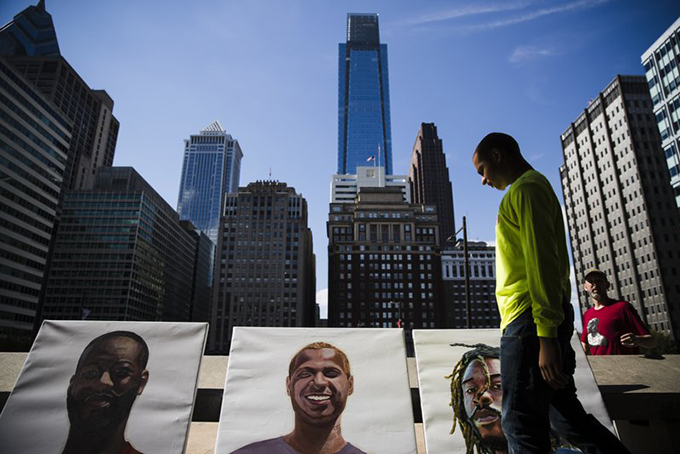
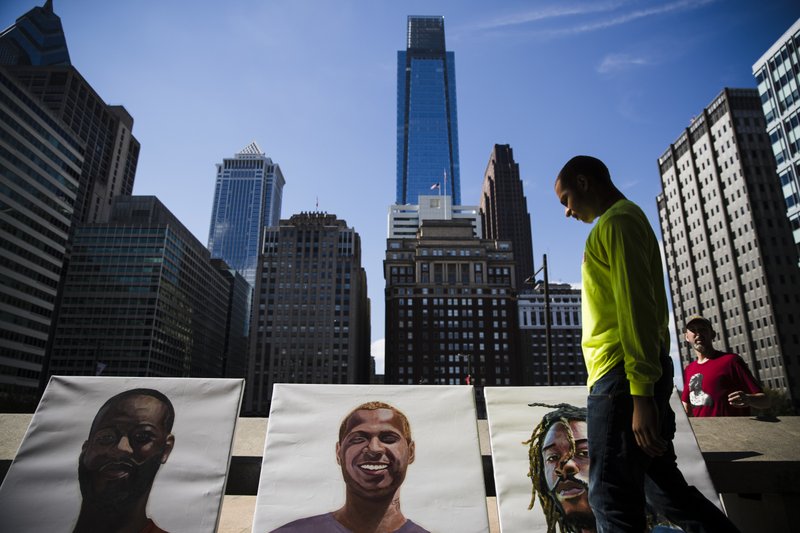
For the 17 men and women depicted in oversized portraits, rehabilitation has come through connecting with art and their community. They all work for a Mural Arts program called “The Guild,” a paid apprenticeship for formerly incarcerated people, seen as a way to unite those affected by crime through shared creative expression.
Their images — many looking elated and beaming, others evoking a quiet pride — wrap around the base of the building and are painted against a brick background meant to symbolize the barriers to re-entering society after being released from jail. During five performances over the next few weeks, the public will have an opportunity to wipe away a brick, and replace it with their own handwritten thoughts on how to solve problems in the criminal justice system. By the end of the program, the bricks will have vanished, replaced with solutions.
At the unveiling Wednesday, lead artists Jesse Krimes and Craig wiped two blocks clean. Mayor Jim Kenney and District Attorney Larry Krasner each wrote their ideas for reducing incarceration. Kenney wrote: “Employment and Training;” Krasner wrote: “End excessive parole and probation.”
He has created a piece specifically for “Portraits of Justice.”
Other formerly incarcerated artists to perform are: Shontina Vernon on Oct. 11; Sue Ellen Allen on Oct. 18; and Mary Enoch Elizabeth Baxter on Oct. 25. The program culminates on Nov. 2 with a symposium at the University of Pennsylvania led by Luis Suave Gonzales.
The program is one of the first projects funded by the Art for Justice Fund, which was launched in 2017 and invests in programs working to cut the U.S. prison population and boost education and employment opportunities for the recently released. Philanthropist Agnes Gund in collaboration with the Ford Foundation and Rockefeller Philanthropy Advisors founded the fund.
The mural’s placement at the building isn’t the only temporary art on the site. After protests over the Rizzo statue and community meetings, Kenney announced last year that it would be moved to a new location. In August he said the move wouldn’t happen for at least two years.”
Christopher Bryant’s face is one of the 17 featured on the mural. The 24-year-old did 2 ½ years in prison for robbery, and has been working with The Guild for about three months, referred by his probation officer. He’s learning carpentry, airbrushing and life skills and has worked on murals around the city, he said.
“It’s exciting and I’m so happy my face is a part of something positive. I want people to know I’ve changed,” he said.