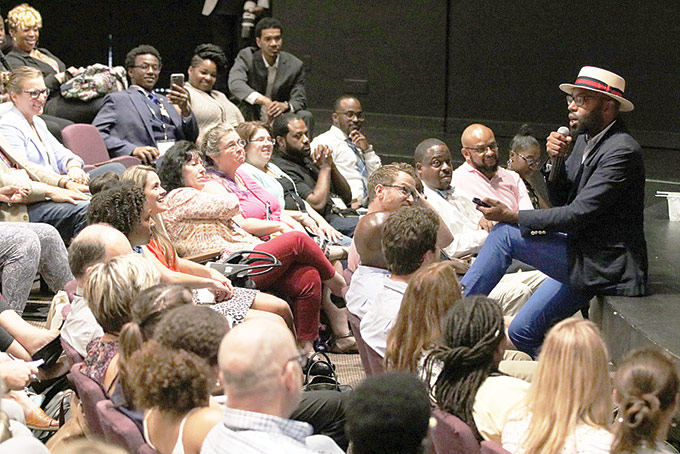
It was a recurring theme at the State of Black Learning conference held at Chatham University recently—The education system is a flawed system.
The question now is, what can be done to still give African American youth the proper education and tools to succeed?
The State of Black Learning conference was established by the Urban Academy of Greater Pittsburgh charter school this year. It was held, Aug. 17-18. Teachers, school administrators and other professionals were in attendance, fostering a dialogue of how they can better serve African American students.
Keynote speaker Dr. Christopher Edmin, author of “For White Folks Who Teach in the Hood,” didn’t mince words during his 20-minute speech. “If you see crime in neighborhoods, it’s the school’s fault. It’s the teacher’s fault,” Dr. Edmin said, with varying reactions from the crowd. “And don’t tell me, what about the parents? Those parents went to a school that failed them, that put them in the cycle they’re in. You got a job, and your job is teacher, educator,” as Dr. Edmin challenged the teachers in the crowd to hold themselves more accountable.
“Time is of the essence. Young people are dying, a physical death,” Dr. Edmin continued. “Young folks are shooting young people…he saw no value for that dude’s life, and I’m telling you that the devaluing of the life of others is based on a schooling system that is not truly (teaching) young folks to understand the beauty of a man as you are, and you have a potential beyond who you are.”
Dennis Henderson didn’t mince words, either. In an exclusive interview with the New Pittsburgh Courier, the Deputy CEO of Manchester Academic Charter School believes “our education system is flawed. When you just look at the fact that we utilize standards as a measurement. I have two children. My two children are not the same. I cannot hold them to the same standard as far as saying, ‘this is your intelligence test right here’ and if you do well, you’re my favorite daughter, because you’re more intelligent than my other child,” Henderson explained. “No. I have one child that excels in certain things that the other child doesn’t, and I don’t have any worries about either one of my children because I know in their own due time, they’ll both get to where they need to be to be the best person whom they are, and I don’t need a standardized assessment to tell me what child is better than what, or if my children are at a level where they are proficient, or below average…just the whole concept that we have in this country is what flaws our system.”
Henderson cited countries like Finland as having a viable education system, where students are never referred to as “failing.” Thus, “being that you cannot fail, you can never be considered below meeting a benchmark,” he told the Courier.
The conference’s theme was, “Justice. Equity. Excellence.” K. Chase Patterson, CEO of the Urban Academy, said in a release he was “very excited to challenge our educators to lean forward in love, care and compassion in the ultimate pursuit of a just, equitable and excellent learning experience for the Black children in our classrooms.”
Allen Gunter, a fifth-grade co-teacher at Urban Academy, told the New Pittsburgh Courier that the first step of bettering Black students in the classroom is simply listening to them. He believes that Black students’ voices are often not heard, so it’s important to “embrace hearing what they have to say and then giving my feedback,” he said. Then it’s about “getting to know your students, your scholars, to have that bond, that relationship, and being accountable for your actions and holding them accountable for their actions.”
Sam Morant, director of programming and co-founder of 1 Nation Mentoring, told the Courier more emphasis should be placed “on the people who are actually influencing and teaching the Black students and making sure they’re culturally competent and prepared and ready to go into these types of classrooms.” Morant said most times, the teachers and the administration staff “aren’t from the neighborhoods that the kids are from, they can’t relate to their lifestyles or what they’ve been through.”
Like us at https://www.facebook.com/pages/New-Pittsburgh-Courier/143866755628836?ref=hl
Follow @NewPghCourier on Twitter https://twitter.com/NewPghCourier
About Post Author
