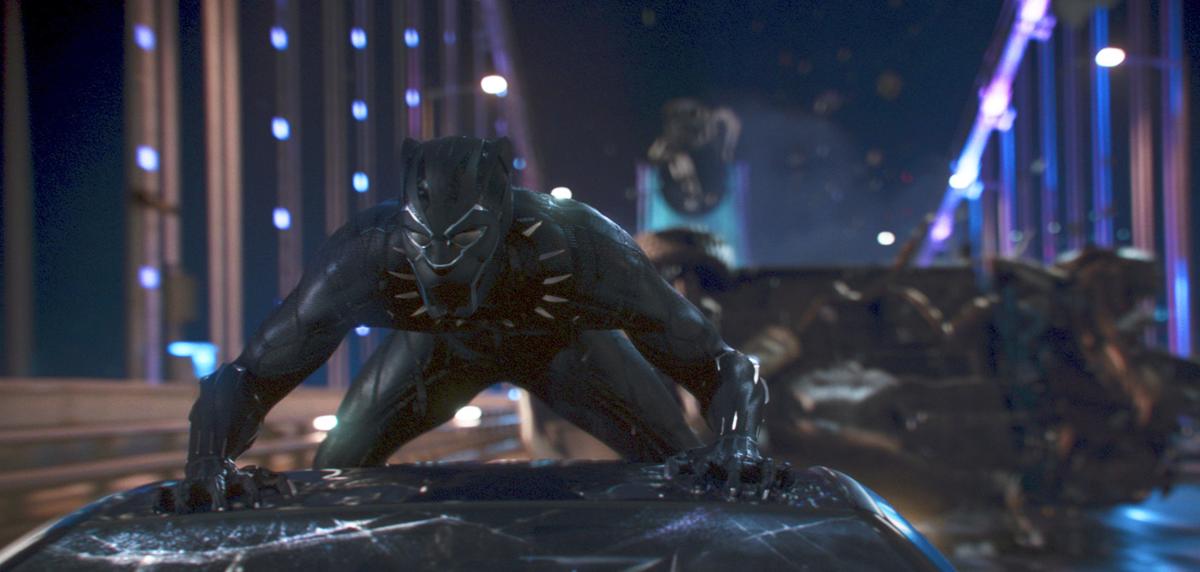
Over the weekend I took in the movie, and I was tickled by the mix of bemusement and derision etched on the faces of some moviegoers who could not figure out why African Americans and Africans showed up at the suburban theater decked out in traditional African wear to eat popcorn, sip soft drinks and cheer with the atypical fervor the exploits of King T’Challa, aka the Black Panther.
I’m sure that in most cases those who saw this as spectacle defaulted to “It’s just a movie,” and they are right, it is just that.
Matthew Henson has been to the North Pole and Jackie Robinson has long since broken the color barrier in baseball, yet – and this is a societal indictment – we still celebrate African-American accomplishments that are famous firsts. And when it happens in places where bigotry is still the norm – like Hollywood – reasons for celebration become amplified.
Moments like this are particularly gratifying when they occur in places known to fly “No colored” signs prominently.
Take, for example, the country club sports. In 1990, Hall W. Thompson, founder of the Shoal Creek Country Club near Birmingham, Ala., famously said, “We don’t discriminate in every other area except the Blacks.”
So when nappy-headed Tiger Woods started showing up at these events and making a mockery of the majority White fields, brother and sisters who never set foot on a golf course couldn’t contain their joy.
Serena Williams is universally loved now that she has demonstrated herself to be the best women’s tennis player of this or any other era. But before she won 23 Grand Slam singles titles, Williams, in 2001 and still a teenager, was booed unmercifully at a tournament in Indian Wells, Calif., after a never-verified yarn was spun accusing her father of fixing matches.
“When Venus and I were walking down the stair to our seats, people kept calling me n—-r,” Richard Williams told USA Today. “One guy said, ‘I wish it was ’75; we’d skin you alive.’ ”
It is this type of ignorance that still exists years after after the Rev. Martin Luther King Jr. and Malcolm X gave their lives in an effort to force the nation to live up to its audacious declarations. It also comes more than a century after Matthew Henson reached the North Pole, and 70 years after Jackie Robinson broke Major League Baseball’s color barrier.
So after the Academy Awards went two years (2015-16) without nominating any Black actors, 2018 has yielded this: a movie, produced by Disney, with a majority Black ensemble that set the February release record by taking in $192 million nationwide. Throw in the $362 million the flick grossed internationally and that’s more than a half-billion dollars.
However, it matters on deeper level when my boy from North Carolina A&T brags that Jesse Jackson is an Aggie and I can counter with Thurgood Marshall is a fellow Howard Bison, and, oh, by the way, so too is Chadwick Boseman, Black Panther’s star.
It matters that Kenyan Lupito Nyong’o, with her flawless near-midnight complexion, is not only a stunning beauty but that she can get work in Hollywood where thousands before her, and like her, previously were only casts as cleaning ladies, slaves or extras.
It matters that Michael B. Jordan, who has played incredible roles from “The Wire” to “Fruitvale Station” to “Creed,” now has the opportunity to showcase his talents with powerhouses such as Marvel and Disney behind him.
That Daniel Kaluuya, a Londoner who is the son of a Ugandan immigrant and was the 2017 breakout star in the critically acclaimed “Get Out” – for which he was nominated for an Academy Award — will not be a one-hit wonder.
So enjoy this movie experience. They don’t come around often but perhaps there is change in the air, air that has for so long been stale.
About Post Author
