This is part seven of my series entitled “End Philly’s Jim Crow Hiring and Business.” But unlike past columns, this one’s about blaming Blacks for financing racism. We go to stores and give our hard-earned money away to white folks who have not hired and do not hire anyone who looks like us. That’s crazy. And then we complain about being unemployed. That’s even crazier.
We gotta end the employment discrimination and gotta stop the co-signing of that discrimination. Racism in hiring along with the self-destructive fueling of that racism is the problem. So what’s the solution? There are three: Boycotts. Boycotts. Boycotts.
What’s a boycott? It’s a concerted refusal to purchase products or services from someone. It’s named after Charles Cunningham Boycott who, as a landlord in Ireland, charged high rent to his tenants. In response, they formed an organization in 1880 and refused to pay. That organization grew so powerful that Boycott’s employees became intimidated and stopped working for him. The protest spread to local businesses that wouldn’t accept his money and to the local post office that refused to deliver his mail. He was ostracized by the entire community, so much so that he left town. And the happy ending was that the rent was later reduced by the new landlord.
That’s the kind of thing we must do. We must boycott businesses to end their racist sinfulness or evict unrepentant businesses and replace them with respectful ones.
I don’t necessarily wanna change racists’ opinions or attitudes. I simply wanna change what they do to my community. And they can start by hiring us wherever we make them rich when we spend our money. In other words, they must respect us.
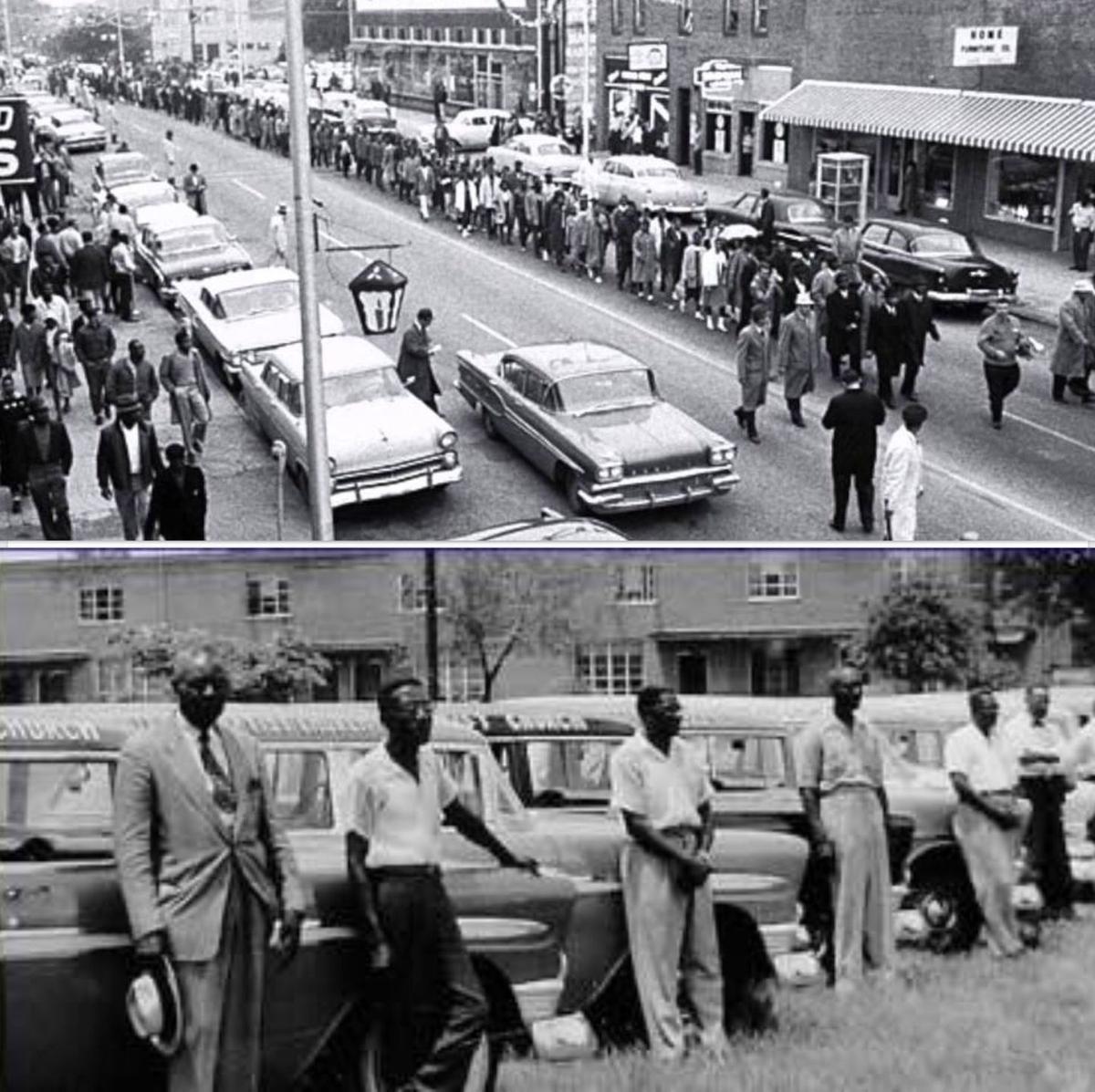
We don’t have to reinvent the wheel in order to gain that respect. Our ancestors and elders showed us the way. Remember the mid-1950s when the bus company in Montgomery took our money but made us sit in the back? Remember when we reminded them that we constituted 75 percent of their ridership? Remember when they ignored our demands for equality? Remember when we boycotted for 381 days from December 5, 1955 through December 21, 1956? Remember how it ended? Our ancestors and elders won when the racist bus company surrendered and began showing us some damn respect.
Two and a half years before the successful Montgomery Bus Boycott, there was a partially successful one in Louisiana. It was the first bus boycott in the country actually. On June 15, 1953, the Baton Rouge protest began after Black folks there were partially victorious three months earlier in their political battle regarding the passage of City Council Ordinance 222. l say “partially” because, although that local law mandated a type of “first come, first served” seating, it also mandated that Blacks be seated from the back to the front and whites from the front to the back. But because all the bus drivers were white, they defied the ordinance and wouldn’t permit any Blacks to reach the front or any whites to reach the back. Things got worse when a court invalidated that law by declaring it in violation of state segregation laws. As a result, Black leaders got together and organized a boycott. One of the spokespersons, Reverend T.J. Jemison of Mount Zion Baptist Church, said, “The Negro passenger has been… insulted and… (is) tired of… mistreatment and injustice.” The organizers then came up with something they called the “free ride network” that provided car and truck transportation by Blacks for Blacks at no cost. That strategy was later used by Dr. Martin Luther King Jr. in Montgomery.
The Baton Rouge bus company and, as a result, the downtown business owners were economically brought to their knees and begged for a compromise that reserved the two side front seats for whites and the long rear seats for Blacks. The remaining seats were to be available to anyone on a “first come, first served” basis. The Black community, after ten days of boycotting, grudgingly accepted on June 25, 1953, thereby laying the foundation not only for the completely successful Montgomery boycott but also for our right later to sit anywhere we want on buses, trolleys, cabs, trains, planes, and boats.
There was a much earlier transportation boycott, the Nashville Streetcar Boycott from 1905-1907. And although it wasn’t successful at all in terms of changing any of the streetcar segregation, it was extremely successful in another way. Here’s the background. The 1896 Plessy v. Ferguson ruling by the Supreme Court declared that “separate is equal.” Consequently, Tennessee in 1899 tried to expand its railway segregation law to apply to streetcars. After the state legislature went back and forth making revisions to comply with the state constitution, the new law, Bill Number 87, finally took effect on July 5, 1905. In response, St. Paul A.M.E.’s Reverend R.A. Jones, a prominent activist, publicly predicted that 90 percent of the Black community would boycott rather than accept second-class citizenship. And The Nashville Clarion, a Black weekly newspaper edited by Reverend Edward W.D. Isaac, called on its readers to purchase buggies if they could afford them and, if they couldn’t, to walk. The boycott began on that July 5 date, causing the Nashville Transit Company to lose hundreds of customers and a lotta money each day. The bad news is that by 1906, the boycott had ended without any change in the law. But the good news- I mean the great news- is that on October 3, 1905, the Black-owned and operated Union Transportation Company with its steam-driven cars and later its electric-powered buses, began traveling the city’s streets. Do for self! That’s the real answer to white racism.
All we want is equal access and equal opportunity. All we want is economic freedom. We demand to be hired appropriately and proportionately where we spend our money. And the first step toward getting what we want and what we demand is to realize that we gotta stop supporting people who don’t support us. We gotta start doing business only with people who do business with us. It’s just that simple. Otherwise, we’ll continue to die economically. Self-preservation is the first rule of nature.
So far, I’ve reached out to Urban Outfitters, CVS, and a few others to determine where they stand on equal access and equal opportunity from their entry-level positions to their boards of directors. You’ll be surprised by what I’ve uncovered. Stay tuned to find out which of Philly’s businesses will be on my condemnable “Name & Shame” list and which will be on my commendable “Show & Shine” list.
As the great Aretha Franklin sang, ”I’m about to give you all of my money. And all I’m askin’ in return, honey, is to give me my propers….” Blacks are like Sistah Ree Ree. We want and demand exactly what whites want and demand: R-E-S-P-E-C-T.
https://www.phillytrib.com/why-do-blacks-help-make-racist-businesses-rich/article_923d4de9-a88c-5538-a01c-1cc8405ab8f0.html
About Post Author
