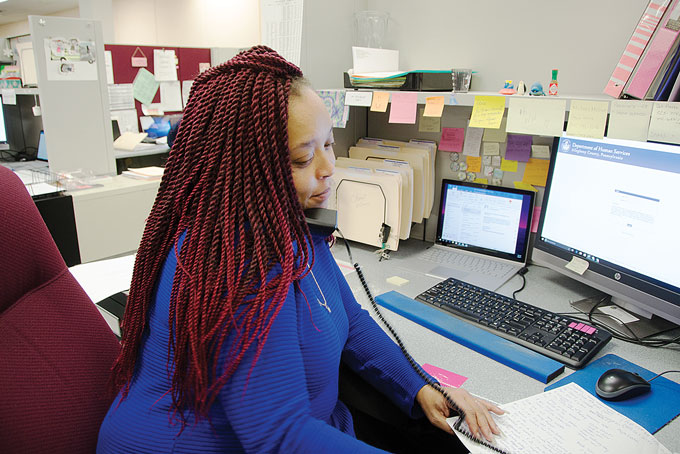
Employment as a caseworker with the Allegheny County’s Department of Human Services, Office of Children, Youth and Families is far more than just a job.
It’s far more than just removing children from homes. This is an important fact to understand because lay people often equate caseworkers with removal of children. The mental picture is often that if a pensive looking White woman hovering in the background clutching her purse while two brutish looking police officers are tearing a screaming toddler who is kicking and flailing out of the arms of a cursing screaming wailing mother.
While that work does involve protecting children from abuse and neglect, it also involves strengthening families who are involved in child welfare in Allegheny County. The overall purpose and goal is to “fix” families, restore them, and to make the family environment a whole and healthy one for all concerned, with a focus on the children.
What is true about the job are a few things shared by some caseworkers featured in a video on the DHS web site: Elise Royster, intake specialist said, “This is not a straight 9–5 job; it’s not like you come in at 9 a.m., get to your desk do your work then get up and leave.
“Everyday is different; many times you have to be prepared to respond to emergencies; and your “office” is not always your office. You may be in court, you may be conducting some kind of community meeting and certainly you may be driving around. Driving around can be a big part of the Case Worker’s job.”

The DHS is currently working to increase its visibility and is engaging an ongoing process of recruiting new caseworkers. An important aspect of the recruitment of new caseworkers is first to remove the myths surrounding the job, one being that caseworkers have upwards of 50 caseloads each—this is not at all the true, said Lisa Ford who handles many administrative matters around the work of CYF.
“It was many, many years ago when we were looking at those numbers, at this point it is much lower, like 15-20,” Ford said.

“It is important to understand that the job of a caseworker is not for everyone. Fast paced and challenging and requires a specific skills and competencies to be 100 percent effective.”
“This work is demanding because our goals and objectives of serving and protecting children does require often the ability to think on your feet; but by far it can be the most rewarding work you can imagine,” said Kelly Dillard, a lead in the recruitment of new workers. “Applying is a process, but we are here to help. There is an online application, but along with that is a requirement that applicants must take the state civil service exam,” she said.
Because of the nature of the work, dealing with delicate situations, impacting the lives of families, the process to become a full-fledged caseworker is somewhat involved. This is necessary in order to assure that the “right” people get in place,” Royster said.
The individual who will be a caseworker for CYF should hold a bachelor’s degree in social work, which is the preferred, or if not then the candidate should have a degree in psychology, sociology, criminal justice, child and family studies, or human services. These degrees prepare individuals for the work that they do. Without the degree one should demonstrate 12 hours of university work in one of those fields.
The newly hired caseworker goes through 6-8 weeks of training that includes curriculum developed by the University of Pittsburgh, visitations into the six regional offices across the county, meeting people and supervisors and shadowing season employees.
There are county and state levels of certification to be achieved.
“The tract for new employees is that they are hired as a caseworker 1, after six months of county probation you move to caseworker 2. And it requires a total of 18 months to become a state certified caseworker 3,” Ford said.
Caseworker trainees (during the first six months) under the general supervision of a casework supervisor are responsible for working with a family from the point the family is referred to DHS/CYF until they are no longer involved with the agency.
Other core responsibilities include: Participating in conferencing and teaming to help families with their plan goals including safety and self-sufficiency; Providing crisis intervention where appropriate and presenting case facts and testimony in Children’s Court.
Employment of minorities with CYF is an essential element in providing support and services for African American families. “In our city; they still represent a greater percentage of children in the system than their White counter parts. At the same time it can translate to a career and daily work where you as an employee keeps on “giving”. The challenges, requirements, and level of intensity that comes with the territory anytime you are dealing with a vulnerable population do not outweigh the reward in being able to meet the bottom line of protecting children and empowering families,” Ford said.
Along with this, for all the effort in choosing to be a caseworker as a career, there are very tangible and generous benefits package that come with this work as follows: comprehensive medical benefits, dental and vision; defined benefit pension plan; CWEL Master’s program tuition reimbursement; and public service loan forgiveness after 10 years.
(For more information on how you can become a caseworker with Allegheny County Department of Human Services, www.alleghenycounty.us/dhs/CYFcaseworkcareers or call (412) 350-5701.)
Like us at https://www.facebook.com/pages/New-Pittsburgh-Courier/143866755628836?ref=hl
Follow @NewPghCourier on Twitter https://twitter.com/NewPghCourier

