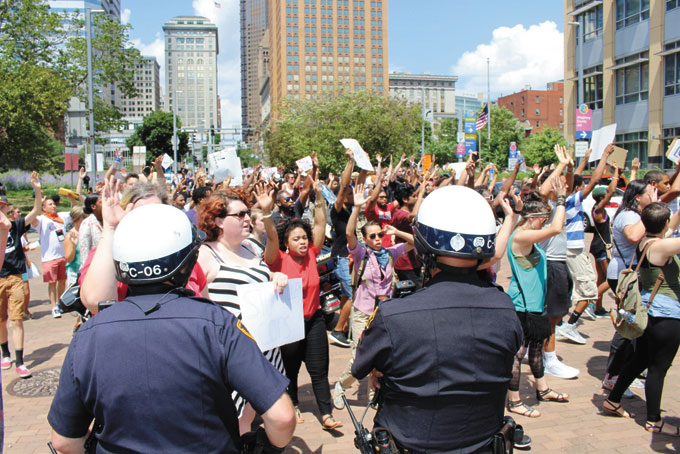
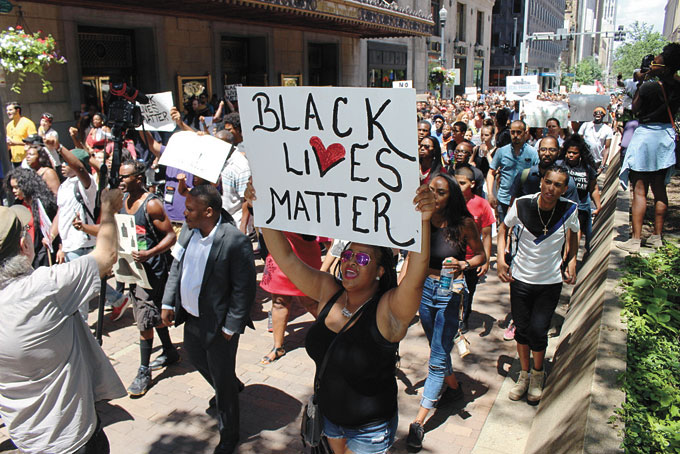
In the wake of the police involved fatal shootings in Louisiana and Minnesota, and the killing of five police officers in Texas, a spontaneous Black Lives Matter march that brought more than 1,000 to Pittsburgh’s streets following its bicentennial festivities. It could have turned confrontational in an instant, but it didn’t.
Pittsburgh police Chief Cameron McLay credited his staff’s communication with the group and its professionalism for keeping things calm during the July 9 march, especially when participants indicated they wanted to go shut down traffic the Parkway East—similar to what protesters in Altanta, Ga. had done the day before.
“People could be killed down there,” McLay said, adding that there would have been arrests had the marchers tried to cross barricades police had set up on Parkway ramps.
But Cooler heads prevailed, and the marchers turned back toward Point State Park where they had started more than an hour earlier—marching up Liberty Avenue, in the opposite direction from the earlier bicentennial parade.
They stopped outside the Port Authority of Allegheny County offices, and recalled District Attorney Stephen Zappala’s decision not to bring charges against the authority police officers who fatally shot Bruce Kelley Jr. in January.
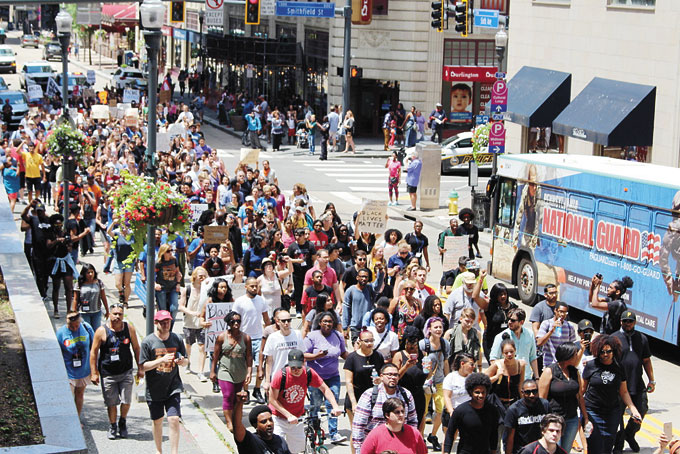
“We have to remember it’s not just the police—but the people who are supposed to prosecute crimes,” shouted one protester. “Stephen Zappala has been here for 18 years while Black lives have been destroyed. We should make sure he doesn’t have another term in any office.”
When the crowd returned to Point State Park, took to the stage including William Anderson, who said the problem is bigger than police violence against Blacks.
“Yes they are killing us, killing our future,” he said.
“But if Black Lives Matter, they have to matter to us first. We have to stand up against the violence in our communities. Say something, make a phone call—take a picture with your phone. Continue to stand up, continue to fight, and continue to love each other.”
Walt Gibson, who told the crowd he is a licensed gun owner, said he was particularly disturbed by the video of an officer shooting legal gun owner Philando Castile in Falcon Heights, Minn. as he reached for his license during a traffic stop.
“On any other day, that could have been me,” he said. “People need to realize there are millions of us law-abiding Black men who legally carry guns. We’re not carrying them to shoot you, we’re carrying them to defend ourselves. Philando Castile was exercising his 2nd Amendement right—he didn’t deserve to die for exercising his right.”
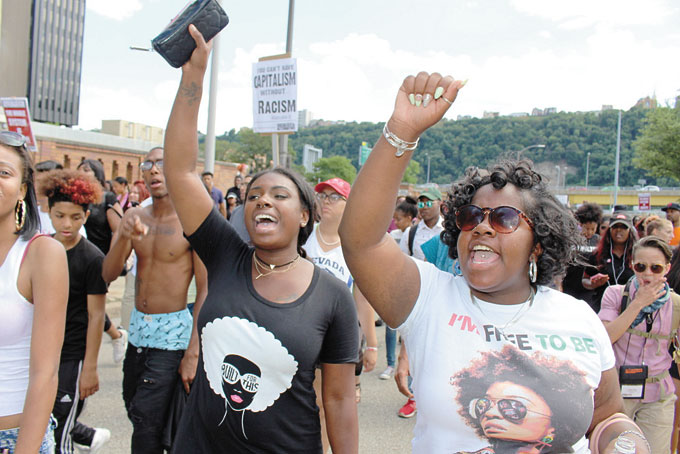
Sarafina Davis, who organized the rally with a simple Facebook post, said she had no idea it would grow so large.
“I want to thank everyone who came out, I didn’t think it would get this big. I started this because I’m only 23 and I was taught in school that racism was over—and yet I see police killing our brothers, children, sisters, and I had enough,” she said.
“We have to teach our children to defend themselves from a society that doesn’t like us or want us. Don’t leave it to the schools, educate them yourself. And if you see a young boy in your neigh who need guidance take him under your wing.”
That was the sentiment echoed by Mayor Bill Peduto, who called for holding a peace summit in a press release.
“We are all affected by the violence in our communities—whether it be here in Pittsburgh, in Dallas, or so many other cities—and we all must do everything we can to stop it,” He said. “Pittsburgh is a strong and resilient place, and our bonds are even stronger when all of us in the city work together.”
Working with Allegheny County Executive Rich Fitzgerald, Peduto said he intends to gather leaders from law enforcement, faith-based institutions, activist groups, foundations, labor, the corporate community and government to work constructively to address vio lence facing Pittsburgh and the entire nation, and find ways to promote racial healing.
On July 12, the Pittsburgh Interfaith Action Committee held a press conference to push the idea further, calling for a dialog on not only on policing, but on the racial disparities found in jobs, housing, and education that make people of color more likely to interact with police. PIIN will kick off this dialogue with a community meeting next week.
“We can ask our police to have all the implicit bias training in the world, but as long as people of color face racism and adversity in every other aspect of our society, we will continue to be more likely to be arrested, locked up, or the worst of all possible outcomes, killed,” he said.
No event has yet been scheduled.
Like us at https://www.facebook.com/pages/New-Pittsburgh-Courier/143866755628836?ref=hl
Follow @NewPghCourier on Twitter https://twitter.com/NewPghCourier
About Post Author
