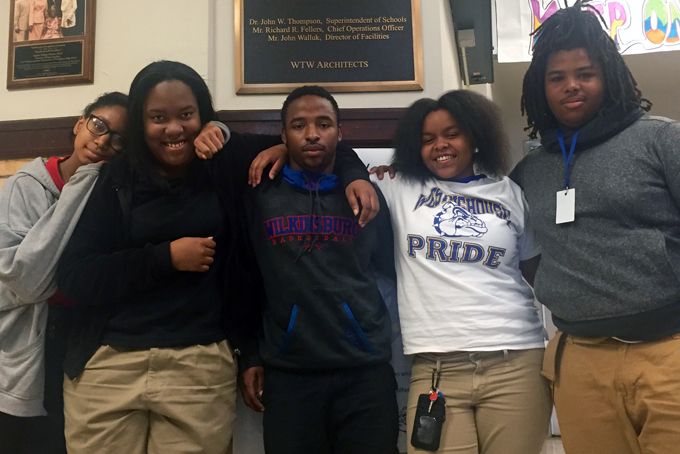
Wilkinsburg has taken one more step to ultimately merge with the City of Pittsburgh. First, outsourcing their fire department and waste management responsibilities. Now, another huge step in that transition has been taken. Recently, the Wilkinsburg school board voted unanimously, 9-0, to merge both middle and high school students with Westinghouse 6-12 graders in a move that many see as a foreshadowing of more mergers to come. The Pittsburgh School Board voted 7-2 to accept them.
Wilkinsburg has 217 students in 7th through 12th grade with less than 100 in high school. It simply became too small to justify its large building and cost overhead. Westinghouse has twice as many students.
The main difference in education is that Westinghouse offers a few advanced placement classes and several vocational programs such as culinary arts and cosmetology. Most importantly, Westinghouse has a commodity that is scarce to come by in Wilkinsburg—books.
Sylvia Wilson, school board representative for district 1, where Westinghouse is located, describes being appalled at what she saw when she met with the 6-11 graders at both Wilkinsburg elementary schools and high school to welcome them to the district. “They asked questions that just made you sad. They asked, ‘Do you guys have books?’ And I was like oh my goodness.”
To outsiders of both communities this would seem a match made in heaven. Two overwhelmingly African American schools set in poverty stricken and violent neighborhoods with histories of academic failure and consequent dwindling enrollment joining together. Both schools’ average SAT scores and overall academic performance places them both in the bottom 2.5 percent of schools statewide.
For longtime PPS board representative Mark Brentley, this partnership is long overdue. Brentley said that PPS should have assumed the responsibility of taking in failing schools on the outskirts of the city and should just change their name to Greater Pittsburgh Public Schools in a transition in which Wilkinsburg just happens to be the first.
Children in the first year of the transition who have a specific skill set will be denied access to transfer to magnet schools. Brentley said that’s the part that almost makes him think they are setting them up to fail. “Wilkinsburg kids can apply. If they are accepted they are held. A kid who is in 11th grade, who is a possible musician and candidate for CAPA, will have to stay in Westinghouse through their final school year and not have access to programs that they are eligible for? You don’t do that to children. To hold these kids back almost in a holding tank.”
Diversity is something pushed as a plus for White children; to have exposure to other ethnicities and backgrounds. When asked if the kids of Wilkinsburg and Homewood deserved the same opportunity of diversity, Wilson was not concerned. “Diversity doesn’t just mean color. I don’t believe that just because there aren’t White kids around that you can’t get a good education. We have plenty of HBUs that prove that.
“I am sure some said that, (but) Wilkinsburg parents that actually went to Westinghouse instead of just judging it from a distance were pleasantly surprised with what they saw,” she said.
State Reps. Ed Gainey and Jake Wheatley, and state Sen. Jay Costa asked the Pittsburgh Department of Education to provide funding for the transition to make its budget neutral.
Although attending a Pittsburgh Public School, Wilkinsburg children will not have access to the Pittsburgh Promise, which is a $30,000 scholarship for kids attending public schools in Pittsburgh and who also live in the city limits. Saleem Ghubril, executive director of The Pittsburgh Promise, said the solution for that is the marriage of the municipalities and having Wilkinsburg become the Wilkinsburg neighborhood of Pittsburgh.
Like us at https://www.facebook.com/pages/New-Pittsburgh-Courier/143866755628836?ref=hl
Follow @NewPghCourier on Twitter https://twitter.com/NewPghCourier
Download our mobile app at https://www.appshopper.com/news/new-pittsburgh-courier
