
For most Americans, Labor Day represents a national tribute for the contributions American workers have made to the strength, prosperity and well-being of the country. But, for millions of citizens left marginalized or completely out of the labor force, this national holiday celebrating the American Dream is an annual reminder of their daily nightmare.
These citizens are the formerly incarcerated, of which the vast majority are unemployed (up to 75 percent), and will likely remain so due to the extraordinary restrictions employers have placed on the background of workforce hires. The skyrocketing rates of arrests and incarceration of the unemployed cost our nation more than $74B annually, with nearly 7 million Americans under the supervision of an adult correctional system. Former inmates seeking employment represent an opportunity for the job market to help transform this huge taxpayer liability into economic productivity. When inmates are released back into society at a rate of 630,000 each year, the labor market nationwide is impacted. Unfortunately, for most ex-convicts, the signs for employment opportunities read: NEED NOT APPLY.
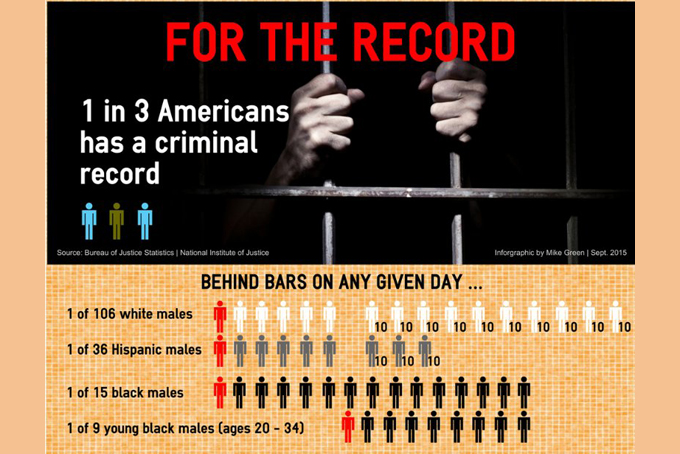
Most employers want to know if a job applicant has ever been arrested. Today, one in three Americans by age 23 will have a record of arrest. Estimates range from 70 million to 100 million. But, when broken down into racial demographics, there is an ominous trend that emerges across America, which disproportionately impacts people of color, and black males in particular.
DISPROPORTIONATE ECONOMIC IMPACT
For those black Americans who play by the rules, are educated and law-abiding citizens, finding a job can be statistically much more difficult than for the average American. While the national unemployment rate ticked down from 5.3 to 5.1 percent, for black Americans, it went up from 9.1 to 9.5 percent. Overall, for black Americans the unemployment rate is nearly twice that of the national average. And year over year, since statistics were started in the 1940s, black unemployment has remained consistently twice the rate of white unemployment. But those data only tell a part of the story.
Two studies by the National Institute of Justice revealed that a criminal record reduces the chances of a job callback for an interview by 50 percent for anyone who has been arrested. But for black applicants the rate was “significantly higher.” The study also showed that nearly 75 percent of arrestees are black males. And black males are six times more likely than white males to be incarcerated. Today, black males comprise 40 percent of the prison population, though all black Americans as a demographic make up only 13 percent of the national population. As bad as these data sound, the story gets even worse.
BLACK MALES AT RISK IN AMERICA
On any given day, 1 in 106 white males are behind bars. For Hispanic males it is 1 in 36. For black males it is 1 in 15. And for younger marriage-aged black males (ages 20-34) the number is 1 in 9. In fact, according to the National Institute of Justice studies, young black males who drop out of high school are more likely to be incarcerated than employed. And once incarcerated, their chances of employment upon release are dramatically lower than their white counterparts. But the story doesn’t end there.
Children are impacted significantly. On any given day in America, 1 in 28 children have a parent behind bars. For black children, it’s 1 in 9. And, according to one study, 25 percent of black children born after 1990 will have an incarcerated father before they reach puberty. These dads will re-enter society seeking a job to care for their families. They will be directed back into economically distressed communities and the vast majority will not find livable-wage work. And of those few who manage to find work, they will take home 40 percent less pay than their workforce counterparts with no record. The result is predictable. Up to 84 percent of young black males released from prison will return within five years.
ENTREPRENEURSHIP: KEY TO ECONOMIC OPPORTUNITY
Given the deplorable rate of employment among black Americans, the rate of entrepreneurship and business starts is inversely proportional. Whereas black unemployment is nearly twice the rate of white unemployment, entrepreneurship among black Americans is more than triple the national rate. Unfortunately, the consistent high rate of business growth among black Americans do not translate into high productivity and job growth. All 1.9 black-owned businesses in America produce less than 1 percent of GDP and zero percent job growth. Combined with all Hispanic-owned businesses, the total contribution to GDP remains less than 3.5 percent. This low level of business productivity virtually assures that the landscape of black and Hispanic workers and prospective workers will have no job options among black and Hispanic business owners.
Yet, entrepreneurship is the key to economic freedom from dependency upon the private sector jobs landscape, which is increasingly pockmarked with explosive barriers to entry for those with criminal records. And for black males with criminal records, starting a business may be a great option while scouring the landscape for a livable-wage job. Unlike the search for jobs with a criminal record, there are many stories of business success by former inmates. And successful businesses need not grow to a lot of employees to sustain a lifestyle that supports a family and pays for the education of children.
Bob Pelshaw is one of those success stories. Pelshaw is today a real estate developer who emerged from incarceration with a desire to help ex-convicts develop a new lease on life. He is the author of “Illegal to Legal: Business Success for (ex) Criminals.” Pelshaw travels the country speaking to groups and organizations that support former inmates in their journey to re-entering society on a productive path. He has a deep understanding of the obstacles and offers small doable steps toward starting a business, even with no money. And he gives practical advice with case studies of many small businesses that anyone with a strong work ethic can follow.
“You can succeed at any business you want,” said Pelshaw, “as long as you focus on your strengths and do something you love (or are passionate about).”
This Labor Day (and every day) let’s remember the 2.2 million incarcerated workers and hundreds of thousands who will be released each year seeking employment opportunities or starting their own journey as entrepreneurs. And let’s help them for the benefit of us all.


Mike Green
Co-founder, ScaleUp Partners LLC
https://www.linkedin.com/pulse/remembering-americas-forgotten-workforce-mike-green