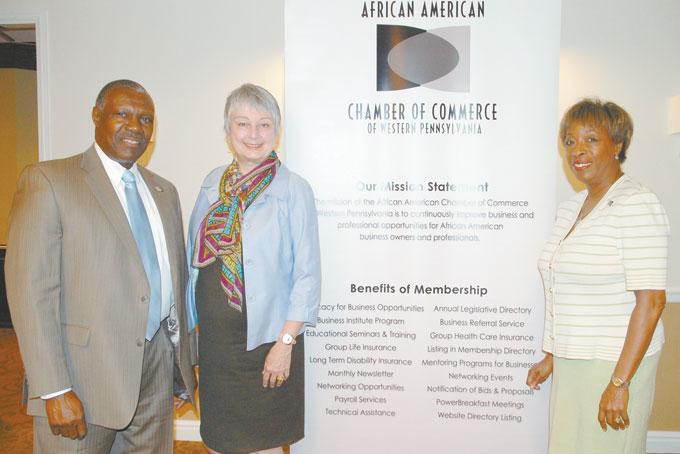
The word commonwealth is a familiar term in Pennsylvania, one of four of the constituent states of the United States considered a commonwealth state. Jo Ellen Parker, president and CEO of the Carnegie Museums of Pittsburgh liken her consortium of museums as a commonwealth.
Kentucky, Massachusetts, Virginia and Pennsylvania are four of the first 15 states that joined the Union and Parker heads the four cultural museums in the city of Pittsburgh. The Carnegie Museum of Art, the Carnegie Museum of Natural History, the Carnegie Science Center and the Andy Warhol Museum, four entities that date back to 1895 when founded by Andrew Carnegie.
The guest speaker during the African American Chamber of Commerce of Western Pennsylvania’s monthly Power Breakfast Meeting, Parker discussed her vision and value system for the museums. “The value and idea of the commonwealth is that none of us succeed unless all of us succeed. We don’t really succeed if others are struggling,” she said.
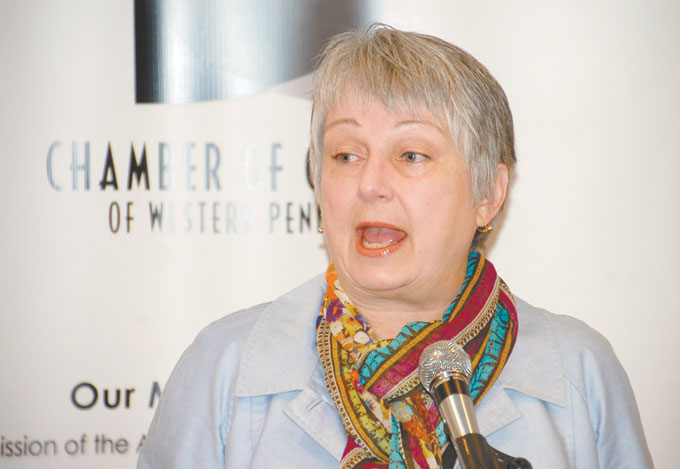
“That value operates for us at the Carnegie Museum at a number of levels. As a family of museums all four has to thrive to contribute to the welfare of the city to represent a range of cultural opportunities and perspectives of the people that visit us,” she explained. “We are, as a family of museums a small commonwealth that operates within a city that has for its size and population a remarkable cultural commonwealth. We understand the significance that all the cultural organizations within the city have to thrive and succeed as well as the whole city as a commonwealth of businesses, governmental sectors and the non-profit cultural sectors to create an intellectual and cultural ecosystem that is good for everybody. I love the term commonwealth for a museum because what a museum holds and offers to the public is literally the common wealth of humanity. The art and science that we hold, protect, interpret and share with our community is the common wealth of human kind,” she said tying the concept together.
Other values of the museums that she identified were transparency, digital sophistication, social inclusion and being an entrepreneurial non-profit.
Transparency she said means being thoughtful about the information that is needed to help people make good decisions.
“Being good communicators and sharing trust worthy good information, with the public, supporters and those that rely on the programs that the museum offers,” she said.
Digital sophistication, Parker said means not being quant. Technology, she said has to be translated into the world of the Internet and digital information. The goal she said is to reach people from all areas of the world that might never enter the physical walls of the museums. “Reaching people with our programming, information, and cultural assets as well as preserving what we know and do and share in a digital format we can have a national and international reach.”
With the belief that it is important to share the museums philanthropic legacy Parker explained that social inclusion is a value to the museum administrators. Inclusion she said means involvement from all backgrounds, heritages, levels of ability and faith traditions. “We want to make sure that we are sharing the riches of our legacy with everyone that is interested,” she emphasized.
To assure that they are meeting their goal of being a social inclusive museum a diversity catalyst position has been created she said to guarantee that changes are being created within their interactions.
Parker expressed that operating as an entrepreneurial non-profit or mission centered organization is also a principal and value of the Carnegie Museums. She suggested that the breakfast attendees think of the legal structure of a B-Corp, what she described as a form of corporate charter in which a for profit organization is legally permitted to include social good values with shareholder return as corporate mission. She said that at the Carnegie Museums they are quite capable of being mission centered and are savvy business people, have market awareness, are disciplined in the way they approach their business and mindful to their cost and revenue and how both are managed. She said such thinking goes back to the commonwealth theme of wanting to seek to do well rather operating as a businessperson or non-profit.
To conduct business within the Carnegie Museums system, Parker suggests contacting the financial and operations department to find out what business opportunities are available or to be directed to proper departments. “If there happens to be a problem I can be contacted directly,” Parker said.
President and CEO of the Carnegie Museums of Pittsburgh since August of last year, Parker is the former president of Sweet Briar College located in Virginia and has served as executive director of the National Institute for Technology in Liberal Education and as president of the Great Lakes Colleges Association. She is a native of Olathe, Kansas and has earned her A.B. in English from Bryn Mawr, her M.A. in English from the University of Kansas and her Ph.D. in English literature from the University of Pennsylvania.
The African American Chamber offers a variety of programs and services aimed at assisting its participants in their development and gaining access to decision-makers for business growth. Its next event is a members’ mixer scheduled for June 25 at 5 p.m. at the Skyline Terrace Community Room at 385 Elmore St. The mixer is hosted by KBK Enterprises.
The Chamber’s Business Institute is conducting a cyber-security presentation Oct. 7 at 1 p.m. at the Manchester Bidwell Corporation. Pittsburgh native Diana Burley, PhD co-Pl and Research Director for the National CyberWatch Center and Full Professor in the Graduate School of Education and Human Development at George Washington University is the presenter.
(For information on the African American Chamber of Commerce events call 412-392-0610..)

