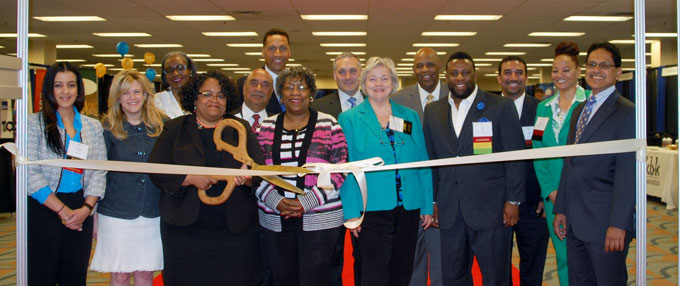
“Events like this are important because they present resources and provides a venue for corporate purchasing representatives to get acquainted with local MWBEs,” said Cofield.
One of the major opportunities discussed and outlined during the Opportunity Fairs’ luncheon panel was the Lower Hill Development Project. “There is a lot of development happening in our region,” said facilitator Bill Flanagan. “But the Hill is one of the most popular in South Western Pennsylvania.”
Panelists explaining the projected development of the 28-acre former Civic Arena site were Clarence F. Curry, senior diversity coordinator for the Sports and Exhibition Authority and Kimberly L. Slater-Wood, director of outreach for the Pittsburgh Penguins. Collectively they described that 17 of the 28-acre site is expected to be transformed into a mixed development consisting of a hotel, commercial and office space, and residential and open park space. Also, Arthur Milton Porter lll, senior consultant for St Louis based Marks and Associates who is serving as Diversity Coordinator for Clayco, developers of the U.S. Steel Headquarters Building was a panelist. He indicated that the world headquarters of U.S. Steel is expected to be the first development completed on the site.
“There are a lot of opportunities for minority and women businesses,” said Slater-Wood. She said a request for qualification has been issued for a minority-owned development firm to develop 250 housing units to be located on the 10-acre site located near Crawford Square. Proposals are due by June 12 with a possible selection to be made by mid-July. The 250 units are a part of the 1,100 units predictable to be constructed in that area.
With an expected move in date of fall 2017, the U.S. Steel building will consist of a five-story, 268,000-square-foot office building retail space and a museum to honor the area’s steel heritage.
Slater-Wood said that the Penguins, SEA and the Urban Redevelopment Authority of Pittsburgh are working with community leaders in the Hill District through a Community Collaboration Implementation Plan to develop a framework for the development to provide jobs, economic and other wealth building opportunities for the Hill District community. The CCIP will aid the groups in working toward meeting their MBE and WBE goals in all aspects of the project. Passionate about what is occurring with the project she said, “This is personal to me because I grew up in the Hill District and currently reside there.”
Keith B. Key, CEO of Keith B. Key Enterprises and Omni Management Group also serving on the luncheon panel commented that this is an exciting time to be in Pittsburgh. Last week his firm conducted a ribbon cutting ceremony for Skyline Terrace, the former City of Pittsburgh Housing Authority Addison Terrace site. The 400 units town home mixed income development he said is the largest award to a minority business enterprise in the history of Pittsburgh, at approximately $160 million. Other Pittsburgh developments he has been involved with include Garfield Commons and the Larimer Scattered Site development.
Chief Corporate Relations Officer for the Allegheny Conference on Community Development and its affiliated regional development organizations, Flanagan concurs that this is a good time to live in the region. He said there are more people working across the region and that the population is starting to get younger.
“Even though we are still one of the oldest regions in the United States the median age in Allegheny County is now going down and the median age in the city of Pittsburgh is below the national average,” he said.
He said research indicates there are younger people migrating to the city and a lot more younger people are staying. Another positive aspect he said is that a lot of the younger people locating here are better educated than their peers across the US. He said the percentage of young people with advanced degrees in our workforce; meaning with a master’s degree and above that this region has the third highest concentration of young people with advanced degrees in the US. “The highest two metropolitan cities doing better are Washington, DC and Boston,” he said.
Flanagan pointed out that the biggest challenge to the region is to assure that everybody has the opportunity to participate in the upside of the progress.
Breakfast keynote speaker, Michael DeWitt, vice president of procurement at Highmark Health explained his corporations’ MWDBE goals and procedures. “With the aim to lead by example we are looking to build a strong supplier diversity base by looking for the best suppliers to partner and grow with. We want long lasting sustainable relationships,” he said.
A few business opportunity areas he said Highmark Health is looking for are temp personnel in the field of information technology services, facility services and materials, and hardware facilities and goods. He said his office is always looking for a variety of qualified suppliers.
DeWitt suggested that interested parties register as a supplier with Highmark Health. “The more the procurement office knows about a business the better it is for us to match a business with the needs we have.” He also indicated that interested businesses should strongly point out their capabilities and what value they bring to the corporation.
County Executive Rich Fitzgerald and Erin Molchany from Governor Wolf’s office made remarks and welcomed participants to the Opportunity Fair during the breakfast.
Alexander Nicholas, EMSDC chief operating officer views this years’ Opportunity Fair as achieving its purpose of connecting minority business enterprises to corporations and buying entities. “It is rewarding when I see MBEs and corporate representatives engrossed in conversation and exchanging contact information. The four pillars of the council are to certify, develop, connect and to advocate. The Opportunity Fair is an example of how we connect,” he said.
EMSDC is one of 24 affiliates of the National Minority Supplier Development Council, a nonprofit corporate membership organization that advances business opportunities for its certified Asian, Black, Hispanic and Native American business enterprises and connects them to its corporate members. One of the country’s leading corporate membership organizations, NMSDC was chartered in 1972 to provide increased procurement business opportunities for minority businesses of all sizes.
About Post Author
