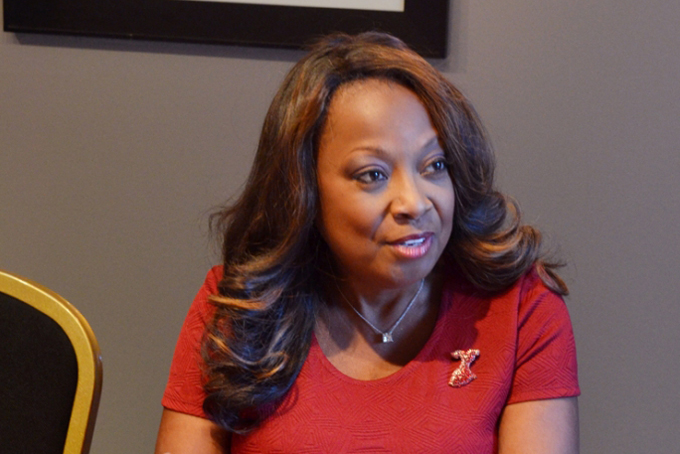
(NNPA)–Star Jones is a successful attorney, author and TV personality whose confidence and uncanny ability to explain legal and social issues has landed her into the hearts and homes of millions of viewers around the world. What you may not know is that Star is also a heart disease survivor and American Heart Association National Volunteer.
Star Jones underwent gastric bypass surgery in 2003 to help her shed over 150 pounds. Yet by 2008, something didn’t feel right to Jones, a former senior district attorney who later was chief legal analyst on the Inside Edition TV program during the O.J. Simpson trial. She was extremely tired, short of breath and experiencing frequent and intense heart palpitations. After extensive testing in 2010, she was diagnosed with heart disease. Her cardiologist, former AHA president Dr. Valentin Fuster, said she needed open heart surgery to repair a damaged aortic valve. The hope was that the procedure would allow Jones to stave off the need for a valve replacement or heart replacement surgery later in life.
To perform the procedure, doctors had to remove her heart and actually stopped her heart for 22 minutes and put it on ice. The surgery was a success. And Jones, one of the original hosts of ABC’s “The View” weekday talk show, was determined to become a heart health advocate.

Seven months after her surgery and countless hours of intensive cardiac rehabilitation, Jones competed on NBC’s “Celebrity Apprentice” reality show on behalf of the American Heart Association and its Go Red for Women campaign. She raised a record-setting $175,000 on the show and another $175,000 by the time it aired. Heart health has been Star Jones’s passionate plea ever since.
I was recently given the opportunity to sit down and discuss the importance of heart health in a candid interview with Ms. Star Jones minutes before she served as the keynote speaker for the Houston Go Red for Women Luncheon held at Hotel ZaZa.
Chelsea Lenora White: I just first wanted to let you know that your story touched me personally because in 2010, the same year that you were diagnosed with heart disease, my mother passed away unexpectedly my freshman year of college. I was home the weekend before for Easter and that Monday, she packed my car with food that she had just cooked and waved goodbye. We talked every day as usual that week while she was running her business and that Saturday after I had returned to school I received word that my mother had died suddenly and without warning that morning from a massive heart attack.
Star Jones: That’s how women are. As women, we take care of everything. It does not surprise me and I’m so sorry to hear that you lost your mother. But it doesn’t surprise me when you tell me that just the week before, she was taking care of business. We as women take care of everything and everybody but ourselves.
Massive cardiac arrest can happen just out of the blue; but almost all of the time there are some warning signs. My warning signs were extreme fatigue; lightheadedness when I would go from seated to standing; shortness of breath; and intense heart palpitations. I did not have a cardiac event because I actually listened to my body. Having had weight loss surgery years earlier, I knew that I should not be having those feelings. I had kept the weight off, I was exercising, so I couldn’t understand it. So, I wonder what your mom was feeling the week and even the month before.
CLW: Exactly. Maybe something that she brushed off and didn’t share with anyone else.
SJ: Right, or even acknowledging it to herself. What you may not know is, as women, we suppress those feelings. For instance, if your nose was running while she was packing food in your car, you would be going to the doctor. Your mother would be on your case saying, “So why is your nose running? How long has it been running? What are you going to do about that?” But for ourselves, we ignore it. Our noses could be running and it will just run because we have too much to do. The one thing we have to do, though, is take care of our health.
CLW: The unique thing about your story is that you did lose the weight, were physically active and eating consciously, and you were still diagnosed with heart disease following that change in your lifestyle.
SJ: Well, first of all, I had a genetic disorder which also lent itself to it. I ended up having a sub aortic membrane, which is like a little piece of extra flesh around the aortic valve. That’s genetic and there’s nothing that you can do about that.
I had also been massively obese for my entire adult life. Basically from 20 to 41 years old, I had not been exercising. Honestly, I was forty-two years old before I caught or kicked a ball in my life other than in gym class (and I figured out how to get extra credit in something else so that I wouldn’t have to do gym class). I was sedentary and lazy, and I take full responsibility for my own behavior. So all of that had led up to me becoming just over 300 lbs. at 5’5 and ultimately led to me having weight loss surgery. A lot of people think of gastric bypass as a quick fix and it’s just a jump start. Trust me. I attribute about 80 lbs. to the weight loss surgery, because what it does is it changes the way that your body is constructed. So I lost about 80 lbs. just based on the surgery; but in order to lose that next 80, I had to work. I lost a total of 160 lbs. initially. I lost an entire human being. I actually lost two pounds less than what I weigh now. I lost a whole me; another Star could be sitting right here next to me. So I lucked out. I listened to my body and when I heard my body say that something wasn’t right, I went and dealt with it.
CLW: How did you team up with American Heart Association as a National Volunteer?
SJ: I was sitting in bed at the hospital and I thought to myself: “Clearly, I have been kept here for a reason.” I left the hospital six days after open heart surgery. It was my birthday the next day and I said that I wouldn’t be in the hospital on my birthday. So I walked out in Jimmy Choo shoes and my daddy had to hold me in the car because I was completely wiped out. Honestly, they won’t let you walk through the halls, they have to wheel you out. They wheeled me out to the door and I said, “I WILL walk out of this door” and of course, I had to fight with the nurses. But I walked out of the door and to the car and that was something that I wanted to do to prove to myself that I could do it. And just from that short walk, I needed to sleep for eight hours after that because open heart surgery completely wipes you out.
I remember just saying to myself, “I have to do something.” So I called the American Heart Association, myself and I said, “This is Star Jones. I just had open heart surgery and my surgeon and cardiologist are members of AHA; and as a matter of fact, my cardiologist was a former president of AHA.” And they asked who he was and I told them Dr. Valentin Fuster. Now that should have been enough for them to realize that they had the real Star Jones but I don’t think they really trusted it initially. So eventually I got a call back from them and they asked, “Is this really Star Jones?” And I said, “Yeah it is and I’m yours.” So I started to volunteer almost immediately after cardiac rehabilitation. I did three months of cardiac rehab because I wanted to get my life back and cardiac rehabilitation gives you your life back.
CLW: Do you have any advice for on-the-go women, especially within the African-American community, who may not know or take early warning signs for heart disease seriously?
SJ: Honestly, you have to love yourself enough to save your own life. I try to keep it as simple as possible; eat less and move more. I have learned to “half” my plate because American portions are so big. I actually eat what I want. Like yesterday, I had lunch at Pappasito’s Cantina and it’s like my favorite place on earth. And I took from the big platter, I did not eat from the big platter, and made a small portion and ate from my portion. What I’ve learned to do is, push it away and if I’m hungry and want more I will put more on the small plate. But nine times out of ten, I’ve made enough on the small plate. So I always ask for a small plate. I don’t need a big, giant plate. So I trick myself because it is a struggle to maintain heart health.
My other piece of advice, of course, is don’t smoke. That’s nasty anyway and besides it smelling bad, it’s not healthy. So little, tiny changes in your life matter. 80% of heart disease is completely preventable by changes in our own lifestyles. So, love yourself enough to save your own life is my best piece of advice.
I didn’t realize that heart disease was the #1 killer of women and is more deadly than all forms of cancer combined. I was even more shocked to learn that an estimated 43 million women in the U.S. are affected annually by cardiovascular disease which kills approximately 455,000 women (one every minute).
Special to the NNPA from the Houston Forward Times
About Post Author
