Vibrant Pittsburgh
Last week, The Workforce Diversity Indicators Initiative released a report outlining minority participation in the Pittsburgh metro area employment market. The title says it all: “Behind The Times, The limited role of minorities in the greater Pittsburgh workforce.”
The report compared the seven-county Pittsburgh Metropolitan Statistical Area against 14 others and found that Pittsburgh came in dead last. With the other regions averaging 25 percent minority inclusion in their workforces, Pittsburgh recorded 11 percent, less than half the average, and with just seven percent held by African Americans.
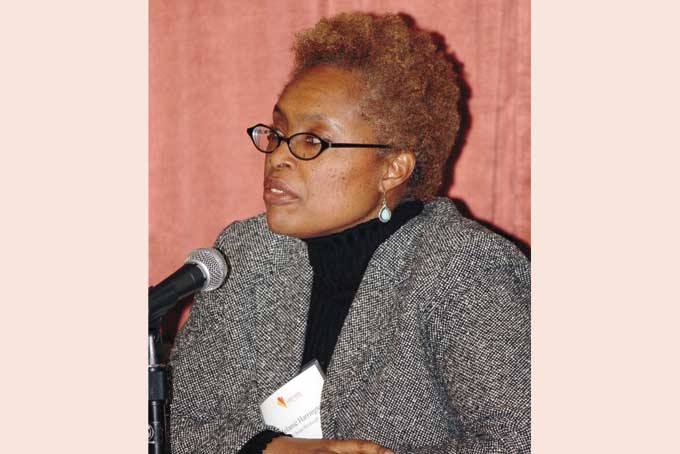
Douglas Heuck, director of Pittsburgh Today, joined fellow report contributors Vibrant Pittsburgh President and CEO Melanie Harrington, RAND Corp. sociologist Gabby Gonzales, Allegheny Conference on Community Development Vice President Jim Futrell, and Three Rivers Workforce Development Board Strategy and Research Director Vera Krofcheck to discuss the report’s findings at a forum March 5.
“Unlike other regions, for all intents and purposes when we’re talking about minority jobs in Pittsburgh, we’re talking about African Americans,” said Heuck. “Pittsburgh is the Whitest of the 15 municipal areas studied.”
Not only do Blacks comprise a low total number of workers, they are mostly concentrated in the lowest-paying job sectors. Within these sectors, Blacks comprise 20 percent of the administrative support jobs, 16 percent of accommodation and food service jobs, and 14 percent of health care and social service jobs.
Among high end jobs, African Americans hold just 9 percent of professional, scientific and technical positions, 7 percent of manufacturing positions, and just 5 percent of construction jobs.
“It’s not a pretty picture,” said Krofcheck. “Many are stuck in low-wage sectors with a lack of upward mobility.”
Because of that, there is a significant wage gap in the region with Blacks averaging a monthly salary of $2,666 compared to $4,047 for Whites. Gonzales said that leads to a damaging situation for individuals, families and even communities because it can create a cycle where people don’t even consider opportunities in other jobs sectors.
“So on the bright side, this report can show people that there are opportunities out there,” she said.
Beyond issues of fairness, there could be a greater economic price to pay for the lack of diversity is showing in the 22,000 jobs going unfilled annually despite the region’s economic recovery. That problem will grow, said Futrell, because 100,000 members of the aging White workforce will be retiring in the next 10 years, and there is no one to replace them.
Harrington said that is why she has recommended a two-pronged approach to that issues; recruit diverse talent to the area to address the short-term needs while training and educating the indigenous communities of color to address both short- and long-term needs.
“Our demographer at the Brookings Institute says Pittsburgh has time to fix this,” she said. “But there is still a sense of urgency because competing regions, which frankly aren’t as attractive, are engaged in huge diversity initiatives.
”Inclusion, retention and successful navigation are critical components Because if you don’t feel you can advance here, you’ll make a plan to advance elsewhere. Seeing someone who looks like you advancing in a given field helps.”
Candi Castleberry Singleton, chief diversity officer for UPMC and who attended the forum, suggested another avenue for increasing workforce diversity—making new friends.
“If the five people I’d recommend for a job, and the five you’d recommend all look like us, it won’t make a bit of difference,” she said. “The biggest challenge we face is to make new friends—because they’re not going to try it first in the workplace. This should be a call to individuals.”
The report itself, Heuck said is only the first in a series, a snapshot of the way things are, a baseline. Future reports will benchmark various diversity initiatives against the baseline 2 percent increase in diversity the report noted.
(The report is available at pittsburghtoday.org/workforcediversity.html.)
Follow @NewPghCourier on Twitter https://twitter.com/NewPghCourier
Like us at https://www.facebook.com/pages/New-Pittsburgh-Courier/143866755628836?ref=hl
Download our mobile app at https://www.appshopper.com/news/new-pittsburgh-courier
About Post Author
