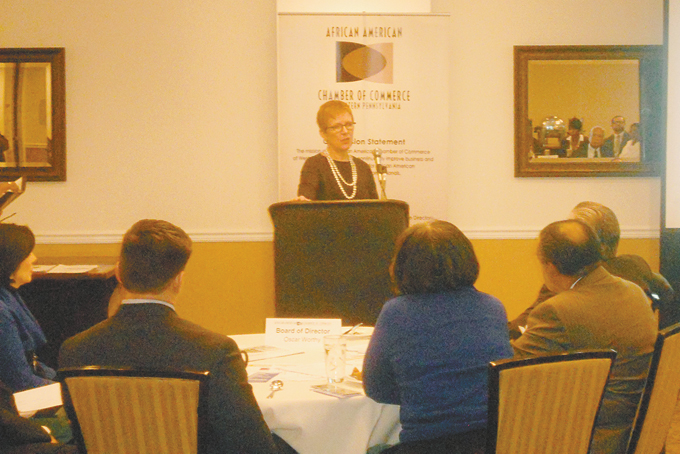
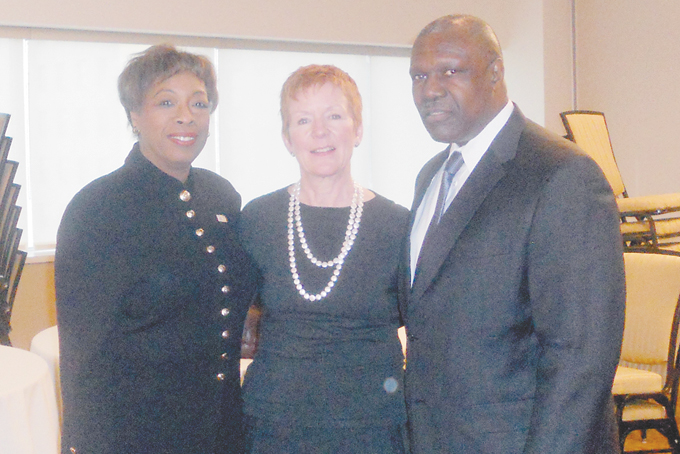
Despite the double-digit below freezing temperatures that usually mean transportation nightmares, a full house attended the African American Chamber of Commerce’s February PowerBreakfast meeting to hear Port Authority of Allegheny County CEO Ellen McLean talk about transportation’s future.
In her introduction, chamber President and CEO Doris Carson Williams recalled working with McLean to review Pittsburgh’s finances in the late 1990s. After a stint in Washington, she returned, and is glad to be managing the authority in a time of stability, and perhaps expansion.
“Mass transportation in Pennsylvania has been in financial trouble for years. So it was critical—and it took years to make sure that Act 89 of 2013 included transportation, not just roads and bridges,” she said. “But Act 89 gave us capital funds not operating funds. So we still need to look at ways to increase revenue.”
Advertising, she said, is one of those revenue streams—and is increasing. The authority is also trying to find a way to earn more money from the 24 percent of the riders that live outside the County. McLean also said PAT is looking at sponsorships, such as selling naming rights to its stations. But there might also be a way for capital expenditures to generate new revenue opportunities with Transit Oriented Development.
“The Eastside project is being done right, there’s a diversity of businesses and residential development, all tied to transit,” she said. “However, the property we contributed was incredibly valuable and has increased in value, and we just get a set fee for maintenance. I’d rather see us get an increment of that increase.
“We’re putting together a transit oriented development policy—how many stops or stations do we need, what type—because without it we’ve been at the mercy of developers.”
All this is not to say capital money isn’t welcome. It has helped address issues outlined by a 2014 advisory panel on improving the rider experience, system timeliness and efficiencies, mostly through technology such as the smartcard and TrueTime bus tracking application.
Capital money also pays for buses, which cost about $400,000 each.
“We’re also looking at adding natural gas buses, which will require a new fueling station,” she said. “But because that addition would be very costly, and because we’re near capacity, we’re looking to build a new garage. We’re looking at land outside the east busway.”
And on a related note, McLean also said the capital funding has also allowed the authority to improve its Internet technology with respect to those seeking to do business with the authority.
“We issue 115 public contract a year and 250 RFPs,” she said. “Using our Ebusiness site, you can get those sent directly to your company.”
After thanking McLean, Williams welcome new members and corporate sponsors and reminded everyone that next month’s speaker will be Pittsburgh Mayor Bill Peduto, and April’s speaker will be developer Keith B. Key. The chamber’s annual meeting is in May and will feature Highmark CEO David Holmberg. PowerBreakfast speakers for June and July will be Pittsburgh Partnership President Jeremy Waldrup and Pittsburgh police Chief Cameron McLay, respectively.
