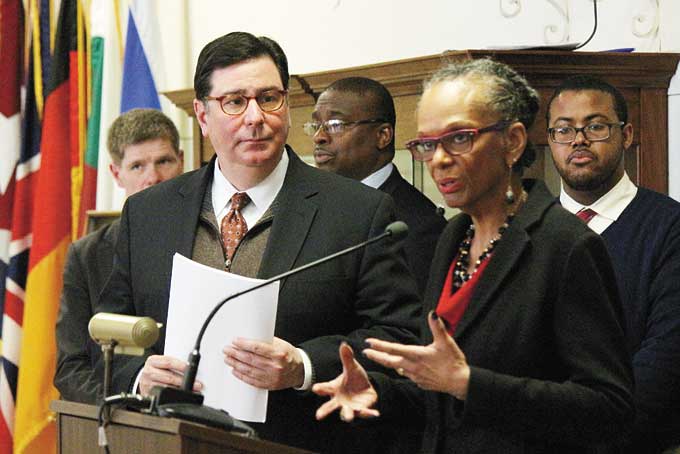
Joined by city council members, former council members, teachers’ union and school district officials, and education advocates, Pittsburgh Mayor Bill Peduto released his Education Task Force final report on how the district and the city can cooperate on building a stronger school system.
He noted the need for the task force grew out of a 2013 fight between city council members and the school board over school closings and teachers evaluations.
“It’s a conversation of how far you step; where are the responsibilities of one, where are the responsibilities of the other?” Peduto said of the district and city. “What this is, is a blueprint for us to be able to work together on a common goal.”
Theresa Kail-Smith, who sponsored legislation creating the task force last year, said the report reflects a new era of cooperation.
“This shows that we’re united, because this is our future,” she said. “If we don’t collaborate and cooperate, we’ll continue the downward spiral that has seen us lose 14,000 residents with school-aged children.”
The report focuses on four areas: public safety, out-of-school programs, community schools initiatives, school funding and boosting the district’s image in order to attract families to the city.
District Superintendent Linda Lane said telling positive stories about the district and increasing student safety were both incorporated in the district plan released last year and are the two main issues she is concerned with along with the community schools model that includes wrap-around services for students and families.
“It may be health services, it may be dental, it may be social services,” she said. “Often it means having a way for families to support the work of the school social worker to connect families to agencies within the city they might need to be able to access.”
Peduto said there would be a line item in the next city budget to fund these cooperative efforts, specifically about city police contributing more to school safety.
“It’s focused on what schools need and what we can provide,” he said.
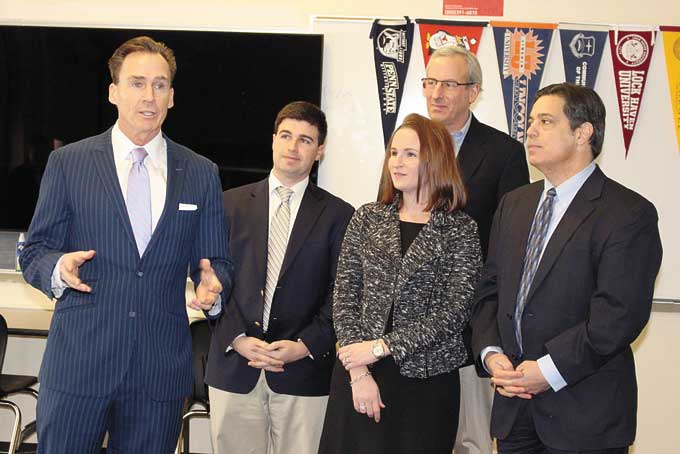
Peduto also said the city and district will be united in lobbying for changes in the state funding allocation formula and for additional school funding.
“It’s a blueprint where the school board and Pittsburgh city council can put resources behind a common goal and we understand the lobbying needed in Harrisburg is on one single piece of paper.”
Less than an hour later, Lt. Gov. Mike Stack, speaking at Allderdice High School in Squirrel Hill, addressed that, saying public schools across the state need the infusion of funding that Gov. Tom Wolfe’s proposed Education Reinvestment Act would provide.
Stack noted the Pittsburgh School District has coped with $25 million in funding cuts since the 2010-11 school year, while throughout Pennsylvania, other districts have suffered from similar reductions totaling $1 billion.
“We have seen larger class sizes, fewer teachers, and vital programs eliminated or scaled back,” he said. “The superintendent and the teachers here have done incredible things even with these cuts, but we should be investing more in our kids and schools, not less. This is not only the right thing to do—it is also smart—for our economy,”
During his campaign, Wolfe said he favored imposing a 5 percent extraction tax on natural gas as opposed to the impact fee former Gov. Tom Corbett’s administration had approved. The new proposal, would also add an additional 4.7 percent tax per thousand cubic feet of gas, generating an estimated $1 billion in revenue by 2017.
“We’re failing to tax this resource at a time when our schools need more funding,” said Stack. “We can generate much-needed revenue for education while still permitting the natural gas industry to prosper in Pennsylvania.”
The proposal, however, also comes at a time when, thanks to the rapid expansion of shale oil drilling across the nation, natural gas prices are at an all-time low. This has forced the industry to scale back operations, resulting in job layoffs.
Governor Tom Wolfe’s office released a statement later in the day saying he is committee to restoring lost education funding for Pittsburgh and the rest of the state.
“The Wolf Administration continues to believe that the district’s financial situation cannot responsibly handle the approval of new charter schools. Governor Wolf remains committed to restoring cuts and delivering more funding to public schools across the commonwealth to ensure our children have the resources necessary to succeed. It is imperative for both our children and our economy that we reverse Pennsylvania’s public education deficit.”
(Send comments to cmorrow@newpittsburghcourier.com.)
Follow @NewPghCourier on Twitter https://twitter.com/NewPghCourier
Like us at https://www.facebook.com/pages/New-Pittsburgh-Courier/143866755628836?ref=hl
Download our mobile app at https://www.appshopper.com/news/new-pittsburgh-courier
About Post Author
