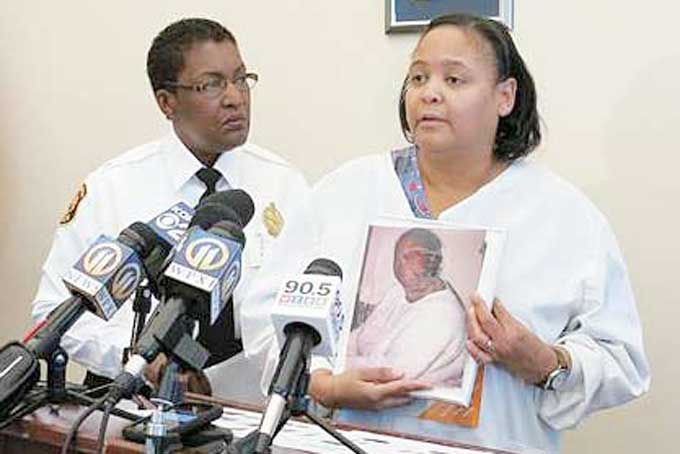
Kimberly Waller, a jitney driver who was robbed and killed on Pittsburgh’s South Side Dec. 27, was the final city homicide of the year.
But there is no finality for her sister Thelma Gregg because the killer is still at large.
“Somebody saw something. Somebody heard something,” Gregg said as she clutched her sister’s photo during a press conference at Pittsburgh Police headquarters. “We need leads. We’re making a public plea so that we can find who did this to my sister.”
Waller’s death bought the city’s homicide total for 2014 to 71, the most since 2008. According to statistics released at the press conference, of those, 26 were cleared by arrest, three others were cleared by the perpetrators’ deaths, six are pending grand jury or district attorney action, and in another eight, the killer is known but police do not have enough evidence for an arrest. The remaining 28 cases are still being investigated.
That yielded a clearance rate of 44 percent, 20 points below the national average for last year. Chief Cameron McLay, assistant Chief of Investigations Maurita Bryant and Major Crimes Cmdr. Rashall Brackney all said that is unacceptable and changes are coming.
“We’ve been in defensive mode, playing catch-up,” said McLay. “So, how can we make better use of intelligence and data, so we can get the community more involved. They know the few who are involved in this violent behavior.”
The report also noted that 79 percent of the known perpetrators were Black, as were 89 percent of the homicide victims. This again raised the issue that cases involving Black killings are not being solved with the same zeal as high-profile White victims’ cases. McLay disagreed.
“There is no distinction. Every one of our cases get the same level of attention,” he said. “Not every case gets the same level of media attention.”
McLay said the department is moving to implement a focused deterrent model that targets those responsible. It is essentially Prof. David Kennedy’s model for the PIRC program that was not supported by the police.
“This problem has been consistently and effectively dealt with by implementing a model of focused deterrence in city after city,” McLay said. “The latest example is Chicago—which had off the charts levels of violence compared to Pittsburgh.”
He said this approach is very effective against loosely organized groups like those driving the crime in Pittsburgh.
“Calling them gangs gives them more credit than they deserve,” he said.
The deterrence model also relies on service delivery to get the criminals away from the streets and community buy-in to help identify them. Brackney said even though the city’s ShotSpotter system is up and working “very well,” police need witnesses.
“The human element is what solves each and every crime,” she said.
With respect to that, McLay and Bryant promoted the city’s witness protection program as a major asset, noting very few municipalities have their own program.
“And we have never lost a witness who has stayed in the program,” said Bryant.
In addition to the targeted deterrence and witness protection, McLay praised District Attorney Stephen Zappala for moving to a grand jury system to gather testimony needed to build cases and issue warrants. Grand jury proceedings are secret, allowing witnesses to testify without the targeted criminal learning of it.
He also noted that though the bureau lost several detectives to retirement, they gained new ones from vice and narcotics that bring a wealth of new contacts to the table.
“We are going to be proactive,” he said. “And we will do whatever it takes to make this clearance rate better.”
(Send comments to cmorrow@newpittsburghcourier.com.)
Follow @NewPghCourier on Twitter https://twitter.com/NewPghCourier
Like us at https://www.facebook.com/pages/New-Pittsburgh-Courier/143866755628836?ref=hl
Download our mobile app at https://www.appshopper.com/news/new-pittsburgh-courier
About Post Author
