An 11th hour—plus 20 minutes—agreement between all the parties has resolved the dispute over ownership of the bankrupt August Wilson Center for African American Culture in favor of the consortium of foundations that sought to prevent hotel development on the center site.
The 980 Partners group, which had previously won tentative approval for its hotel project, with its $9.5 million bid, bowed out prior to a scheduled Sept. 29 trial before Judge Lawrence O’Toole on whether deed covenants prohibited the deal.
“We’ve said all along that preserving the mission of the center was one of our priorities, and in the end this seems to be the best way to help do that for the African-American community and the city,” said 980 Partners principal Matthew Shollar. “We’re disappointed we couldn’t go ahead, but we’ve forged some good relationships and look forward to possibly working together in the future.”
All parties: 980, the foundations, the Urban Redevelopment Authority of the City of Pittsburgh, the City of Pittsburgh, Allegheny County and the State Attorney General’s Office, court-appointed receiver Judith Fitzgerald and Dollar Bank approved the agreement.
A confidential side-deal was also forged to compensate 980 for the legal, consulting and engineering expenses it incurred since its plan was tentatively approved in the spring.
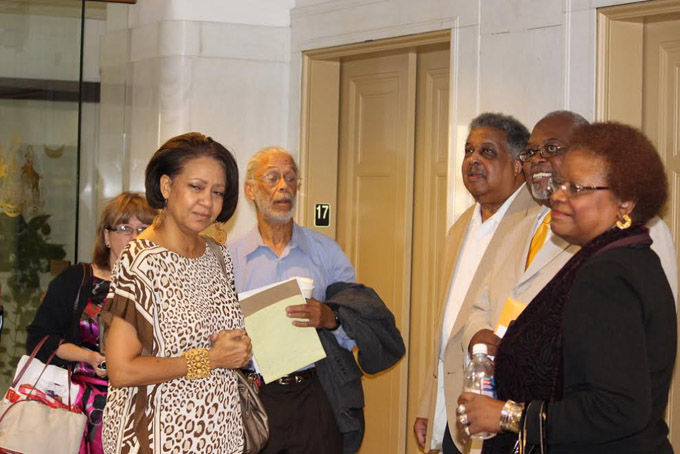
Though O’Toole’s courtroom was filled to capacity and beyond by representatives of various community and arts organizations—among them Esther Bush, Marimba Milliones, Mark Clayton Southers, Tim Stevens and Janera Solomon—the action took place in the hallway outside and in O’Toole’s chambers as lawyers scurried back and forth to put the finishing touches on the deal.
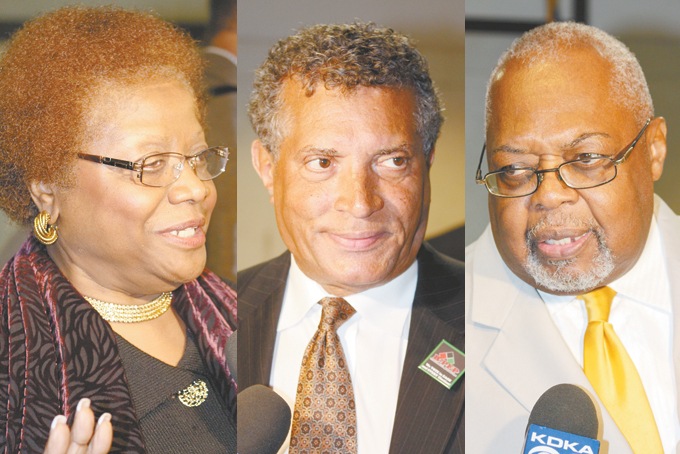
Bush, president and CEO of the Urban League of Pittsburgh, said she was elated.
“It’s time to have an agreement, an agreement with the community coming together to carry out the original purpose of the August Wilson Center,” said Bush. “This is a day for the whole city to celebrate. We now need to make it happen, to come together as a community to make sure it happens. I’m happy.”
Sala Udin, a founding member of the Center, praised the foundations for their commitment.
“We showed up ready for a trial, so we were a little surprised there was a settlement. This is a tribute to the local foundation community because somebody came up with almost $2 million extra to get this deal done,” he said. “We all have another opportunity to get it right, to try it over again and build an African-American cultural center that is worthy of the name August Wilson.”
Black Political Empowerment Project President Tim Stevens said it was a very emotional experience.
“We have a center going forward, and we will have one for decades,” he said. “Everyone in the African-American community and our White partners must come forward with annual commitments to keep this institution going—churches, agencies, individuals, on an annual basis.”
The particulars of the deal would pay mortgage holder Dollar Bank $7.9 million and Fitzgerald and her legal and financial team $590,000—half of what was billed—for a total sales price of $8.49 million. No other creditors, including the URA, would be paid. All tax liens would also be forgiven. The foundations will pay $5.3 million and the URA will pay the balance.
It is not clear where the money will come from, as the foundations’ highest bid—already augmented by the URA and $1 million in unsourced county funds—was $7.2 million, $1.29 million less than the sale price. The Regional Asset District is holding $525,000 in escrow, which is what it would have paid the Center prior to the bankruptcy. County Executive Rich Fitzgerald said the $1 million he already pledged would come from RAD also, but it is not in the RAD budget released Sept. 30.
The timeline requires the URA to pay the receiver $250,000 within five days. The balance of the payments are due by Oct. 31. Should the deal fall through, Dollar Bank could foreclose and sell the Center at a November sheriff’s sale.
