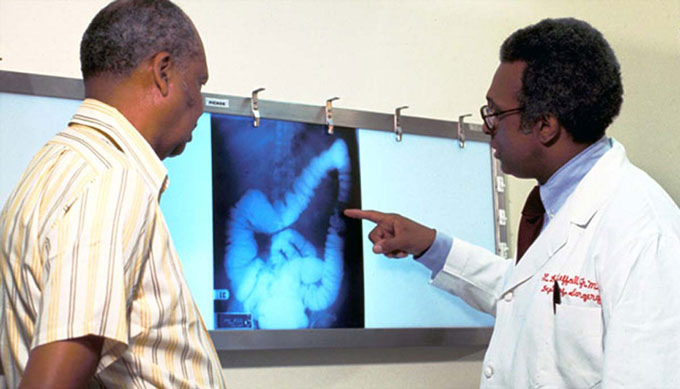
March is National Colorectal Cancer Awareness Month. The month helps focus attention on the fact that colorectal cancer is the second leading cause of cancer death in men and women combined in the U.S., according to the Centers for Disease Control and Prevention (CDC). Because of this statistic, it’s important to know that colorectal cancer is preventable. The CDC reports that 90 percent of people diagnosed with the cancer in its early stages will survive longer than five years.
Colorectal cancer, often called colon cancer, is caused by cancer cells forming in the colon (the large intestine) or the rectum (the passageway that connects the colon to the anus—see Figure 1, image National Cancer Institute). Sometimes people don’t have any signs of the disease. But if they do the symptoms include:
1. Blood in or on bowel movements
2. Stomach pain that doesn’t go away
3. Losing weight without knowing why
The risk of getting colon cancer increases with age. People who have inflammatory bowel disease or a personal or family history of polyps or colon cancer are at a higher risk. Diets high in red or processed meat, obesity, lack of physical activity, smoking and alcohol use are also risk factors

“Pennsylvania has one of the highest rates of colon cancer in the U.S., especially here in Western Pa.,” says Edward Chu, MD, professor of medicine and of pharmacology and chemical biology at the University of Pittsburgh and deputy director of the University of Pittsburgh Cancer Institute. “It’s estimated that about 7,000 new cases of colorectal cancer will be diagnosed in Pennsylvania in 2014. The majority of people diagnosed with colon cancer don’t have family members who have had the disease.”
The good news is that colon cancer is highly preventable with screening and early detection. “A colonoscopy is the gold standard method of screening,” says Dr. Chu.
A colonoscopy involves inserting a lighted tube through the rectum into the colon. The health care professional performing the procedure will be able to see if there are any polyps (growths) or tumors (abnormal masses of tissue). Polyps and tumors aren’t always cancerous. But colon cancer often begins as polyps, so they need to be removed and tested, along with tumors, to see if they are cancerous.
The stomach and bowels must be emptied of food before a colonoscopy. People are usually given a medication to help them relax during the procedure. A colonoscopy is typically painless. A colonoscopy may not seem like a pleasant experience given the bowel prep that is required. But Dr. Chu reminds people that “identifying a problem and curing it is a much better experience than dealing with cancer that has spread from the colon throughout the body.”


Treatment for colon cancer depends on different factors, including how far the cancer has spread and the patient’s general health. The most common treatment is surgery. The surgery can be the removal of polyps or tumors in a colonoscopy or it can be through the abdomen. Patients may also receive chemotherapy (drugs that kill cancer cells), radiation therapy (high-energy rays that kill cancer cells) or other treatments.
However, the best treatment is to talk to your health care provider about getting screened. “At most, only 40-50 percent of people in the U.S. are getting colonoscopies, and we really need to increase this number,” says Dr. Chu. “Without question, screening for colon cancer can save your life.”

