

VALERIE DIXON
A conversation of healing
In a workshop that proved to be a dialogue of healing, seven local women shared their painful stories about the impact of violence in their lives and our community.
As part of the Bev Smith “A Challenge to African American Women” conference held Aug. 28 though Aug. 31, the African American Women Speak Out About Violence panel discussed the impact of violence, guns, drugs and the pain that never goes away.
George Curry, NNPA president and CEO, moderated the panel discussion that included Maurita Bryant, assistant chief of investigations at Pittsburgh Bureau of Police, first national vice president of the National Organization of Black Law Enforcement Executives; Clair Cohen, child psychiatrist at PACE school; Terez Miles, mother of Jordan Miles, young Pittsburgh African American male who was severely beaten by plainclothes City of Pittsburgh police officers while walking to a relative’s home; Valerie Dixon, mother of Robert James Dixon, who was murdered in 2001, and founder of Prevent Another Crime Today (PACT) Initiative; Marsha Grayson, Esq., mother of Jeron Grayson, who was murdered at an off campus party near Indiana University; Rosemary Crawford, Esq, Crawford McDonald, LLC, and Marcia Sturdivant, PhD, president and CEO, NEED.


MARSHA GRAYSON
The stories were hard to hear: Grayson shared the tragic story of the sudden loss of her son from a stray bullet. Dixon told the story of her son’s senseless murder in 2001, and Miles recanted the story of the unprovoked brutal beating of her son, at the hands of those charged with serving and protecting. Crawford shared her story of how fear prevented her from reporting being sexually accosted as a young teen, and stocking incidents that she endured as an adult. She said that as a prosecutor, she has seen first hand how law enforcement views situations of violence against women. “They dismiss such cases as ‘just domestics,’ she said. But Crawford has also seen first hand how victims of intimate partner violence are impacted. Crawford hoped that after the conference there would be a significant difference resulting in people being armed with action items such as education, mentoring, and the desire to invest in the community.


BEV SMITH
Each mother said faith is what got them through and continues to get them through the pain of what happened to their children. Dixon said she changed her career. She left her position at UPMC to help others at the Center for Victims of Violent Crimes who have fallen victim to today’s senseless, rampant crime.
The traumatic effect of violence can wreak havoc on a person, not only psychologically, but also physically as well. Cohen talked about how children can be traumatized not only psychologically, but also physically by violence. She said one way to deal with this is by prevention: “Our society has greatly failed our children,” she said. “Because we do not have family-friendly policies. Working moms need to have flexible work schedules so that they can also tend to the needs of their children.” She also stated that the United States is one of eight countries that does not mandate decent child care for working parents. “We need to make sure that our children have the attention, care, and supervision that they need. Our homes need to be sanctuaries.”
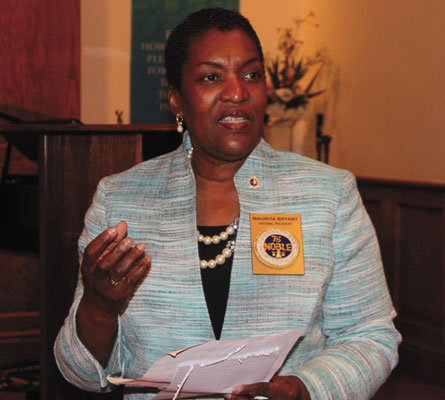

MAURITA BRYANT
She went on to urge people, especially women and children, who have been victims of violence to seek help from places such as the Center for Traumatic Stress at Allegheny General Hospital, the YMCA or Center for Victims of Violent Crimes.
“Don’t be ashamed. Don’t keep quiet,” she said. She also warned that parents should never assume that because children don’t talk about something doesn’t mean it hasn’t affected them. “Traumatized children may not verbalize their pain,” she said. “They may begin acting out, or school grades may begin to slip. That traumatization will manifest itself in various ways. It’s imperative to get these kids help. Trauma is a very powerful thing. Kids just may not be able to talk about it.”
Bryant, said she lives in Pittsburgh’s Zone 5, Homewood, which she calls the city’s most violent neighborhood. She said she lives there not because she has to, but because she chooses to. Yet Bryant said it saddens her to see the increase of violence in her neighborhood. From a professional prospective, Bryant said she has come to appreciate that the most violent crimes occur in low income, minority communities. “This is a reality. I know many people don’t like to hear this,” she said. Citing sobering statistics, Byrant brought home the seriousness of the workshop’s topic.
“This year in the city of Pittsburgh there have been 31 homicides of which 16 homicides occurred in Zone 5. All but two of those 16 Zone 5 homicides were African-American, and two were female,” Bryant said.
Bev Smith called for people to get back to basics, to unite and become closer. “We are too disconnected. We don’t greet one another. We have to smile at each other and smile on the inside at ourselves more, we have to be more grateful.” Smith said she wanted the session because of personal family experience with the senseless violent murder of her nephew. “All of us have been touched,” she said. “And what happens after the funeral and after all the friends and family has gone away? We don’t talk about it like we should and I wanted this to be a healing conversation, a conversation of love.”
Your comments are welcome.
Follow @NewPghCourier on Twitter https://twitter.com/NewPghCourier
Like us at https://www.facebook.com/pages/New-Pittsburgh-Courier/143866755628836?ref=hl
Download our mobile app at https://www.appshopper.com/news/new-pittsburgh-courier