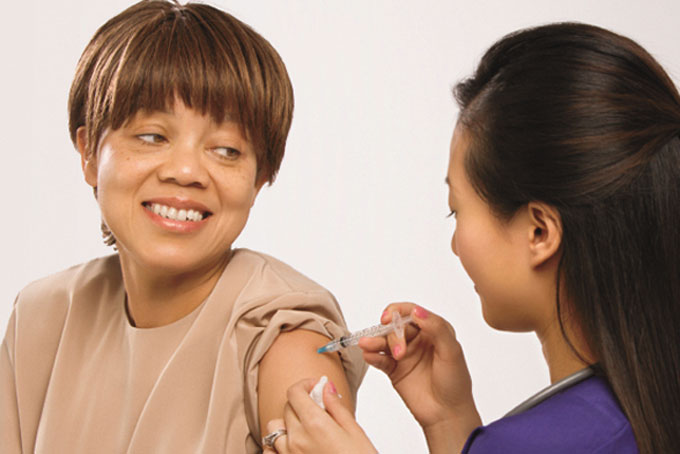

What do many people consider one of the greatest public health accomplishments? It’s vaccines—a substance given, often as an injection, to keep people from getting certain diseases. Not long ago, diseases like measles, polio or whooping cough often disabled or killed young children and adults.
They were common and often passed from person to person as easily as a simple cold does. Now, vaccinations have helped to nearly wipe out certain diseases in the U.S. and worldwide. Some diseases are preventable but only if people get a vaccine for them.
Unfortunately, health care professionals have been seeing some of these diseases returning. For different reasons, some parents are choosing not to vaccinate their children. Some adults are choosing not to get vaccinated. Some don’t know what vaccines they need to get beyond childhood. And if certain diseases are rare, why would people need to be vaccinated?
“Take a disease like measles,” says Richard K. Zimmerman, MD, MPH, professor of family medicine and associate professor of behavioral and community health sciences at the University of Pittsburgh. “We’ve had a 99 percent drop in measles cases because of vaccinations. But recently, doctors are seeing it here and there. The cases are in people who come to the U.S. from other countries. The cases are also in people in the U.S. who have decided not to get vaccinated.”
Federal programs that provide free vaccinations to children and state laws that require vaccinations have helped the majority of children to be vaccinated and be protected from preventable diseases. The Centers for Disease Control and Prevention (CDC) reports that most children are getting vaccinated. The CDC also cites few racial disparities among children with regard to vaccination rates.
However, in adults, racial disparities in vaccination rates do exist. In 2011, the CDC reported racial disparities in vaccination rates for pneumococcal disease (caused by bacteria that can lead to pneumonia and other serious illnesses) in adults age 65 and older. In Whites, the rate of vaccination in this age group was 65 percent; in African Americans, it was 48 percent; and in Hispanics, the rate was 43 percent. African Americans experience pneumococcal attacks at a higher rate because of genetic and environmental reasons. Getting vaccinated for the disease is especially important.
In 2011, the CDC also reported a racial disparity in the number of women who complete the three-dose vaccination series to protect against human papillomavirus (known as HPV—a virus spread through sexual contact that can lead to certain kinds of cancer if untreated). In White teens, the vaccination completion rate was 75 percent; in African Americans, it was 65 percent; and in Hispanics, it was 56 percent.
What causes these disparities in different racial groups? There’s no easy answer to that question. Dr. Zimmerman cites research that says people have the perception that their doctors aren’t recommending certain vaccines. He also says that people avoid vaccines because they’re afraid they’re not safe and they feel they don’t work. Some people see getting a yearly flu vaccine as a hassle. And, even though many vaccines are available at community pharmacies, some people still have difficulties accessing health care or don’t have insurance.
Dr. Zimmerman suggests getting accurate information about vaccines and their safety. He recommends talking to a health care professional about any concerns and going to www.immunizationinfo.org, a Web site that takes no money from the government or from drug companies. If people are still concerned about vaccinations, Dr. Zimmerman reminds them that they don’t want to be the one who passes on a preventable disease to a grandchild, child or other loved one. Because most people have been vaccinated, we forget how horrible and deadly diseases like whooping cough or polio can be.
“Doctors have evidence that vaccines work and that they are safe,” Dr. Zimmerman says. “The best recommendation I can give to people is this: Every year I get the flu vaccine, my wife gets it, and my four children get it.”
Your comments are welcome.
Follow @NewPghCourier on Twitter https://twitter.com/NewPghCourier
Like us at https://www.facebook.com/pages/New-Pittsburgh-Courier/143866755628836?ref=hl
Download our mobile app at https://www.appshopper.com/news/new-pittsburgh-courier