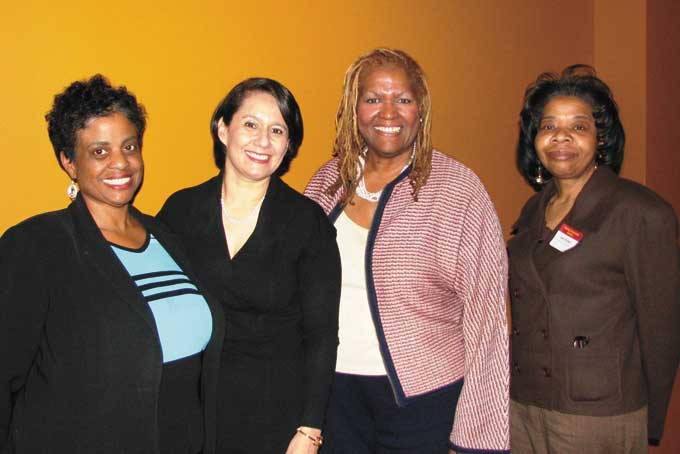

POSITIONED TO ASSIST BUSINESSES BENCHMARK—Alice Williams of Women Empowered for Entrepreneurial Excellence, Ana Harvey of the U.S. Small Business Administration’s Office of Women’s Business Ownership, Debra Mason of E-Magnify and Judy McNeal of the Business Development Resource Center are inspired after the Building A Benchmark business symposium. (Photo by Diane I. Daniels)
Statistics indicate that there are 7.8 million women-owned businesses in the United States reflecting a 20.1percent increase from 2002 to 2007. According to the National Women’s Business Council, 28.7 percent of all nonfarm women businesses across the country generate $1.2 trillion in total receipts with 11.7 percent of the firms having paid employees, employing a total of 7.6 million people across the country with a payroll of $217.6 billion.
In Pennsylvania there are 348,372 businesses employing 631,591, generating 80 billion dollars in sales. And in the metropolitan statistical area there are a reported 43,111 women businesses providing employment for 66,000 of the region’s workers generating 7.9 billion dollars in sales.
If it were up to Jayne Huston and the staff of Seton Hill University’s E-Magnify, the number of women entrepreneurs operating in the region would be even higher. Since 2006 their mission has been to strengthen the economic impact of women business owners as a collective force and to advance their growth through innovative programming in entrepreneurship and new venture creation.
While keeping on track with their mission, E-Magnify recently sponsored their 2013 annual symposium designed to help build a benchmark business. Speakers included Ana Harvey, assistant administrator, U.S. Small Business Administration’s Office of Women’s Business Ownership; Lyn Doverspike, director, U.S. Commercial Service; Julia E. Trimarchi Cuccaro, attorney at law; Gayle Nuppnau, procurement liaison, PA Department of General Services Bureau of Small Business Opportunities; and Jacqueline Garry Lampert, senior health policy analyst, UPMC Health Plan.
“The keyword of today is benchmark,” said Huston, E-Magnify director. “It is about setting industry standards, being ready and on top of your game. As a small business owner you have to think differently and know that things are always changing.” She said that the events of the day would be enlightening and focused on customers, cash flow and certification. Topics included: accessing capital, international trade, Pennsylvania State Certification and the Affordable Care Act.
With Women Business Centers in every state and Puerto Rico, President Obama’s commitment and support to helping small businesses is demonstrated through the U.S. Small Business Administration’s Office of Women’s Business Ownership. Harvey pointed out that Women’s Business Center programs are geared toward promoting the growth of women-owned businesses through programs that provide business training and counseling, access to credit and capital, and multiple businesses and networking opportunities.
“It is about producing, high performance, being prepared and knowing what you bring to the table,” Harvey conveyed.
Speaking from her experience of operating a multilingual communications company she said, “Others often see your potential and qualifications before you. It is important for you to look at the opportunities that are out there, know what is ahead and what is best for you.”
Adding a D and E to the three Cs the SBA are known for, (contracts, counseling and capital) Harvey mentioned the disaster assistance program and the export loan programs. “Women business owners have to be prepared for disasters of all types and they have to be aware that opportunities are worldwide. We are a global economy,” she said.
Ninety-seven percent of the world’s purchasing power is outside of the United States, reported Doverspike. Addressing the question, why export, she said, if you operate an exporting company you are less likely to go out of business. She indicated that Pennsylvania ranked eleventh in total state exports for 2011 with the top ten exporting destinations being Canada, China, Mexico, Japan, Germany, the United Kingdom, the Netherlands, Brazil, Belgium and South Korea. The state’s top exporting industries are chemicals, machinery, except electrical, primary metal manufacturing, computers and electronic products, transportation equipment, minerals and ores, electrical equipment, appliances and components, petroleum and coal products, food manufacturers and fabricated metal products.
Sighting that exporting enables companies to diversify their portfolios and to weather changes in the domestic economy, she pointed out that being a strong domestic business is the basic qualification for most small to medium size businesses to export.
A division of the US Department of Commerce’s International Trade Administration, the U.S. Commercial Service is the trade promotion arm located across the United States and in U.S. Embassies and Consulates in nearly 80 countries. With three locations in the state, Pittsburgh, Harrisburg and Philadelphia, the Pittsburgh office covers the exporting needs of 36 counties in western, and parts of central Pennsylvania. Doverspike pointed out that their services include trade counseling, market intelligence, business matchmaking, and commercial diplomacy needed to connect with lucrative business opportunities.
“We also help develop trade finance and insurance strategies that align with your particular business objectives and help you complete your export transaction,” she said.
With the state playing a major role in the exporting market, Doverspike encouraged the audience to utilize the resources of her office as well as the products of the SBA. “Do your research, ask questions, think outside the box and know your market,” she said.
In the law field for more than 25 years, Cuccaro said it is important for entrepreneurs not to waste money.
Agreeing with Harvey and Doverspike she said no matter what stage of operation of the business it is important to know your market and to utilize available resources. When dealing with a lender she recommends knowing how much money you need and what the money will be used for. “Know your lending community and be smarter than your lender,” she said.
According to Nuppnau, the Pennsylvania Department of General Services, Bureau of Small Business Opportunities is committed to implementing programs that increase contracting opportunities for self-certified small and verified small businesses.
“Governor Corbett is big on small business,” she said pointing out that he has signed executive orders that will assist small businesses and veteran-owned businesses. She indicated that the Small Diverse Business program will streamline the process for minority, women, veteran and service disabled veteran owned small businesses to participate as prime contractors, subcontractors, suppliers and professional service providers.
A major concern for all businesses is the Affordable Care Act. “In 2014 changes are coming, everyone will be responsible to have insurance,” Lampert pointed out. Discussing a complicated topic she said no matter if you are self-employed, an employer with fewer than 25 employees, an employer with fewer than 50 employees, or an employer with 50 or more employees, different provisions of the Affordable Care Act will apply and that research is the key to finding out what works best. Other than communicating with one’s current health care provider, she recommended the Department of Health and Human Services as a source of information.
Stressing that resources to help entrepreneurs at
all levels are plentiful, Harvey acknowledged that E-Magnify is one of the top Women Business Centers and that the region has numerous Small Business Development Centers and SCORE chapters. Assisting women entrepreneurs to start, sustain, and grow their businesses for more than two decades, E-Magnify provides counseling, training, and mentoring services.