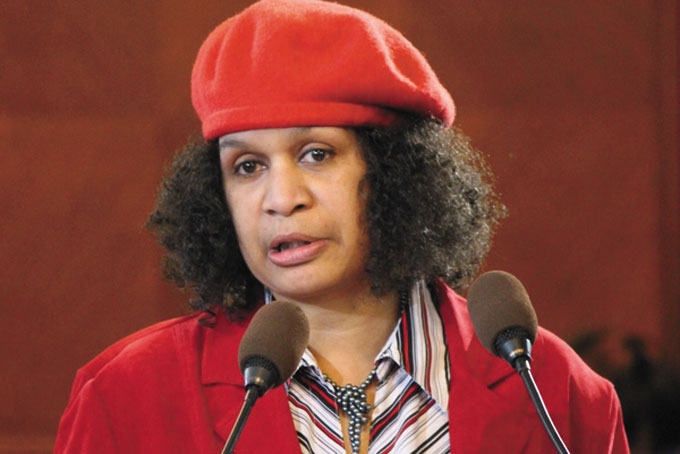

CELESTE TAYLOR (Photo by J.L. Martello)
When former Pittsburgh Bureau of Police Chief Nate Harper resigned last month, members of the community jumped at the chance to have their input considered in the selection of a new police chief. A few weeks later, when Mayor Luke Ravenstahl announced he would not seek re-election, amidst controversy surrounding his involvement in the police bureau’s alleged corruption, the community saw the potential to revolutionize the bureau as a whole.
On March 6, more than 20 community representatives voiced their vision for a new police chief and reform in the bureau at a public hearing before city council.
“We’re asking that the mayor not make an appointment during the rest of his term in office,” said Tim Stevens, chairman of the Black Political Empowerment Project. “We still don’t know really what happened. However there will be a new chief so this is as good a time as any to begin having a conversation about what we want in a new chief. We don’t know what happened but we know what we want to see.”
Following the public hearing, on March 11 Mayor Ravenstahl answered the request of many at the public hearing by deferring the selection of a new police chief to the incoming mayor to be elected in November. This means Pittsburgh will have to wait nearly a year to see changes in the police bureau.
“This is going to go on for a long time. The new police chief will not be appointed for a long time,” said District 6 City Councilman Daniel Lavelle. “We need a severe cultural change from within our system. Whoever becomes our next police chief needs a mayor who will back them up. We need someone who’s willing to stand up against those outside forces.”
At the public hearing, members of city council were also given the opportunity to share their criteria for a new police chief. While Councilmen Rev. Ricky Burgess, who sponsored the public hearing, and Bill Peduto, who is running for mayor, have laid out their vision for the next police chief and changes in the bureau, other council representatives were not so quick to define their criteria.
“It’s wrong for us to lay out criteria before we’ve heard from experts and the community. It’s also wrong to be doing this at this point because we’re not all sure what went wrong,” said District 7 Councilman Patrick Dowd. “It’s not clear to me for example whether the last chief did something by himself to divert funds into an unauthorized bank account. Is it possible?”
However, the criteria laid out by Peduto and Burgess, did not address the recent allegation of police corruption and instead mirrored much of the community’s demands at the public hearing. Peduto’s criteria as outlined in his 100 Days/100 Policies to Change Pittsburgh initiative, calls for a stronger commitment to increasing diversity on the police force. Burgess’ criteria includes a commitment to improving community trust and reducing gun violence.
While the mayor is responsible for appointing a police chief, city council must vote to approve the mayor’s appointments. However, no chief appointed by the mayor has ever been declined by council.
An area of contention among the speakers was whether or not the next police chief should come from within the bureau. Both council and the community seemed split on the issue and many praised former Police Chief Harper’s performance.
“I want to stress that Chief Harper has served this city for six years and not one of you has ever said he’s done a bad job,” said Dan O’Hara, president of the Fraternal Order of Police Union. “So to say you’re going to look outside the city for the next police chief is a problem.”
The community’s demands included an array of commitments from increasing diversity, improving police community relations, and reducing gun violence, to increasing police presence in public housing communities, standing up to the FOP union and minimizing police misconduct among off-duty police officers.
“Give me a new police chief that really wants to focus on gun violence,” said Rob Conroy, Western Pa. coordinator for CeaseFire PA. “We had the lost and stolen gun legislation passed here, but unfortunately we had a mayor and a police chief who would not enforce it.”
“Restoring integrity to the department and restoring control over the officers is huge,” said Vic Walczak, ACLU of Pennsylvania legal director. “We’ve had countless crazy off duty incidents and the problem isn’t only that these incidents are happening, it’s that no one is taking responsibility.”