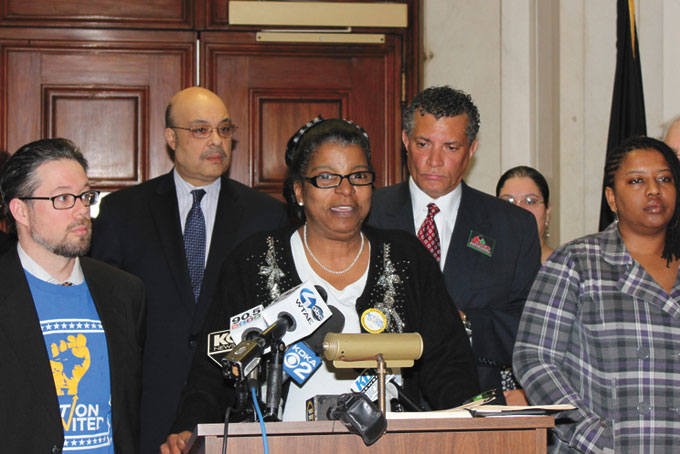

POLICE CHIEF SEARCH—Hazel Blackman speaks at a Feb. 27 press conference. (Photo by J.L. Martello)
Questions still surround the resignation of former Pittsburgh Bureau of Police Chief Nate Harper, who stepped down after more than 35 years of service on the force amid pressure from a federal investigation. But the Pittsburgh activist community already has their sights set on the next chief and is being proactive to ensure their input is factored into the mayor’s decision.
“As you know we’re in a difficult moment in the history of our city with regard to the police bureau,” said Tim Stevens, chairman of the Black Political Empowerment Project at a press conference on Feb. 27. “Maybe the next police chief just has to be bold, bold enough to stand up to officers who abuse their power. Even with that blue uniform and history, they must be as unbiased against their officers as possible.”
While the news media is focused on corruption within the police force with regard to funds that were possibly misappropriated, community representatives at the press conference outside of City Council Chambers were more concerned with issues such as police brutality and the lack of diversity on the police force.
“This is imperative to repairing the relationship between the community and the police. The diversity of the police force has been an issue for many years,” said Brandi Fisher, president of the Alliance for Police Accountability. “In order to change that we need to focus on a common ground of trust.”
The activists made reference to Jordan Miles, a young man allegedly beaten by three police officers; and Ka’Sandra Wade, a woman who was murdered after police responded to a domestic violence call from her home and left before speaking with her. They said these incidents were key examples of police misconduct and called for the next police chief to enforce regulations put in place by a 1997 consent decree, enacted in response to the deaths of two African-Americans in police custody. However, the decree was lifted from the police bureau in 2001.
“For sometime now the police department in Pittsburgh has felt like a runaway train. It hasn’t always been this way and it doesn’t need to be this way,” said Vic Walczak, legal director of the ACLU of Pennsylvania. “What we’re saying is pledge commitment to the management controls in the consent decree.”
The coalition calling for input in the selection of the next police chief is made up of members from B-PEP, the NAACP, ACLU, Pittsburgh Interfaith Impact Network, Action United, the Urban League of Greater Pittsburgh and the APA.
“Without this basic trust bad things happen. We need a police chief who is committed to having real ongoing discussion with the community,” said Hazel Blackman, western regional council representative for Action United. “We need a police chief who is committed to building a police force that looks like us.”
City Council representatives Rev. Ricky Burgess, Bill Peduto, Daniel Lavelle, Bruce Krauss, Darlene Harris and Theresa Kail-Smith have already expressed their support for community input. While the mayor chooses appointments for police chief, fire chief and other administrative positions, city council has to vote on these appointments.
“I will not vote for anyone who is a current or former member of the Pittsburgh police,” said Rev. Burgess. “There are those who don’t want us to have this important conversation. What’s most important is how do we establish a philosophy of policing where the community is engaged as active partners.”
A public hearing is set for March 6. The community has invited all mayoral candidates to attend.