
LANCE HYDE
In its ongoing mission to build capacity for Black-owned businesses, the African American Chamber of Commerce’s Business Institute recently held a forum on the regional shale industry to give its members a better idea of where business opportunities are.
And according to the presenters at the chamber’s Jan. 31 Workforce & Business Development forum, those opportunities abound, and minority business inclusion is actively being courted.
Peter Speaks, who ran the PA General Services Department under former Gov. Ed Rendell and now serves as special counsel for state Senate Democratic Appropriations Committee Chair Vincent Hughes, D-Philadelphia, began with a brief overview of Act 13, the legislation that imposed an impact fee on Marcellus Shale wells.
He noted the law has already resulted in more than $204 million being collected and redistributed back to the communities where drilling is taking place. Among its mandates are stricter environmental controls and legacy requirements for strengthening and rebuilding roads and bridges, and returning sites to their pre-drilling state.
All of these offer opportunities or engineering and ecological impact work before during and after the each well is built, and thanks to a part of the legislation Speaks, himself, wrote, Minority- Women- and Disabled- and Veteran-Owned Businesses Enterprises are mandated to take part.
“Even though this was led by Republicans, I was walking the halls in Harrisburg reminding them at every step that small and minority owned businesses must participate,” he said. “As a result, Section 23.16 states that the industry take ‘maximum practical steps’ to provide opportunities for M/WDBEs.”
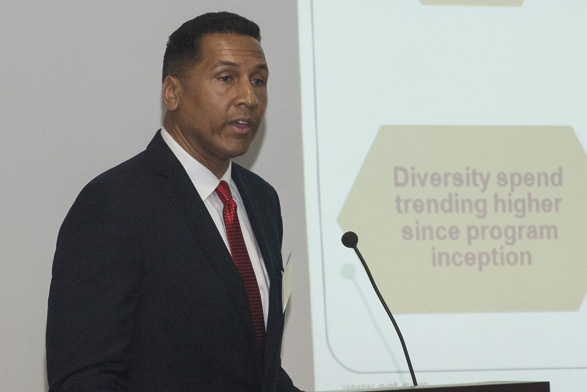
Speaks then singled out Lance Hyde, supplier diversity manager for EQT, for his work and the company’s commitment to inclusion. Hyde said that commitment comes from the top, and he has to report every month on how he is increasing diversity at the production, midstream and distribution phases of natural gas development.
“There are distinct skills needed to drill a single well and we ask or subcontractors to make that same commitment. But it goes beyond that,” he said. “We held an event with Halliburton in August that generated $85,000 in sales for local businesses. Printing, temporary staffing, catering for the event were M/WDBE firms.”
Jim Rodgers, marketing and business development director for minority-owned Dawood Engineering, based in Enola, said the Marcellus Shale Coalition industry group is also committed to diversity.
“Its Marcellus on Main Street outreach program includes an online directory where businesses like ours can show off to the industry,” he said. “The coalition is the best run entity in terms of supplier diversity that I’ve ever seen.”
Alexander “Nick” Nichols, president and CEO of the Western PA Supplier Development Council, reminded the audience that M/WDBE certification with the council means certification with every council across the country and with every federal agency.
“These are the certifications the shale industry looks for and you can take it anywhere in the country,” he said.
Kris Kirk, president of the Mentors Community Wealth Building Initiative, spoke of how the shale industry is supporting her work training young, unemployed African-Americans to work at the production end, on the drilling rigs and in support roles.
Other testimonials included David Velegol, vice president of engineering and technical services for Chester Engineers, whose President and CEO Robert Agbede is a past board chair of the chamber.
“We got a contract to work on two 25-mile, 20” pipelines for EQT,” he said. “And we just got a contract to put in a Bailey bridge for access to a site down in West Virginia.”
Architect Howard Graves also praised the coalition and industry outreach efforts. He said he is getting opportunities to bid on projects he never would have before.
“We just bid on a new office building in Kentucky. We didn’t get it, but it pointed us out to other firms in the industry,” he said. “We have seen the corporate community becoming more involved in securing diverse suppliers. And if you have your ducks in a row, the industry will seek you out. They did with us.”
(Send comments to cmorrow@newpittsburghcourier.com.)